

Author
Anju Khanna Saggi
Content & Media Relations

Contributing specialist
Tanner Williams
Operations Management • Service Management • Sales
Published: 2026-04-24
Last updated: 2026-09-26
Most unplanned shutdowns in a cement plant don't come out of nowhere. There's usually a trail beforehand. Maybe a kiln bearing that's been running 15 degrees above baseline for three weeks, noted by the operator on shift but never formally flagged because it hadn't tripped an alarm yet. The issue isn't a lack of warning, its that small deviations are often tolerated until they tip over into something serious.
A proper cement plant inspection program should answer the following three questions:
- What do we check?
- When do we check it?
- Why do these systems fail in the first place?
When those three are clear, inspection stops being routine paperwork and becomes production control.
This article covers all three perspectives, going into the different things to check from kiln to silo, how often these inspections are necessary, why it fails and how to prevent them. We cover:
What to Check
In cement and heavy process plants, equipment doesn't fail all at once. It begins where stress concentrates – heat, load, friction, pressure, and airflow. Cement plants usually combine all five. That is why inspection routines must focus on the systems that carry thermal load, mechanical load, and air movement. In most plants, the most critical inspection points are the kiln, the mill, the baghouse, and the silos. These are the systems where small issues become expensive ones the fastest, and where inspection routines matter most.
The Kilns
The kiln is the heart of the plant. It runs continuously, at extreme temperatures, under mechanical stress. The kiln maintenance may be the most important part of your maintenance checklist. As the kiln operates near 1450°C, small alignment issues become refractory loss, poor lubrication can become gear damage, and a drifting tire can become shell stress.
What to include in a kiln inspection checklist:
- Shell temperature profile and hot spots
- Tire and roller surface condition
- Thrust roller position and movement
- Lubrication flow, pressure, and contamination
- Refractory thickness and coating stability
- Seal condition and false air intrusion
The Cement Mill
The cement mill is where mechanical load and energy consumption meet product quality. It runs under constant stress – rotating mass, impact forces, airflow, and fine material circulating at high speed. When the mill drifts out of balance, the first signs are subtle: higher amps, rising vibration, reduced throughput, or inconsistent fineness.
Cement mill maintenance is critical because grinding is one of the most energy-intensive parts of the process. Small mechanical inefficiencies show up immediately in power draw and separator performance. If ignored, those inefficiencies turn into liner failure, bearing damage, or gearbox issues.
What to include in a cement mill inspection checklist:
- Main bearing temperature and lubrication flow
- Gearbox oil level, pressure, and contamination
- Vibration trends on bearings and drive system
- Mill sound and load behavior
- Liner and diaphragm wear condition
- Separator speed and reject rate
The Baghouses
The baghouse protects more than emissions. It protects airflow stability across the entire process. When draft conditions change, kiln efficiency changes. When pressure drop rises, fan loads increase. Energy costs climb before anyone sees visible dust. Baghouses can achieve very high collection efficiency, but only when differential pressure, pulse systems, and hopper evacuation are stable. Many plants treat rising differential pressure as normal aging; however, it can usually be an early warning sign.
What to include in a baghouse inspection checklist:
- Differential pressure trends (not just spot readings)
- Pulse air pressure and header leaks
- Hopper discharge and buildup
- Damper position and actuator response
- Bag and cage condition during planned access
- Visible emissions at stacks and joints
The Silos
Silos may look static, but they’re far from that. They carry material weight, internal pressure, and cyclic loading from filling and discharge. Structural fatigue and material buildup develop slowly and out of sight. A missed silo inspection can lead to flow blockages, quality swings, overpressure incidents, or structural cracking.
What to include in an inspection checklist:
- Aeration pads and air slide function
- Overpressure relief valves
- Level sensor accuracy
- Internal buildup and bridging
- Exterior concrete cracks or weld seam movement
- Water ingress points
When to Check
Inspection timing is the backbone of preventive maintenance.
In a cement plant, failures develop at different speeds. A lubrication failure on a kiln drive can escalate in hours, while refractory wear develops over weeks. Structural fatigue in a silo can take months to surface. Preventive maintenance works when inspection intervals match the speed of deterioration.
Shift-Level Preventive Checks
At the operator level, preventive maintenance starts with discipline. Each shift is an opportunity to catch deviations early, rising temperatures, abnormal sound, increased vibration, airflow changes, power draw shifts. Preventive maintenance at this stage is about early correction, where small actions will prevent larger interventions later.
This is where most unplanned downtime can be avoided.
Condition-Based Preventive Maintenance
Weekly reviews shift from observation to analysis. Vibration trends are reviewed, oil condition is evaluated, and energy consumption patterns are compared. This is preventive maintenance in its most effective form – acting on trend data before a component fails.
Industry data consistently shows that structured predictive and preventive maintenance programs significantly reduce breakdown frequency and unplanned downtime. The improvement does not come from doing more maintenance. It comes from doing it earlier and based on condition.
Planned Preventive Interventions
Shutdowns are where preventive maintenance becomes physical. When preventive maintenance is properly timed, shutdowns remain controlled events. When it is not, shutdowns become emergency responses. Preventive maintenance is structured timing, aligning inspection with action. And in cement production, where heat, load, and pressure run constant, timing can be the difference between planned maintenance and forced downtime.
Why It Fails
There are countless technical reasons WHY a component fails – heat stress, misalignment, contamination, fatigue, overload. But in most cases, it never has to go that far. In most cement plants, or any other type of plant for that matter, the root cause often comes back to the same issue: a lack of consistent routine and limited visibility across teams.
Inspections may be performed, but if they are not standardized, documented clearly, and shared across shifts, important details get lost. A rising temperature reading, a gradual increase in vibration, or a small crack in a silo wall can remain isolated observations instead of early warning signals. Without a structured way to capture findings and follow them through to resolution, minor deviations can quickly escalate into major issues.
Inspections that don’t take place
One of the quieter problems with inspection routines in cement plants is verification. Not whether a checklist was filled in, but whether the person filling it in was physically present at the equipment at the time. In a plant where the kiln, mill, baghouse, and silos can be spread across a large site, it's easy for checks to be completed from memory, from the control room, or bundled together at the end of a shift rather than carried out at each piece of equipment as intended.
RFID tags offer a straightforward way to close that gap. A tag is attached to each piece of equipment that requires inspection. The operator scans it with their phone before the checklist opens. No scan, no check. It's a simple mechanism, but it changes the dynamic. It confirms that someone was physically present at the kiln bearing, at the baghouse inlet, at the silo discharge point, at the time the inspection was logged.
For cement plants specifically, this matters because so much of what needs checking is location-dependent. A differential pressure reading only means something if it was taken at the right baghouse compartment. A shell temperature observation only counts if it was made at the right section of the kiln. RFID ties the inspection data to the physical asset, which makes the data more reliable and the audit trail harder to question.
It also takes friction out of the process for operators. Scanning a tag pulls up the correct inspection form for that specific piece of equipment automatically. In a plant running 24/7 with rotating crews, that kind of simplicity helps keep inspection discipline consistent across shifts.
Addressing inspections doesn’t need to be a complex process. A digital platform to keep inspections and follow-up centralised, and RFID to make sure those checks are carried out at the equipment. Between the two, inspection becomes production control.
FAQ
Want to know what CheckProof can do for you?
CheckProof's easy-to-use app makes it easier to do the right thing at the right time. Discover how you can run world-class maintenance that is both cost-effective and sustainable.
Book a demo

2026-09-29
The AggNexus 2026 Report: Highlights from the Digital Innovation Conference
AggNexus 2026 in Austin was the biggest edition yet. After a year of AI first steps, the focus shifted to how to get people to change. Here are CheckProof’s key takeaways on change management, fast-moving AI, compliance and passing on know-how.

2026-09-24
A Stronger Foundation: Rohrdorfer on Digitizing Safety and Efficiency
Rohrdorfer, a leading construction materials producer in five countries, has used CheckProof for years to streamline safety, maintenance and quality work and to sharpen its customer focus.

2026-07-10
10 Must-Have Features for an Incident Management Platform in the Heavy Industry
When an incident happens, every minute matters. A near miss, equipment damage, or a hydraulic leak can quickly become a bigger risk if the issue is not reported, investigated, and followed up properly. When an incident happens, every minute matters. A near miss that goes unreported, or a fault that isn’t followed up, can quickly become a bigger risk if the issue is not reported.

2026-07-09
The Benefits of a Quarry Crusher Management Software
Paper forms, scattered systems, and knowledge locked in one person’s head all delay the same thing: catching crusher problems before they become breakdowns. This piece covers the four biggest challenges in crusher operations and how CheckProof brings inspections, maintenance, and issue tracking into one place.

2026-07-06
Hillhead 2026 – The CheckProof Report
Hillhead 2026 broke every record with 627 exhibitors and three days packed with electric machinery, connected intelligence, and sustainable innovation. CheckProof was on the ground as an exhibitor and sponsor — here’s what our team took away from the show floor.

2026-06-12
Brice Aggregates: What Operational Excellence Looks Like at a Needingworth Quarry
The inaugural CheckProof Industry Excellence Award winners on going digital from the ground up, and the moment their frontline teams bought in.
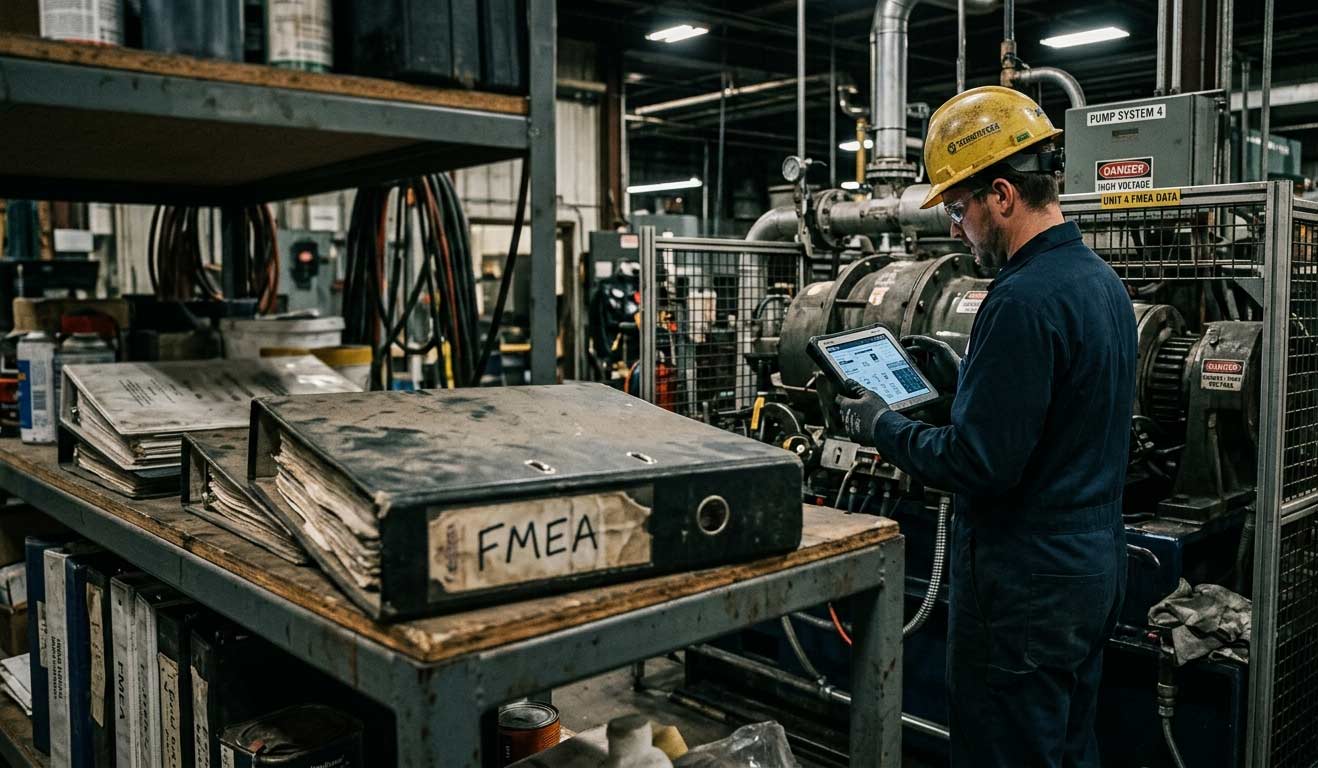
2026-05-07
Why Your FMEA Is Sitting in a Binder (And What It Should Be Doing Instead)
Most facilities have an FMEA — but it’s collecting dust in a binder instead of driving decisions on the floor. Here’s how to turn your risk analysis into a living tool that actually protects uptime.

2026-04-24
CMMS Features and Functionality: What to Look for in a Maintenance Management System
Not all CMMS (Computerized Maintenance Management System) platforms are built the same, and in industries like quarrying, aggregates, cement, and ready-mix concrete, there are certain capabilities that carry more weight than others. The CMMS features that matter most for maintenance teams in asset-intensive industries include things such as centralized asset data, work order automation, preventive and predictive scheduling, digital checklists, deviation management, fleet optimization, and mobile-first design with offline capability.

2026-04-24
Cement Plant Inspection Checklist: What to Check, When to Check It, and Why It Fails
Most unplanned shutdowns in a cement plant don’t come out of nowhere. There’s usually a trail beforehand. Maybe a kiln bearing that’s been running 15 degrees above baseline for three weeks, noted by the operator on shift but never formally flagged because it hadn’t tripped an alarm yet. The issue isn’t a lack of warning, its that small deviations are often tolerated until they tip over into something serious.

2026-04-01
How to Choose the Right Work Order App for Your Industry
When something breaks on site, the fix gets most of the attention, but it’s rarely where things go wrong. What’s just as critical is everything around it: who reported it, who picked it up, what got missed between shifts, and how long it sat before anyone acted. In many operations, that whole flow is still held together by paper forms, radio calls, and memory.


