
Inconsistent work leads to inconsistent results. One shift may check fluid levels meticulously, while the next overlooks them. One worker may be zealous about greasing and ends up over-greasing, while another assumes someone else did. That’s how breakdowns - and near misses - happen. A solid Standard Operating Procedure (SOP) template standardizes tasks, building consistency, accountability, and safety into the work itself.
In this article, we’ll go into detail about what makes a solid SOP template the backbone of a reliable maintenance program - and why it’s worth building these types of procedure documentation right from the start. We’ll cover the following:
Talk to an SOP maintenance expert
Why SOPs Matter More Than Ever in Maintenance
Ask three mechanics how to grease a bearing, and you’ll probably get four answers. That’s not a knock on the mechanic - it’s just how things evolve over time. People learn from different supervisors, different shifts, different procedure documentation, and different habits. The problem is, when everyone does it their own way, inconsistency appears in the shape of unplanned downtime, premature wear, or worse - safety incidents.
A Standard Operating Procedure brings everyone back to the same baseline work instructions. It’s the agreed way of doing the job - the steps, the tools, the checks, and the signoffs that ensure consistency in every task and that it meets the same standard, no matter who’s on shift. But SOPs can do more than set standards:
- They reduce downtime: Routine PMs done the same way each time catch small issues before they grow.
- They protect safety: Lockout/tagout, PPE, and isolation steps are baked into the workflow.
- They make audits painless: Inspectors don’t want to hear “we usually do it this way” - they want proof that procedures are documented and followed.
- They train the next generation: When experienced technicians retire, their know-how doesn’t walk out the door.
What a Good SOP Template Looks Like
A good SOP template isn’t a Word document buried on a shared drive. It’s a working, living tool - clear, visual, and built for the people doing the job, not the people writing policy. Whether it’s for a crusher inspection, mixer cleanout, or pre-trip check, the structure of the work instructions should be the same every time.
A strong SOP template usually includes six core parts:
- Clear purpose and scope: What the procedure covers and when to use it. For example: “Applies to all weekly lubrication tasks on conveyors 3 through 5.” Keeps people from guessing whether they’re following the right process.
- Safety and PPE requirements up front: The first thing someone sees should be how to do the job safely - not step 1 of the task. Include LOTO (lockout/tagout) steps, confined space warnings, hot work permits, or any special isolation notes.
- Tools, parts, and materials list: Technicians waste hours chasing tools or waiting on parts. Listing what’s needed avoids half-finished work and extra downtime.
- Step-by-step procedure: Numbered, action-oriented steps that start with a verb - Inspect, Drain, Tighten, Record. Keep sentences short. If a photo or diagram clarifies something, include it. Clarity beats completeness every time.
- Verification and sign-off: How completion is confirmed - a signature, a photo, or a digital check. This is what turns “we did it” into traceable proof.
- Revision history and ownership: SOPs aren’t set-and-forget. Equipment changes, regulations shift, and new hazards emerge. Always include who owns the SOP, when it was last updated, and when the next review is due.
SOP Example - Crusher Startup Procedure
The following is a straightforward SOP example outlining the key elements of a crusher startup procedure. It’s designed to be clear, concise, and focused on safety and operational consistency. This SOP example represents a simple structure suitable for most maintenance or operations teams, but it can (and should) be expanded with additional detail, visuals, or site-specific requirements depending on the complexity of the equipment or the organization’s documentation standards.
However, it shouldn’t be long or overly complex. It needs to be clear, direct, and free from interpretation, with a simple process that can be repeated the same way, every time.
Section
Details
Procedure name
Crusher startup procedure
Purpose & scope
To safely start and verify operation of the primary crusher after maintenance or downtime. Applies to all operators and maintenance personnel at the plant.
Safety & PPE
- Follow site lockout/tagout (LOTO) procedures.
- Wear required PPE: hard hat, safety glasses, gloves, hearing protection, steel-toe boots.
- Confirm all guards and covers are in place.
- Verify all personnel are clear of equipment before startup.
Tools & materials needed
- Radio communication with control room
- Flashlight or inspection mirror
- Startup checklist or tablet form
Step-by-step procedure
- Inspect area: Check for tools, debris, and ensure personnel are clear.
- Verify maintenance completion: Ensure all work orders are closed and lockouts removed.
- Communicate with the control room: Confirm readiness and downstream conditions.
- Start lubrication systems: Allow oil/grease systems to reach pressure.
- Start crusher motor: Observe for abnormal noise or vibration.
- Check discharge flow: Verify correct material flow.
- Record startup data: Log amps, pressures, and observations.
Verification & sign-off
- Operator initials and timestamp recorded on shift checklist.
- Supervisor review end of shift or via digital dashboard.
Revision history & ownership
Created: Mar 2024 - Jane Smith, Maintenance Lead, Plant A
Last revised: Sep 2025 - John Smith, Operations Manager
Next review: Mar 2026
How to Make SOPs Work in the Real World
A Standard Operating Procedure only adds value if it’s part of the daily routine - not a document people dig up when something goes wrong. To make that happen, the procedure documentation needs to live where the work does.
Printed binders and static PDFs rarely make it past the first revision. Digital versions stored in the cloud, available from your phone/tablet, linked to checklists, or triggered by an RFID-scan at the machine turn SOPs into something people actually use.
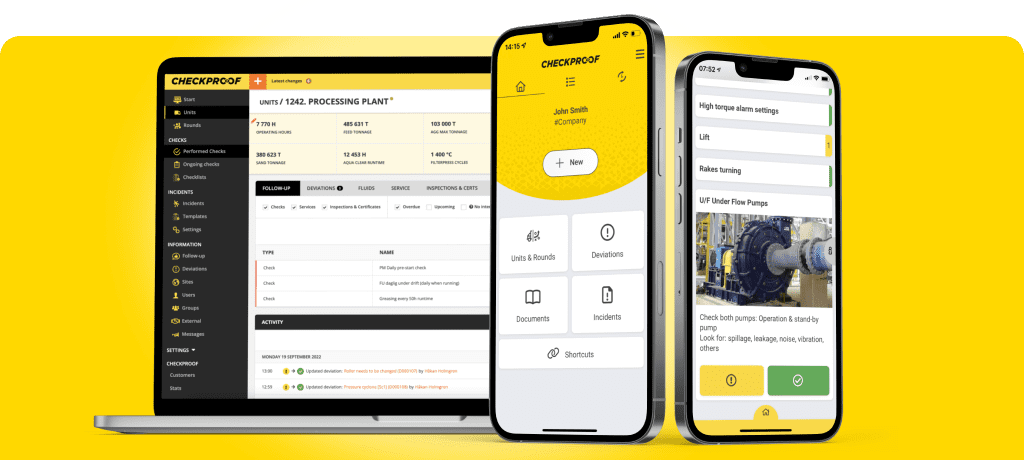
When operators can open the right procedure with one tap, add a photo, tick off steps, and sign digitally - consistency becomes automatic. Supervisors gain visibility without chasing paperwork, and audits stop being a scramble for documentation. The format doesn’t need to be fancy; it just needs to fit into the way work already happens.
Simple access, clear instructions, and proof of completion - that’s how an SOP moves from policy to practice.
8 best practices to ensure SOP compliance
FAQ
Want to know what CheckProof can do for you?
CheckProof's easy-to-use app makes it easier to do the right thing at the right time. Discover how you can run world-class maintenance that is both cost-effective and sustainable.
Book a demo

2026-04-24
CMMS Features and Functionality: What to Look for in a Maintenance Management System
Not all CMMS (Computerized Maintenance Management System) platforms are built the same, and in industries like quarrying, aggregates, cement, and ready-mix concrete, there are certain capabilities that carry more weight than others. The CMMS features that matter most for maintenance teams in asset-intensive industries include things such as centralized asset data, work order automation, preventive and predictive scheduling, digital checklists, deviation management, fleet optimization, and mobile-first design with offline capability.

2026-04-24
Cement Plant Inspection Checklist: What to Check, When to Check It, and Why It Fails
Most unplanned shutdowns in a cement plant don’t come out of nowhere. There’s usually a trail beforehand. Maybe a kiln bearing that’s been running 15 degrees above baseline for three weeks, noted by the operator on shift but never formally flagged because it hadn’t tripped an alarm yet. The issue isn’t a lack of warning, its that small deviations are often tolerated until they tip over into something serious.

2026-04-01
How to Choose the Right Work Order App for Your Industry
When something breaks on site, the fix gets most of the attention, but it’s rarely where things go wrong. What’s just as critical is everything around it: who reported it, who picked it up, what got missed between shifts, and how long it sat before anyone acted. In many operations, that whole flow is still held together by paper forms, radio calls, and memory.

2026-04-01
Best Practices for Work Order Management
Efficient maintenance starts with clear work orders. When issues are logged quickly with the right details, photos, and priority, teams spend less time chasing information and more time fixing problems. The result is reduced downtime, smoother shift handovers, and audit-ready operations — even in low-signal or harsh environments where mobile work orders let crews flag issues before they escalate.

2026-03-26
How DAY Group went paperless and transformed maintenance operations with CheckProof
DAY Group Ltd is an independent, family-owned business supplying construction materials and services across the south of England since 1947. Handling over five million tonnes of material annually across divisions including Day Aggregates, Day Glass Recycling, Day Contracting, and Day Equestrian — plus recycling operations processing over 1.5 million tonnes a year — the group operates with close to 200 staff and a large fleet of plant equipment, making uptime, compliance and safety mission-critical.

2026-03-17
CONEXPO-CON/AGG 2026 – CheckProof’s Industry Report
CONEXPO-CON/AGG 2026 highlighted an industry laser-focused on execution: demand is strong, but labor, schedules, and downtime risk remain tight. The goal is clear — repeatable performance, early risk visibility, and simpler tech adoption. This report covers the key signals from the show and what they mean for the next era of construction materials.

2026-02-20
Standortübergreifende Instandhaltung zum Wettbewerbsvorteil machen
Gebr. Arweiler, ein familiengeführtes Unternehmen mit mehreren Standorten im Saarland und Frankreich, ist seit langem dafür bekannt, Tradition mit zukunftsorientiertem Handeln zu verbinden. Mit acht Werken, einer LKW-Flotte von 26 LKW´s – darunter auch 5 Elektrofahrzeuge – und dem Engagement für Nachhaltigkeit benötigte das Unternehmen eine digitale Lösung zur Optimierung von Instandhaltung, Anlagenverwaltung und Compliance.

2026-02-12
Predictive Maintenance vs Condition-Based Maintenance
Walk any quarry, plant, or yard and you’ll see the same thing: assets and equipment emitting tell-tale signs of its condition, long before it actually fails. Operators note “sounds off” on a pre-shift, but the note gets buried in a binder or a spreadsheet. The gap between seeing a problem and acting on it at the right time is often where maintenance strategies break down.

2026-02-06
Fault Tree Analysis 101 – A Comprehensive Guide
Equipment rarely fails for a single reason. Fault Tree Analysis (FTA) helps teams work backwards from a breakdown, separate symptoms from causes, and identify what needs to change to prevent repeat failures.

2026-01-30
Holcim’s Torr Works Super Quarry – a Customer Success Story
On a quarry as large and complex as Holcim’s Torr Works, staying on top of daily work is a constant challenge. When information is scattered across paper, radios, and emails, even small issues can take too long to act on. This customer story looks at how Torr Works brought everything into one connected system with CheckProof – and what happened when visibility and ownership became part of everyday site work.