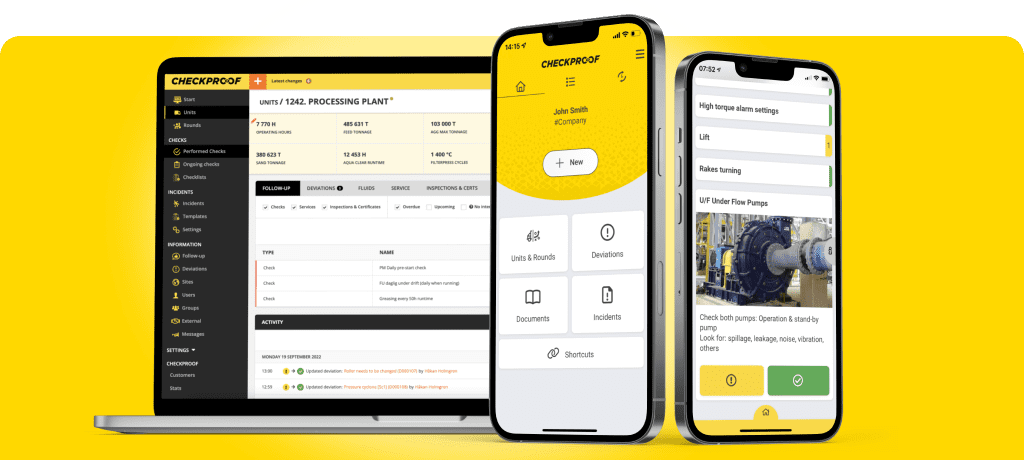

Larger companies across a variety of industry segments worldwide, tend to rely on Enterprise Resource Planning (ERP) systems to manage day-to-day operations. The construction materials industry is no exception, and ERP systems will often form the backbone of how companies manage their supply chain, finances, purchasing, and more. CheckProof offers an external API that enables integrations with ERP systems. Merging data from our platform into your current ERP system is a winning combination and will help give a true representation of the state of your assets.
In this article we’ll cover:
- ERP Systems – what is it?
- The Role of ERP Systems in the Construction Materials Industry
- Benefits of adding CheckProof to optimize ERP systems
- Enabling information exchange through API & Integrations
ERP Systems – what is it?
Enterprise resource planning (ERP) is a software system that companies use to manage the core functions needed to run their business. This can range from financial management, asset management, managing sales pipelines, and logistics to name a few. An ERP system is relied on to run the day-to-day operations of companies, regardless of size.
Investopedia defines ERP as a “platform companies use to manage and integrate the essential parts of their businesses”. ERP is applied across a vast spectrum of industries to gain deeper insights and reporting, in order to increase productivity and create stronger efficiencies, as well as cross-functional visibility. ERP is the generic name for this process or system. Independent software providers, such as Oracle or SAP, will have their own branded ERP system adapted and enhanced, tailored to their clients.
The Role of ERP Systems in the Construction Materials Industries
In the construction materials industry, ERP systems play a crucial role in managing complex operations, optimizing resource utilization, and assessing asset performance. Companies within this segment rely on systems that can support meticulous planning and coordination across various stages of the supply chain.
Every company will have its own unique needs and specific requirements, but below is a list of typical applications of an ERP system within the industry:
- Asset Management: Tracking the availability and movement of assets, and finished products across multiple locations and sites. Comparing assets to understand if a particular brand is performing less well than others to guide future purchasing decisions.
- Production Planning: Optimizing production schedules, resource allocation, and workflow management to meet demand while minimizing costs and downtime.
- Supply Chain Management: Streamlining procurement processes, managing supplier relationships, and ensuring timely delivery of materials to plants and sites.
- Financial Management: Integrating financial data from various departments to track expenses, manage budgets, and analyze profitability.
- Regulatory Compliance: Ensuring compliance with industry regulations, safety standards, and environmental requirements through centralized documentation and reporting.
10 Benefits of adding CheckProof to optimize ERP systems
Through API Integrations, CheckProof can seamlessly merge data with ERP systems to provide clients with the critical information they need to optimize their operations. There are significant benefits to ‘bolting on’ CheckProof to an existing ERP system, as seen in the table below.
Benefits of Merging Data from CheckProof with ERP Systems | Examples |
|---|---|
1. CheckProof’s interface is simple for operators to use. | ERP systems can be overly complex for frontline operators to use, as well as an overload of fields to fill in, resulting in the bare minimum being reported. With CheckProof, routines are more likely to be followed, due to the easy-to use interface. |
2. Frontline operators can use CheckProof’s app on mobile devices. | Frontline workers can do simple digital checks through CheckProof’s app on their mobiles, effectively moving away on desktop reliance for capturing crucial data. |
3. Capture all incidents & deviations | Don’t miss any incidents and deviations during inspection rounds. Identifying this will allow for better analysis whilst also triggering action plans to improve asset reliability and safety. |
4. Enhanced maintenance scheduling | Utilize real-time data on equipment condition and performance to schedule maintenance activities more effectively, reducing downtime and optimizing resources. |
5. Improved regulatory compliance | Automatically generate compliance reports and documentation, ensuring adherence to regulatory requirements and industry standards. |
6. Optimized resource allocation | Identify inefficiencies such as heavy machinery idling time, enabling better resource allocation and cost savings. |
7. Streamlined inventory management | Integrate inspection data with inventory systems to track usage, replenishment needs, and inventory levels accurately. |
8. Better decision-making | Access to comprehensive, more accurate data insights allows informed decision-making, driving operational efficiency. |
9. Increased asset reliability | Proactively address equipment issues based on real-time data, minimizing breakdowns and extending asset lifespan. This data will guide Asset Management analysis within ERP systems. |
10. Improved Visibility and seamless Data flow across departments | Help different teams by centralizing ALL data from the field and allowing a seamless data flow within the ERP system, contributing to visibility, transparency and accountability. |
Enabling information exchange through API & Integrations
An Application Programming Interface (API) serves as a communication method between different systems, allowing them to interact seamlessly. With an API, systems can efficiently exchange data and instructions, enabling integration between disparate systems. This allows for automatic transmission of information, capturing all relevant data and ensuring complete visibility.
CheckProof’s integrated systems align with the construction materials industry and fleet management standards. So, you can manage telematics data from diverse machinery and vehicles across multiple brands within one platform. Furthermore, the integration allows for the correlation of this data with frontline employees‘ reports of deviations, facilitating proactive issue resolution and ensuring routines are followed.
In addition to pre-built integrations, CheckProof offers an external API that enables integrations with other types of systems and assets. So, for example, CheckProof can simply push data into a company’s existing ERP system. For further information on what information can be fetched, created, and updated with CheckProof’s external API, view the External API documentation.
The saying, ‘You can’t manage what you can’t measure.’ is particularly applicable in this case. Merging data from CheckProof with ERP systems offers significant benefits for organizations in the construction materials industries. By centralizing inspection data within the ERP environment, businesses can achieve seamless workflows, improved decision-making, and enhanced compliance. As these industries continue to evolve, the integration of CheckProof with ERP systems is a clever strategy for driving operational excellence and staying competitive.
Want to know what CheckProof can do for you?
CheckProof's easy-to-use app makes it easier to do the right thing at the right time. Discover how you can run world-class maintenance that is both cost-effective and sustainable.
Book a demo

2026-04-24
CMMS Features and Functionality: What to Look for in a Maintenance Management System
Not all CMMS (Computerized Maintenance Management System) platforms are built the same, and in industries like quarrying, aggregates, cement, and ready-mix concrete, there are certain capabilities that carry more weight than others. The CMMS features that matter most for maintenance teams in asset-intensive industries include things such as centralized asset data, work order automation, preventive and predictive scheduling, digital checklists, deviation management, fleet optimization, and mobile-first design with offline capability.

2026-04-24
Cement Plant Inspection Checklist: What to Check, When to Check It, and Why It Fails
Most unplanned shutdowns in a cement plant don’t come out of nowhere. There’s usually a trail beforehand. Maybe a kiln bearing that’s been running 15 degrees above baseline for three weeks, noted by the operator on shift but never formally flagged because it hadn’t tripped an alarm yet. The issue isn’t a lack of warning, its that small deviations are often tolerated until they tip over into something serious.

2026-04-01
How to Choose the Right Work Order App for Your Industry
When something breaks on site, the fix gets most of the attention, but it’s rarely where things go wrong. What’s just as critical is everything around it: who reported it, who picked it up, what got missed between shifts, and how long it sat before anyone acted. In many operations, that whole flow is still held together by paper forms, radio calls, and memory.

2026-04-01
Best Practices for Work Order Management
Efficient maintenance starts with clear work orders. When issues are logged quickly with the right details, photos, and priority, teams spend less time chasing information and more time fixing problems. The result is reduced downtime, smoother shift handovers, and audit-ready operations — even in low-signal or harsh environments where mobile work orders let crews flag issues before they escalate.

2026-03-26
How DAY Group went paperless and transformed maintenance operations with CheckProof
DAY Group Ltd is an independent, family-owned business supplying construction materials and services across the south of England since 1947. Handling over five million tonnes of material annually across divisions including Day Aggregates, Day Glass Recycling, Day Contracting, and Day Equestrian — plus recycling operations processing over 1.5 million tonnes a year — the group operates with close to 200 staff and a large fleet of plant equipment, making uptime, compliance and safety mission-critical.

2026-03-17
CONEXPO-CON/AGG 2026 – CheckProof’s Industry Report
CONEXPO-CON/AGG 2026 highlighted an industry laser-focused on execution: demand is strong, but labor, schedules, and downtime risk remain tight. The goal is clear — repeatable performance, early risk visibility, and simpler tech adoption. This report covers the key signals from the show and what they mean for the next era of construction materials.

2026-02-20
Standortübergreifende Instandhaltung zum Wettbewerbsvorteil machen
Gebr. Arweiler, ein familiengeführtes Unternehmen mit mehreren Standorten im Saarland und Frankreich, ist seit langem dafür bekannt, Tradition mit zukunftsorientiertem Handeln zu verbinden. Mit acht Werken, einer LKW-Flotte von 26 LKW´s – darunter auch 5 Elektrofahrzeuge – und dem Engagement für Nachhaltigkeit benötigte das Unternehmen eine digitale Lösung zur Optimierung von Instandhaltung, Anlagenverwaltung und Compliance.

2026-02-12
Predictive Maintenance vs Condition-Based Maintenance
Walk any quarry, plant, or yard and you’ll see the same thing: assets and equipment emitting tell-tale signs of its condition, long before it actually fails. Operators note “sounds off” on a pre-shift, but the note gets buried in a binder or a spreadsheet. The gap between seeing a problem and acting on it at the right time is often where maintenance strategies break down.

2026-02-06
Fault Tree Analysis 101 – A Comprehensive Guide
Equipment rarely fails for a single reason. Fault Tree Analysis (FTA) helps teams work backwards from a breakdown, separate symptoms from causes, and identify what needs to change to prevent repeat failures.

2026-01-30
Holcim’s Torr Works Super Quarry – a Customer Success Story
On a quarry as large and complex as Holcim’s Torr Works, staying on top of daily work is a constant challenge. When information is scattered across paper, radios, and emails, even small issues can take too long to act on. This customer story looks at how Torr Works brought everything into one connected system with CheckProof – and what happened when visibility and ownership became part of everyday site work.