
Author
Anju Khanna Saggi
Content & Media Relations
Published: 2025-11-20
Last updated: 2025-12-05
On paper, your maintenance strategy may look airtight - PMs mapped out, targets in place, and dashboards full of green lights. But in a plant or on site, things don’t always go that way. Week after week, the same old story plays out with unplanned stops, a growing backlog, and management wondering why reliability keeps slipping.
The reality is that most maintenance strategies don’t fail because teams lack skill, effort, or ambition, they fail because the bridge between strategy and execution is broken. What was meant to be maintenance optimization turns into firefighting with a spreadsheet. A maintenance strategy only works when it’s rooted in daily planning, real data, and consistent feedback from the field.
In this article we’ll guide you through the main reasons why maintenance planning fails and what you can (and should) do to ensure it doesn’t:
Contact us
Why Maintenance Strategies Fail in Practice
Most maintenance strategies don’t fail overnight; rather, they fade over time. A few skipped PMs, a growing maintenance backlog, and before long, the plan everyone agreed on becomes just another document. The reason is usually the same: the reality doesn’t match the plan.
A good maintenance strategy demands balance between production pressure and planned downtime, between field input and management goals. But when planning becomes disconnected from day-to-day reality, that balance disappears. The result is a system that looks structured but runs on reaction.
Before you can fix the plan, you need to understand where it breaks.
Reason #1: Planning Without Real Capacity
Many maintenance strategies fail because the plan ignores reality. Staff may have eight hours, but the schedule assumes twelve. Maintenance planning must fit real people, tools, and downtime windows. True maintenance optimization starts with matching workload to capacity and tracking it through solid maintenance KPIs that reflect execution, not intention.
Reason #2: Strategy Without Frontline Input
A maintenance strategy built solely in an office rarely survives contact with the site. Without the technicians’ and operators’ input, maintenance planning misses the realities of access, tool time, and production pressure. The result is skipped PMs and a maintenance backlog full of low-value work. The best plans start with input from your frontline staff; that’s how you get buy-in, accuracy, and real maintenance optimization.
Reason #3: The Maintenance Backlog Nobody Owns
A growing maintenance backlog is more than unfinished work - it’s a sign your maintenance strategy is off track. When no one owns backlog review or prioritization, critical jobs get buried due to the lack of visibility. An effective maintenance plan also needs to acknowledge the backlog. Regularly sorting through it ensures better scheduling and maintenance optimization.
Reason #4: The KPI Trap
Don’t measure what’s easy, measure what matters. When maintenance KPIs focus only on task counts or hours logged, it dilutes the real picture. A strong maintenance strategy tracks indicators that link directly to uptime and repeat failures. Use this data to guide your maintenance planning.
Reason #5: No Continuous Feedback Loop
If field teams can’t feed real conditions back into maintenance planning in a simple way, the same issues will repeat, and the maintenance backlog will keep on growing. Regular feedback turns data into action, for example updating PMs, refining parts lists, or tightening maintenance KPIs. That loop is the heart of your strategy: learn fast, adjust often, and keep the plan alive.
Steps to Make Your Maintenance Strategy Succeed
To make your plan last, you need a structure that can be adapted without breaking. Real maintenance optimization starts to take shape in the shape of small, steady improvements that hold under pressure.
Here are the steps that turn a maintenance strategy from paperwork into performance:
- Start with realistic planning. Build your maintenance planning around real capacity, including workers’ hours, shift coverage, and production priorities.
- Control your backlog early. Review the maintenance backlog weekly. Close low-value work, prioritize what matters, and make backlog management part of every planning cycle.
- Set the right KPIs. Choose maintenance KPIs that show reliability, not just activity. Track planned vs. unplanned work, backlog age, and repeat issues - numbers that actually reflect improvement.
- Create a feedback loop. Frontline workers should contribute to the plan. Use technician notes, deviations, and inspection data to adjust PMs and scheduling.
- Keep it simple. The best systems are the ones that are used. Clear SOPs, consistent schedules, and short routines beat complex workflows.
- Review, adjust, repeat. Maintenance optimization is a cycle, where the teams that win are the ones that refine their plan monthly, or even better: weekly.
How to Keep Your Maintenance Strategy and Planning Alive
Even the best maintenance strategy, or any strategy for that matter, can lose momentum if it’s buried in spreadsheets or paper checklists. That’s where a simple digital tool makes all the difference. When maintenance planning, inspections, and backlog tracking live in one place, everything becomes so much more accessible, making it easier to keep track of.
A mobile platform helps operators carry out inspection rounds and complete scheduled maintenance checks, while technicians can log deviations, upload photos, and update the maintenance backlog instantly. Planners see both inspections and issues as they happen and can adjust schedules before downtime hits. That real-time link turns maintenance KPIs into live feedback - not just an afterthought.
The right digital tools tighten your maintenance loop, keep data clean, and make your strategy visible across the entire operation.
FAQ - Maintenance Strategy & Planning
Want to know what CheckProof can do for you?
CheckProof's easy-to-use app makes it easier to do the right thing at the right time. Discover how you can run world-class maintenance that is both cost-effective and sustainable.
Book a demo

2026-09-29
The AggNexus 2026 Report: Highlights from the Digital Innovation Conference
AggNexus 2026 in Austin was the biggest edition yet. After a year of AI first steps, the focus shifted to how to get people to change. Here are CheckProof’s key takeaways on change management, fast-moving AI, compliance and passing on know-how.

2026-09-24
Stärkere Basis: Rohrdorfer verbessert durch Digitalisierung Sicherheit und Effizienz
Rohrdorfer, ein führendes Baustoffunternehmen in fünf Ländern, nutzt CheckProof seit Jahren für Sicherheit, Wartung und Qualität. Das stärkt den eigenen Betrieb und die Kundenorientierung.

2026-07-10
10 Must-Have Features for an Incident Management Platform in the Heavy Industry
When an incident happens, every minute matters. A near miss, equipment damage, or a hydraulic leak can quickly become a bigger risk if the issue is not reported, investigated, and followed up properly. When an incident happens, every minute matters. A near miss that goes unreported, or a fault that isn’t followed up, can quickly become a bigger risk if the issue is not reported.

2026-07-09
The Benefits of a Quarry Crusher Management Software
Paper forms, scattered systems, and knowledge locked in one person’s head all delay the same thing: catching crusher problems before they become breakdowns. This piece covers the four biggest challenges in crusher operations and how CheckProof brings inspections, maintenance, and issue tracking into one place.

2026-07-06
Hillhead 2026 – The CheckProof Report
Hillhead 2026 broke every record with 627 exhibitors and three days packed with electric machinery, connected intelligence, and sustainable innovation. CheckProof was on the ground as an exhibitor and sponsor — here’s what our team took away from the show floor.

2026-06-12
Brice Aggregates: What Operational Excellence Looks Like at a Needingworth Quarry
The inaugural CheckProof Industry Excellence Award winners on going digital from the ground up, and the moment their frontline teams bought in.
2026-05-07
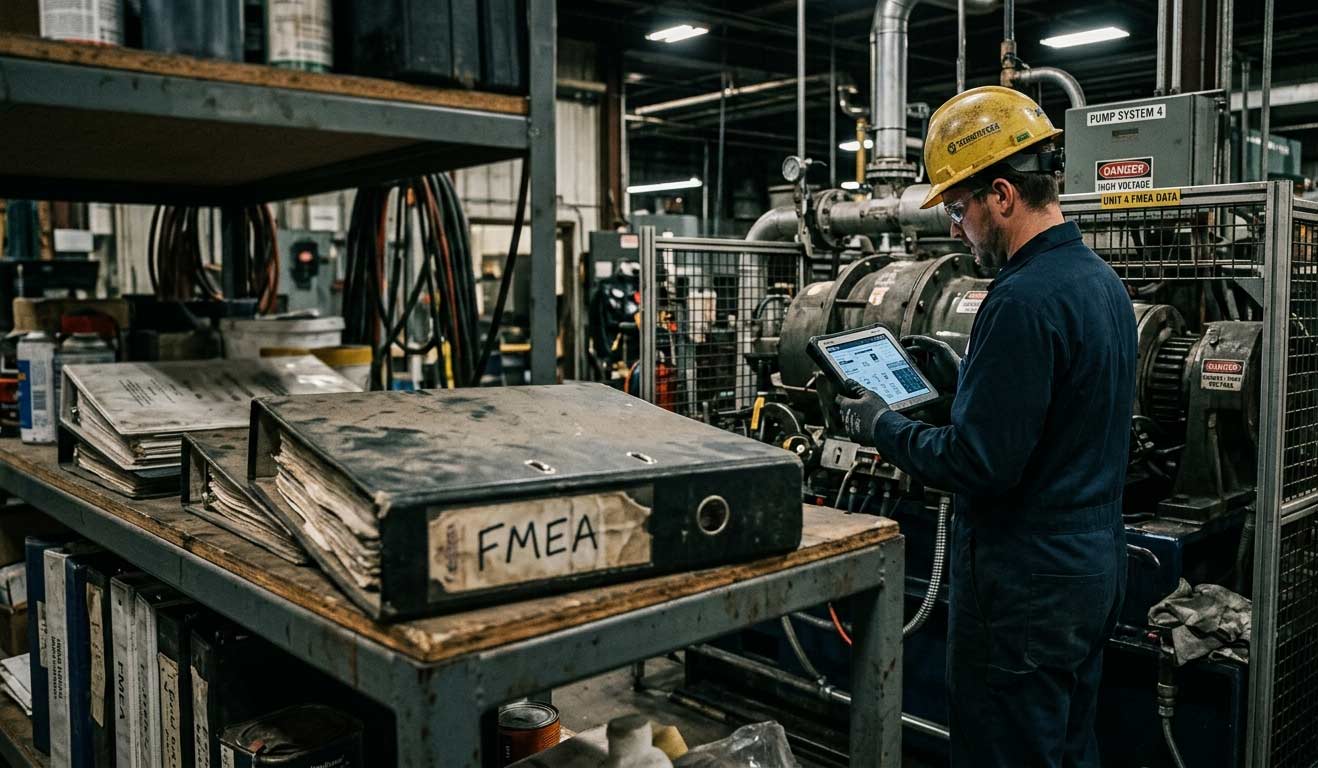
Why Your FMEA Is Sitting in a Binder (And What It Should Be Doing Instead)
Most facilities have an FMEA — but it’s collecting dust in a binder instead of driving decisions on the floor. Here’s how to turn your risk analysis into a living tool that actually protects uptime.

2026-04-24
CMMS Features and Functionality: What to Look for in a Maintenance Management System
Not all CMMS (Computerized Maintenance Management System) platforms are built the same, and in industries like quarrying, aggregates, cement, and ready-mix concrete, there are certain capabilities that carry more weight than others. The CMMS features that matter most for maintenance teams in asset-intensive industries include things such as centralized asset data, work order automation, preventive and predictive scheduling, digital checklists, deviation management, fleet optimization, and mobile-first design with offline capability.

2026-04-24
Cement Plant Inspection Checklist: What to Check, When to Check It, and Why It Fails
Most unplanned shutdowns in a cement plant don’t come out of nowhere. There’s usually a trail beforehand. Maybe a kiln bearing that’s been running 15 degrees above baseline for three weeks, noted by the operator on shift but never formally flagged because it hadn’t tripped an alarm yet. The issue isn’t a lack of warning, its that small deviations are often tolerated until they tip over into something serious.

2026-04-01
How to Choose the Right Work Order App for Your Industry
When something breaks on site, the fix gets most of the attention, but it’s rarely where things go wrong. What’s just as critical is everything around it: who reported it, who picked it up, what got missed between shifts, and how long it sat before anyone acted. In many operations, that whole flow is still held together by paper forms, radio calls, and memory.