
Continuous improvement is exactly what it sounds like. You strive towards always doing better, because there’s always room for improvement. The practice lets you identify opportunities for production and equipment optimisation – resulting in higher efficiency and lower costs. The concept itself seems straightforward, but how do you establish a continuous improvement culture for your facility?
Continuous improvement: get everyone on board
In essence, continuous improvement is based on principles that strive to involve everyone in making improvements everyday and everywhere in your facility.
To achieve this, you need to adopt solutions and create processes that allow you to focus on improving continuously in order to maintain your advantage in the industry. It’s also important to keep in contact with your employees’ morale, help employees and management to see themselves as members of a team, and promote a commitment to personal accountability and a constant flow of feedback.
Follow these five practices to create a foundation for a continuous improvement culture.
1. Facilitate suggestions for improvement
The first and most important step toward continuous improvement is to encourage your frontline team to suggest improvements, and for them to easily be able to report them on-site. Without suggestions, there’s no way of knowing what can improve.
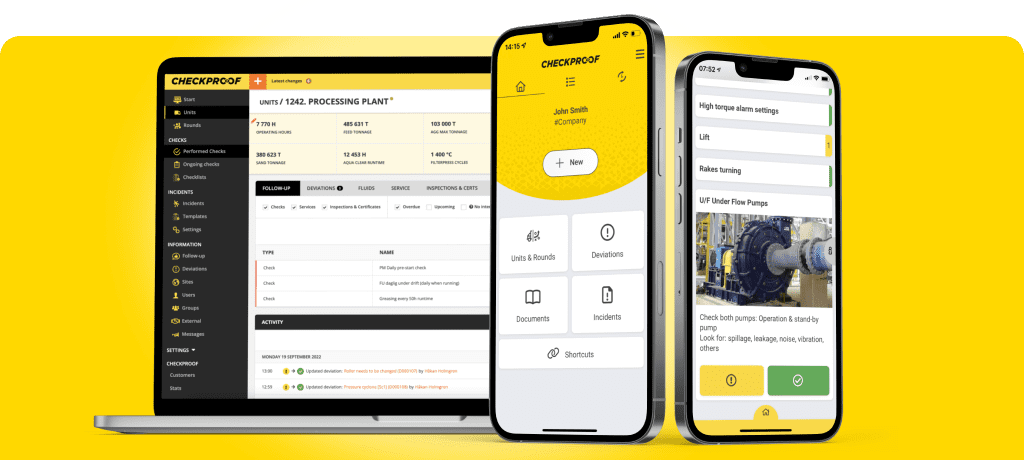
Adopt a digital solution with functionalities that enable your team to report straight from their mobile device to make suggesting improvements a simple task. A data-driven tool also allows your site manager to measure the potential for improvement of suggestions and follow up on improvements made.
2. Collect and utilise the data
You need a smart way of both collecting and managing your data. No data equals nothing to discuss, improve or follow up on. Make sure you implement a system that enables your site managers to easily collect and handle the data needed to spark action. Speak with data, manage with facts.
3. Standardise and structure your way of working
Imagine buying a bookshelf from IKEA and trying to put it together without instructions. Impossible. And even if you’ve built five bookshelves before, the risk of you missing one screw the sixth time is still high.
Standardise and structure your team’s way of working by implementing continuous improvement into your routines and making it a part of your employees‘ day to day. Keep your routines digital to allow anyone to follow up on improvements, or pick up where someone else left off and complete the task according to plan.
4. Be transparent about the impact of improvements
You want a culture where no idea is a bad idea. Where everyone feels involved, part of a team and that they have the power to make a real impact. Where an employee wants to suggest an improvement for the sake of the success of the company.
To achieve this, you need transparency. Have your site managers set up meetings at regular intervals where they show employees the results of changes and that the suggestions they’ve made actually make a difference. Prove to them that when they do report a suggestion, action is taken. This is fundamental to boosting and keeping in contact with your employees’ morale.
Don’t let anything fall between the cracks
One of your employees has an idea on how to reduce the space needed for operations on-site. The lack of a digital reporting tool forces the employee to call the site manager. The manager, being stressed, forgets to write it down. Now, no one will take action. And there is no way for the employee to follow up on the suggestion in question, and will therefore never see an improvement. Will the employee make a suggestion next time? Probably not.
Implement a solution that your team can use to suggest improvements without fearing that it’ll never make its way to the site manager. This way, both your managers and frontline team can go through them retroactively and follow up on each one. Employees will see that their suggestions are looked into – enabling the “no idea is a bad idea”-philosophy. You incidentally increase employee morale and improve the feedback culture in your facility. Three birds, one stone.
Do you want more examples of how digitising your workflow can optimise your routines and minimise downtime? Download your free copy of the guide 9 keys to maximise the availability of your assets through frontline digitisation.
Want to know what CheckProof can do for you?
CheckProof's easy-to-use app makes it easier to do the right thing at the right time. Discover how you can run world-class maintenance that is both cost-effective and sustainable.
Book a demo

2026-04-24
CMMS Features and Functionality: What to Look for in a Maintenance Management System
Not all CMMS (Computerized Maintenance Management System) platforms are built the same, and in industries like quarrying, aggregates, cement, and ready-mix concrete, there are certain capabilities that carry more weight than others. The CMMS features that matter most for maintenance teams in asset-intensive industries include things such as centralized asset data, work order automation, preventive and predictive scheduling, digital checklists, deviation management, fleet optimization, and mobile-first design with offline capability.

2026-04-24
Cement Plant Inspection Checklist: What to Check, When to Check It, and Why It Fails
Most unplanned shutdowns in a cement plant don’t come out of nowhere. There’s usually a trail beforehand. Maybe a kiln bearing that’s been running 15 degrees above baseline for three weeks, noted by the operator on shift but never formally flagged because it hadn’t tripped an alarm yet. The issue isn’t a lack of warning, its that small deviations are often tolerated until they tip over into something serious.

2026-04-01
How to Choose the Right Work Order App for Your Industry
When something breaks on site, the fix gets most of the attention, but it’s rarely where things go wrong. What’s just as critical is everything around it: who reported it, who picked it up, what got missed between shifts, and how long it sat before anyone acted. In many operations, that whole flow is still held together by paper forms, radio calls, and memory.

2026-04-01
Best Practices for Work Order Management
Efficient maintenance starts with clear work orders. When issues are logged quickly with the right details, photos, and priority, teams spend less time chasing information and more time fixing problems. The result is reduced downtime, smoother shift handovers, and audit-ready operations — even in low-signal or harsh environments where mobile work orders let crews flag issues before they escalate.

2026-03-26
How DAY Group went paperless and transformed maintenance operations with CheckProof
DAY Group Ltd is an independent, family-owned business supplying construction materials and services across the south of England since 1947. Handling over five million tonnes of material annually across divisions including Day Aggregates, Day Glass Recycling, Day Contracting, and Day Equestrian — plus recycling operations processing over 1.5 million tonnes a year — the group operates with close to 200 staff and a large fleet of plant equipment, making uptime, compliance and safety mission-critical.

2026-03-17
CONEXPO-CON/AGG 2026 – CheckProof’s Industry Report
CONEXPO-CON/AGG 2026 highlighted an industry laser-focused on execution: demand is strong, but labor, schedules, and downtime risk remain tight. The goal is clear — repeatable performance, early risk visibility, and simpler tech adoption. This report covers the key signals from the show and what they mean for the next era of construction materials.

2026-02-20
Standortübergreifende Instandhaltung zum Wettbewerbsvorteil machen
Gebr. Arweiler, ein familiengeführtes Unternehmen mit mehreren Standorten im Saarland und Frankreich, ist seit langem dafür bekannt, Tradition mit zukunftsorientiertem Handeln zu verbinden. Mit acht Werken, einer LKW-Flotte von 26 LKW´s – darunter auch 5 Elektrofahrzeuge – und dem Engagement für Nachhaltigkeit benötigte das Unternehmen eine digitale Lösung zur Optimierung von Instandhaltung, Anlagenverwaltung und Compliance.

2026-02-12
Predictive Maintenance vs Condition-Based Maintenance
Walk any quarry, plant, or yard and you’ll see the same thing: assets and equipment emitting tell-tale signs of its condition, long before it actually fails. Operators note “sounds off” on a pre-shift, but the note gets buried in a binder or a spreadsheet. The gap between seeing a problem and acting on it at the right time is often where maintenance strategies break down.

2026-02-06
Fault Tree Analysis 101 – A Comprehensive Guide
Equipment rarely fails for a single reason. Fault Tree Analysis (FTA) helps teams work backwards from a breakdown, separate symptoms from causes, and identify what needs to change to prevent repeat failures.

2026-01-30
Holcim’s Torr Works Super Quarry – a Customer Success Story
On a quarry as large and complex as Holcim’s Torr Works, staying on top of daily work is a constant challenge. When information is scattered across paper, radios, and emails, even small issues can take too long to act on. This customer story looks at how Torr Works brought everything into one connected system with CheckProof – and what happened when visibility and ownership became part of everyday site work.