There’s usually a three‑ring binder somewhere on site with “FMEA” (Failure Mode and Effects Analysis) on the spine. It was built during a shutdown or a quality push, printed, filed, and likely forgotten while the day-to-day work on site kept moving.
Needless to say, an FMEA only matters if it changes decisions on the ground. And the ground gets expensive fast. In ABB’s “Value of Reliability” survey of 3,215 maintenance decision‑makers, over two‑thirds of industrial businesses said they experience unplanned outages at least once a month, with a typical hourly cost close to $125,000. Yet 21% still rely on run‑to‑fail maintenance.
In this article, we’ll delve into the importance of FMEA, and how you SHOULD be using it on a daily basis, including:
What FMEA Does
Failure Mode and Effects Analysis (FMEA) is a step‑by‑step way to identify failure modes, understand their effects, and prioritize what to prevent first. “Failure mode” is plain language: how a thing fails – belt mistracking, plugged chute, cracked weld, wrong lockout point, missed lubrication. Most teams rank each item with a risk priority number (RPN), often Severity × Occurrence × Detection.
Two distinct branches of FMEA matter in industrial operations:
- DFMEA looks at design decisions: a new crusher, a retrofit, a guard redesign, a dust collector upgrade.
- PFMEA looks at how you run and maintain: start‑up/shutdown, PM routines, inspection points, handovers, and material flow.
These are formalized heavily in sectors like automotive (AIAG & VDA publish a DFMEA/PFMEA handbook), but the thinking is universal and applies to any type of industrial setting.
The Purpose of a FMEA
A living FMEA is not a compliance tick-box exercise. It’s a prioritized list of “how this plant breaks,” connected to controls your crew can execute. Keep it simple. Start with one constraint asset (primary crusher line, batch plant, your worst conveyor) and do this:
- List failure modes in shop terms. “Tail pulley bearing cooks.” “Belt slices on skirt steel.” “Hydraulic hose rubs through.” “Screen blinds in wet feed.”
- Make Scoring Detection honest. If you only catch the problem when you smell burning rubber, Detection is poor. If a five‑minute walkaround, a temperature‑gun route, vibration check, or oil sample catches it early, score it better.
- Use RPN to rank work, then force an action. An RPN number without a control is just math. Convert your top items into something real, such as an added inspection point, a changed PM interval, a stocked seal kit, a training step. Whatever closes the gap between the score and the fix.
- Don’t let RPN hide severity. High-severity safety and compliance items deserve action even if occurrence feels 'rare.' A low probability doesn't make the consequence acceptable.
- Close the loop after breakdowns. If the same failure mode hits twice, update occurrence and update the control plan. If you solved it, capture what worked so the fix survives the next crew and the next shift.
- Make it accessible where the work happens. If your FMEA, PFMEA, or DFMEA lives in a spreadsheet on someone’s desktop, it won’t survive shift change. The highest-risk failure modes should show up inside daily inspections, PM tasks, and deviation reports – on the tablet in the loader cab or the screen in the shop. When crews can see the top risks, log photos, and update actions in the same place they document the work, and the analysis with resolutions stays alive.
When a FMEA Doesn’t Get Used
Most site FMEAs die because they’re disconnected from work. They’re written in “meeting room language,” they don’t tie to pre‑shift checks and PMs, and nobody owns updates after the next changeout or workaround.
And that’s where most FMEAs fall apart.
If high-risk failure modes aren’t built into daily inspections, they get forgotten. If repeat breakdowns don’t automatically trigger a review of Occurrence scoring, the RPN never changes. If deviations live in one system and PMs in another, nobody sees the pattern forming.
A living FMEA needs to sit where the work actually happens – in the same flow as pre-shift checks, workplace exams, PM tasks, and incident reporting. When a tech logs a failed bearing with a photo, that data should feed the risk picture. When a supervisor closes a deviation, it should affect how Detection is scored next time.
That’s when FMEA stops being a workshop exercise.
FAQ
Want to know what CheckProof can do for you?
CheckProof's easy-to-use app makes it easier to do the right thing at the right time. Discover how you can run world-class maintenance that is both cost-effective and sustainable.
Book a demo

2026-07-10
10 Must-Have Features for an Incident Management Platform in the Heavy Industry
When an incident happens, every minute matters. A near miss, equipment damage, or a hydraulic leak can quickly become a bigger risk if the issue is not reported, investigated, and followed up properly. When an incident happens, every minute matters. A near miss that goes unreported, or a fault that isn’t followed up, can quickly become a bigger risk if the issue is not reported.

2026-07-09
The Benefits of a Quarry Crusher Management Software
Paper forms, scattered systems, and knowledge locked in one person’s head all delay the same thing: catching crusher problems before they become breakdowns. This piece covers the four biggest challenges in crusher operations and how CheckProof brings inspections, maintenance, and issue tracking into one place.

2026-07-06
Hillhead 2026 – The CheckProof Report
Hillhead 2026 broke every record with 627 exhibitors and three days packed with electric machinery, connected intelligence, and sustainable innovation. CheckProof was on the ground as an exhibitor and sponsor — here’s what our team took away from the show floor.

2026-06-12
Brice Aggregates: What Operational Excellence Looks Like at a Needingworth Quarry
The inaugural CheckProof Industry Excellence Award winners on going digital from the ground up, and the moment their frontline teams bought in.
2026-05-07
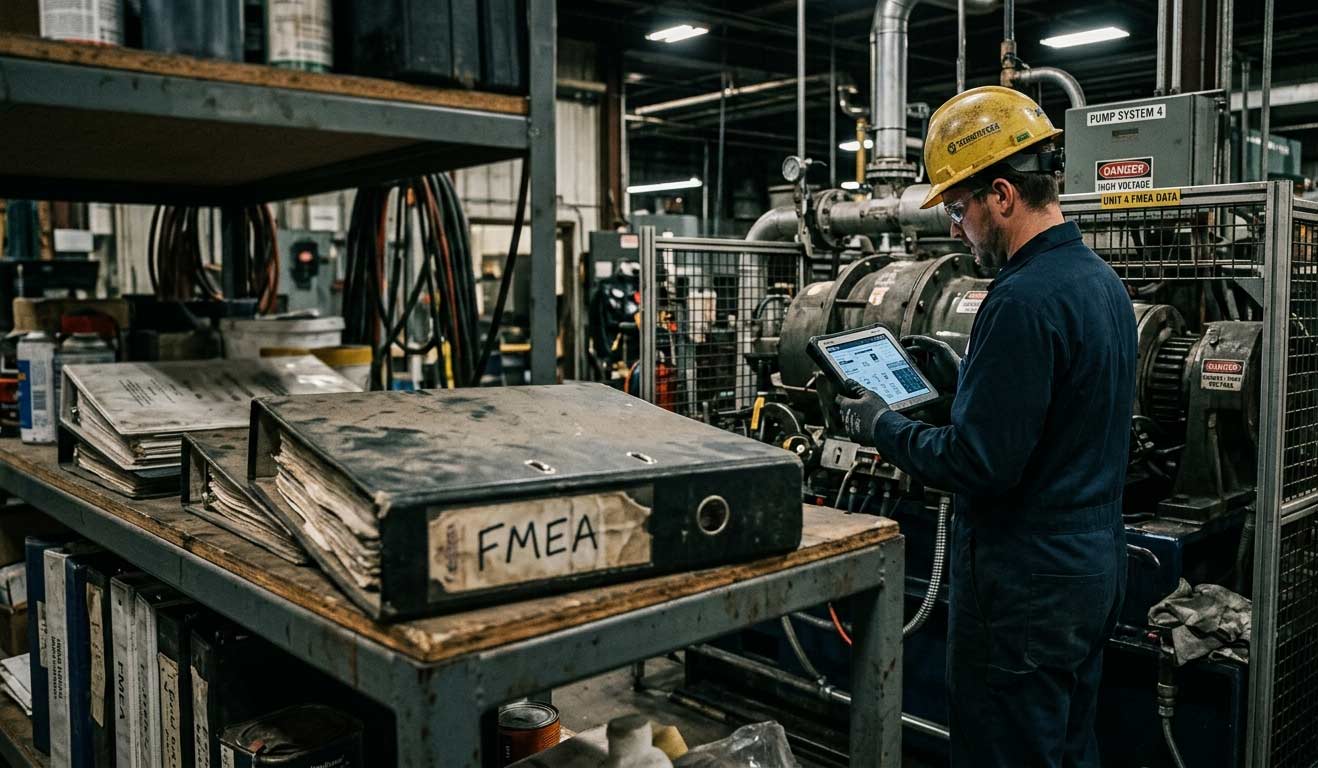
Why Your FMEA Is Sitting in a Binder (And What It Should Be Doing Instead)
Most facilities have an FMEA — but it’s collecting dust in a binder instead of driving decisions on the floor. Here’s how to turn your risk analysis into a living tool that actually protects uptime.

2026-04-24
CMMS Features and Functionality: What to Look for in a Maintenance Management System
Not all CMMS (Computerized Maintenance Management System) platforms are built the same, and in industries like quarrying, aggregates, cement, and ready-mix concrete, there are certain capabilities that carry more weight than others. The CMMS features that matter most for maintenance teams in asset-intensive industries include things such as centralized asset data, work order automation, preventive and predictive scheduling, digital checklists, deviation management, fleet optimization, and mobile-first design with offline capability.

2026-04-24
Cement Plant Inspection Checklist: What to Check, When to Check It, and Why It Fails
Most unplanned shutdowns in a cement plant don’t come out of nowhere. There’s usually a trail beforehand. Maybe a kiln bearing that’s been running 15 degrees above baseline for three weeks, noted by the operator on shift but never formally flagged because it hadn’t tripped an alarm yet. The issue isn’t a lack of warning, its that small deviations are often tolerated until they tip over into something serious.

2026-04-01
How to Choose the Right Work Order App for Your Industry
When something breaks on site, the fix gets most of the attention, but it’s rarely where things go wrong. What’s just as critical is everything around it: who reported it, who picked it up, what got missed between shifts, and how long it sat before anyone acted. In many operations, that whole flow is still held together by paper forms, radio calls, and memory.

2026-04-01
Best Practices for Work Order Management
Efficient maintenance starts with clear work orders. When issues are logged quickly with the right details, photos, and priority, teams spend less time chasing information and more time fixing problems. The result is reduced downtime, smoother shift handovers, and audit-ready operations — even in low-signal or harsh environments where mobile work orders let crews flag issues before they escalate.

2026-03-26
How DAY Group went paperless and transformed maintenance operations with CheckProof
DAY Group Ltd is an independent, family-owned business supplying construction materials and services across the south of England since 1947. Handling over five million tonnes of material annually across divisions including Day Aggregates, Day Glass Recycling, Day Contracting, and Day Equestrian — plus recycling operations processing over 1.5 million tonnes a year — the group operates with close to 200 staff and a large fleet of plant equipment, making uptime, compliance and safety mission-critical.