
Author
Anju Khanna Saggi
Content & Media Relations
Published: 2025-11-07
Last updated: 2026-09-27
At most sites, everyone believes they’re meeting (or hope they’re meeting) OSHA standards - until an OSHA inspection proves otherwise. In 2023, OSHA’s own analysis of federal agency inspections found only 33.8% of programmed (targeted) inspections and 44.4% of unprogrammed (complaint/referral, etc.) inspections ended “in compliance.” In other words, 66.2% of targeted inspections and 55.6% of complaint/referral inspections found at least one violation.
This is rarely because workers are skipping steps, but often because the proof of compliance isn’t consistent. Inspections of course take place, happen, and workplace safety checks get done. But paper logs easily disappear or get dirty and difficult to read, photos stay on personal phones, and maintenance records don’t always make it back to the office. That’s the real challenge of OSHA compliance: it’s not just about following the routines - in the end, you always need to show and document that the routines have been followed.
If you can’t prove that equipment was inspected, hazards were logged, and that corrective actions were closed then you’re not audit-ready. For most plants, quarries, and trucking operations, keeping up with OSHA standards doesn’t mean adding more paperwork or meetings. It means building workplace safety routines that generate proof automatically.
In this post, we’ll walk through practical, frontline, and management-friendly steps to ensure OSHA compliance, that holds up under OSHA inspections, without slowing production or overloading your team.
Key takeaways
-
- The same company may need to follow different OSHA standards across its plants, construction work and transport operations.
- Completing safety checks is only half the job; businesses must also be able to prove what was checked and corrected.
- Short checklists built into everyday work are more effective than lengthy forms that crews are likely to skip.
- Digital OSHA compliance tools keep inspections, evidence and corrective actions visible and traceable in one place.
- Regular self-audits reveal where procedures, records and real workplace conditions no longer match—before OSHA does.
Contact us
Know which OSHA Standards apply to you
The first step in ensuring OSHA compliance is knowing which standards actually apply to your operation. Sounds obvious, but it may be one of the biggest blind spots across the industry.
OSHA doesn’t use a one-size-fits-all rulebook. There’s a difference between Part 1910 (General Industry) and Part 1926 (Construction), and if your site does both fixed-plant and mobile work - like aggregate production and field maintenance - you might fall under both.
That’s where compliance often gets messy. Crews think they’re covered under one set of standards, while inspectors use another.
Start with your core activities
Ask yourself (and your colleagues): “What’s the main thing we do on this site - produce, build, or move?”:
- Fixed plants like crushers, wash screens, and ready-mix operations typically follow 1910 General Industry standards.
- Construction or field work - like mobile maintenance, drilling, or paving - usually falls under 1926 Construction.
- Trucking, hauling, and logistics teams must also consider FMCSA safety rules on top of OSHA requirements.
Even within a single company, different sites or crews may operate under different sections of the OSHA rulebook. That’s why a single, consistent OSHA checklist is so critical - it aligns everyone to the same baseline, no matter where the work happens.
Focus on the hazards that matter
Instead of trying to memorize every regulation, zero in on the areas where OSHA inspections most often find gaps:
- Machine guarding
- Lockout/tagout procedures
- Housekeeping and fall hazards
- Dust, noise, and respiratory protection
- Hazard communication and labeling
- Powered industrial trucks and mobile equipment
These are the same issues that show up repeatedly in OSHA inspection reports across heavy industry. When your checklists, training, and documentation revolve around these core hazards, you’re already much closer to compliance-ready operations.
What’s included in an OSHA Inspection Checklist?
While the exact checklist can vary depending on your operation, most official OSHA compliance checklists include the same major categories. These are the areas OSHA inspectors are trained to verify on every visit:
1. General safety and housekeeping
Inspectors start broad, looking at overall workplace safety conditions. They’ll note walking and working surfaces, clutter, lighting, and floor markings. They’ll check that emergency exits are clear and properly marked. Poor housekeeping is one of the first signs of a weak safety culture.
Examples of what OSHA looks for:
- Clean and dry floors, no oil or debris buildup
- Properly marked exits and accessible pathways
- Secure storage of tools and materials
2. Machine guarding and equipment safety
Mechanical hazards are among OSHA’s top citations. Inspectors verify that all moving parts, belts, pulleys, gears, and blades are guarded and that guards are not bypassed or removed.
Examples:
- Guards installed on conveyors and crushers
- Emergency stop switches functional and labeled
- No exposed rotating shafts or couplings
3. Electrical safety
Under OSHA standards, Subpart S, electrical systems must be properly maintained and grounded. Inspectors check panels, wiring, and extension cords, looking for damage or unsafe modifications.
Examples:
- Electrical boxes covered and labeled
- No frayed cords or daisy-chained power strips
- Lockout/tagout procedures in place for energized work
4. Hazard communication (HazCom)
OSHA’s Hazard Communication Standard ensures workers know what chemicals they’re exposed to. Inspectors review labeling, Safety Data Sheets (SDS), and employee training records.
Examples:
- Chemical containers labeled correctly
- SDS binder or digital access available and current
- Employees trained to read and understand labels
5. Personal Protective Equipment (PPE)
Inspectors check whether required PPE is provided, available, and in use. This includes hard hats, gloves, respirators, hearing protection, and high-visibility clothing.
Examples:
- PPE worn in designated areas
- Respirators fit-tested and maintained
- Hearing protection available near noise sources
6. Fire protection and emergency preparedness
OSHA looks for working fire extinguishers, clear evacuation routes, and posted emergency procedures.
Examples:
- Fire extinguishers inspected monthly and tagged
- Emergency exits unobstructed
- Spill kits and alarms accessible
7. Lockout/tagout (LOTO)
LOTO is another very commonly cited violation under OSHA standards. Inspectors verify that hazardous energy sources are isolated and that employees follow proper procedures during maintenance.
Examples:
- Written LOTO program posted and current
- Locks and tags issued to individuals, not shared
- Training records for authorized employees
8. Fall protection
If work is performed at height, inspectors will assess ladders, scaffolds, harnesses, and guardrails. Falls are consistently one of OSHA’s “Fatal Four” focus areas.
Examples:
- Guardrails installed where required
- Harnesses and lanyards inspected and rated
- Ladders stable, secured, and in good repair
9. Respiratory protection and air quality
For operations dealing with dust, fumes, or silica - inspectors ensure respirator programs meet OSHA compliance requirements and that exposure monitoring is documented.
Examples:
- Air quality testing records
- Respirator fit-testing documentation
- Dust control systems operating effectively
10. Recordkeeping and training
Finally, OSHA checks the paper trail - the documentation that proves compliance. That includes injury logs (OSHA 300/301 forms), training records, and inspection reports.
Examples:
- OSHA 300 logs updated and posted
- Training certifications current
- Inspection and maintenance records accessible
How to build a long-term OSHA Compliance System into your daily work
The above is just the tip of the iceberg. The actual OSHA checklist is obviously much more extensive and detailed. So, how can we ensure we will be OSHA compliant in the long run? We need to bake OSHA compliance into our daily work and ensure we know the ins and outs of their checklists, and that it becomes a natural routine we do per automation.
In the end, the most compliant operations don’t chase paperwork; they build compliance into the work itself. Frontline workers are usually already doing most of what OSHA standards require every day, such as inspecting equipment, flagging hazards, locking out machines before maintenance.
Start every day with a quick pre-shift inspection. Walk the yard or the plant, check guarding, walkways, and PPE. Log hazards on the spot - a missing tag, a spill, a loose handrail. End the shift with a quick workplace exam or housekeeping check. These aren’t new tasks; they’re the same safety habits most teams already do. The difference is that they’re logged, timestamped, and visible.
That’s where a solid, digital OSHA checklist comes in handy, as a short, living record of what’s happening on the ground. It doesn’t need to be long or complicated. In fact, short checklists that crews complete are far more valuable than ones that sit half-finished. Every check should either confirm something’s safe, flag something that needs fixing, or prove that someone looked.
How to implement an OSHA Compliance Checklist
Anyone who’s actually run a crew, a plant, or a pit knows that the real challenge in the end isn’t commitment, it’s consistency. Everyone obviously wants to stay safe and compliant with OSHA standards, but when the shift’s already behind, the checklist is usually the first thing skipped.
So, how do you make OSHA compliance checklists a real part of the workday, not just a pencil whipping exercise? Using a digital tool can be the answer to this.
Digital checklists take what are usually quite frustrating, time-consuming tasks and turn them into a quick, reliable routine. Instead of hunting for forms or scribbling on clipboards, crews can pull up the checklist on a tablet or phone, complete it in minutes, attach photos, and move on. Each submission is timestamped and stored automatically, meaning no lost paperwork, no guessing, and no backtracking when OSHA inspections happen.
The real benefit is a reliable audit trail. Every inspection, hazard, and corrective action is logged and traceable. Supervisors can see what’s done, what’s overdue, and where recurring issues appear. It closes the loop between workplace safety checks and maintenance work orders, turning safety data into decisions instead of just records.
Audit yourself before OSHA does
The best time to find a problem is before an inspector does. A short, honest self-audit every few months is the easiest way to stay ahead of OSHA inspections. Think of it as a walk-through with a purpose.
Start with your own OSHA checklist and treat it like you’re the inspector. Walk the yard, the plant, and the shop floor with a fresh set of eyes. Look for the small things that slip when production takes priority - the same things OSHA inspectors are trained to spot.
Here’s a simple self-audit routine to follow:
- Check documentation first. Are inspection logs signed and dated? Are training records current? Missing signatures or outdated forms are red flags for inspectors.
- Walk the work areas. Look for worn or missing machine guards, damaged ladders, blocked exits, poor housekeeping, or PPE not being used.
- Inspect safety equipment. Verify fire extinguishers, eye wash stations, and first aid kits are accessible, stocked, and tagged within date.
- Review lockout/tagout stations. Make sure tags are legible, locks are assigned to individuals, and your written LOTO program matches how people actually work.
- Match field reality to your records. If pre-shift inspections or maintenance logs say something’s been fixed — confirm it’s true. Documentation and real conditions must align.
- Log and close out findings. Record issues immediately and assign fixes with deadlines. If something needs a part or repair, track it until verified complete.
The goal of a self-audit isn’t to assign blame, it’s to prove that your operation consistently meets OSHA standards and can back it up with evidence. When findings turn into quick fixes instead of finger-pointing, teams take ownership, and that’s where real workplace safety grows.
Self-auditing is just maintenance for your safety system, the same as checking oil or greasing bearings. It keeps your OSHA compliance smooth and prevents breakdowns later. You catch weak spots before they become citations, and you show your crews that your standard is always being audit-ready.
Make use of OSHA Compliance Tools to automate safety checks
OSHA compliance tools come in all shapes and forms, ranging from audit and inspection software to complete safety and operations management platforms. Instead of relying on paper checklists or scattered spreadsheets, these tools can schedule recurring safety checks, notify the right workers and guide them through each control point.
With the CheckProof platform, findings can be documented with notes and photos, assigned as corrective actions and tracked until they are resolved. This gives managers a clear record of what was checked, what went wrong and how the issue was handled, ensuring you can self-audit more easily, continuously improve your operations, and provide the OHSA any documentation they may ask about.
FAQ - OSHA Compliance
Want to know what CheckProof can do for you?
CheckProof's easy-to-use app makes it easier to do the right thing at the right time. Discover how you can run world-class maintenance that is both cost-effective and sustainable.
Book a demo

2026-09-29
The AggNexus 2026 Report: Highlights from the Digital Innovation Conference
AggNexus 2026 in Austin was the biggest edition yet. After a year of AI first steps, the focus shifted to how to get people to change. Here are CheckProof’s key takeaways on change management, fast-moving AI, compliance and passing on know-how.

2026-09-24
Stärkere Basis: Rohrdorfer verbessert durch Digitalisierung Sicherheit und Effizienz
Rohrdorfer, ein führendes Baustoffunternehmen in fünf Ländern, nutzt CheckProof seit Jahren für Sicherheit, Wartung und Qualität. Das stärkt den eigenen Betrieb und die Kundenorientierung.

2026-07-10
10 Must-Have Features for an Incident Management Platform in the Heavy Industry
When an incident happens, every minute matters. A near miss, equipment damage, or a hydraulic leak can quickly become a bigger risk if the issue is not reported, investigated, and followed up properly. When an incident happens, every minute matters. A near miss that goes unreported, or a fault that isn’t followed up, can quickly become a bigger risk if the issue is not reported.

2026-07-09
The Benefits of a Quarry Crusher Management Software
Paper forms, scattered systems, and knowledge locked in one person’s head all delay the same thing: catching crusher problems before they become breakdowns. This piece covers the four biggest challenges in crusher operations and how CheckProof brings inspections, maintenance, and issue tracking into one place.

2026-07-06
Hillhead 2026 – The CheckProof Report
Hillhead 2026 broke every record with 627 exhibitors and three days packed with electric machinery, connected intelligence, and sustainable innovation. CheckProof was on the ground as an exhibitor and sponsor — here’s what our team took away from the show floor.

2026-06-12
Brice Aggregates: What Operational Excellence Looks Like at a Needingworth Quarry
The inaugural CheckProof Industry Excellence Award winners on going digital from the ground up, and the moment their frontline teams bought in.
2026-05-07
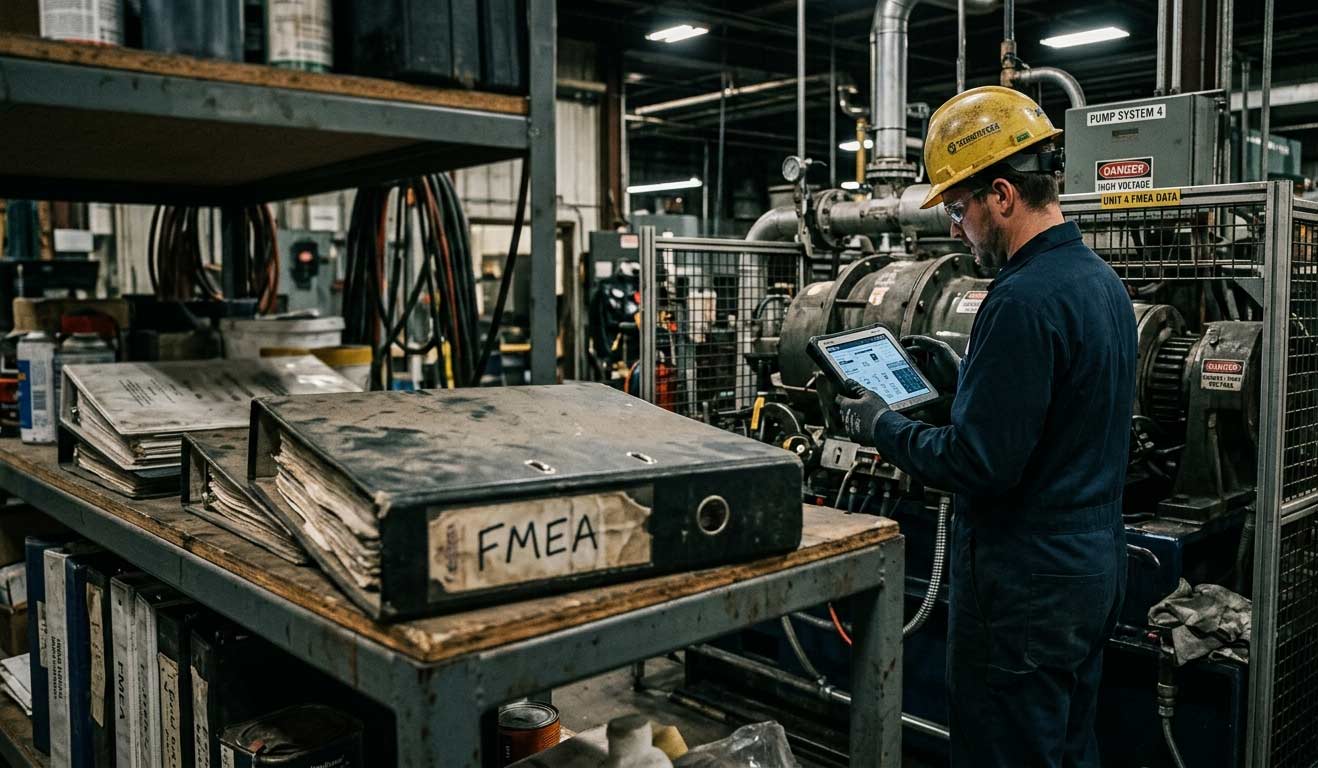
Why Your FMEA Is Sitting in a Binder (And What It Should Be Doing Instead)
Most facilities have an FMEA — but it’s collecting dust in a binder instead of driving decisions on the floor. Here’s how to turn your risk analysis into a living tool that actually protects uptime.

2026-04-24
CMMS Features and Functionality: What to Look for in a Maintenance Management System
Not all CMMS (Computerized Maintenance Management System) platforms are built the same, and in industries like quarrying, aggregates, cement, and ready-mix concrete, there are certain capabilities that carry more weight than others. The CMMS features that matter most for maintenance teams in asset-intensive industries include things such as centralized asset data, work order automation, preventive and predictive scheduling, digital checklists, deviation management, fleet optimization, and mobile-first design with offline capability.

2026-04-24
Cement Plant Inspection Checklist: What to Check, When to Check It, and Why It Fails
Most unplanned shutdowns in a cement plant don’t come out of nowhere. There’s usually a trail beforehand. Maybe a kiln bearing that’s been running 15 degrees above baseline for three weeks, noted by the operator on shift but never formally flagged because it hadn’t tripped an alarm yet. The issue isn’t a lack of warning, its that small deviations are often tolerated until they tip over into something serious.

2026-04-01
How to Choose the Right Work Order App for Your Industry
When something breaks on site, the fix gets most of the attention, but it’s rarely where things go wrong. What’s just as critical is everything around it: who reported it, who picked it up, what got missed between shifts, and how long it sat before anyone acted. In many operations, that whole flow is still held together by paper forms, radio calls, and memory.