

Author
Linn Björklund
Published: 2024-07-04
Last updated: 2026-05-05
Tired of guesstimating when you need to perform maintenance for your assets? The Internet of Things, or IoT, connects non-traditional computing devices to the internet and transfers their data over a network without human interaction. This data can be used to create optimal predictive maintenance routines for any piece of equipment in your facility.
Telematics data is a powerful way to improve the efficiency of the maintenance of your assets. By combining real-time data with actionable insights, you can keep your assets in optimal condition for production.
In this article, we cover:
What is IoT predictive maintenance?
Many facilities use calendar-based maintenance routines, but what if you could build routines and maintenance actions based on real-time data from your assets?
This is where IoT predictive maintenance comes in. IoT-based predictive maintenance systems use sensors which collect data that help monitor the condition of high-value assets to avoid potential problems or risks of breakdown before they happen. As the data collected is streamed directly from the machine or site, it is highly reliable and gives better insight into when maintenance work is necessary and when components need replacement, allowing for better resource allocation and better heavy equipment maintenance processes.
Usage & Applications of IoT predictive maintenance
IoT-powered predictive maintenance covers many industries and segments. For example, in transportation and logistics, IoT sensors attached to trucks, containers, ships, and vehicles monitor cargo status, temperature, humidity, and location in real-time allowing them to optimize routes and prevent freight damage.
Airlines benefit from data on engine operation and overall aircraft health to schedule maintenance services.
The energy sector uses IoT sensors to monitor turbines, transformers, and generators, identifying signs of equipment degradation and preventing accidents.
In healthcare, IoT sensors monitor critical medical equipment like MRI machines and ventilators, reducing costly downtime and improving patient safety. Wearable devices track health metrics, helping prevent unexpected health issues and improve patient outcomes.
Examples of parameters that are used within IoT predictive maintenance can include:
- Length of time and production levels: Maintenance triggers are activated after a specific amount of active running time, or production amounts achieved.
- Vibration and temperature: By setting an optimal range for vibration or temperature will, sensors can help trigger maintenance tasks when the temperature or vibration goes outside a certain range.
IoT predictive maintenance can therefore always initiate maintenance at the right time – leading to improved availability and reduced maintenance costs for your assets as last-minute repairs are avoided and maintenance tasks can be scheduled more accurately.
Industries using IoT predictive maintenance
Several industries rely on IoT predictive analytics as a gold standard to ensure operations run smoothly. Within the construction materials industry, companies leverage IoT for fleet management, gathering data on engine performance, tire pressure, and fuel efficiency to proactively schedule maintenance and keep fleets running smoothly.
Within our industry, integrations are often associated with telematics and IoT, i.e. the technologies needed for a connected plant.
CheckProof has pre-built integrations with Volvo, Caterpillar, Liebherr, Scania, Terex, and several other manufacturers allowing companies to stream data such as location, operating time, fuel levels, and more – straight from your fleet into your CheckProof platform. The system then turns this information into insights on trends and potential areas of improvement and of course to trigger different predictive maintenance tasks.
Companies can manage telematics data from a variety of machines and vehicles of several different brands, all on the same platform and pull data about deviations reported by frontline employees to follow up on ongoing issues and make sure routines are followed.
Other industries that use IoT for predictive maintenance include:
- Manufacturing use IoT predictive maintenance to reduce downtime and boost production by scheduling repairs before breakdowns.
- Heavy Rental & OEM are also examples of industries that leverage IoT maintenance to minimize reactive repairs, improving equipment reliability and customer service.
- Pharmaceutical and bioscience industries also rely on IoT maintenance to ensure equipment reliability, protect samples, and maintain optimal lab conditions.
4 Benefits of IoT predictive maintenance
We list four crucial benefits of moving maintenance routines to IoT predictive maintenance.
1. Maintenance based on usage, not just set intervals
The most fundamental benefit of IoT and data-driven maintenance is the fact that your routines are carried out exactly when they need to be – not too early nor too late. This leads to reduced unplanned downtime and minimized repair costs for your assets. It also enables better proactive maintenance.
2. Digital documentation and traceability
IoT improves the traceability of your assets. Each piece of equipment will have a complete logbook of previous values, meaning that you gain an overview of that specific asset’s maintenance history. This will increase accountability amongst your staff and improve the timing of future checks. Digital documentation also comes in handy when e.g. creating reports for your management team or dealing with warranty claims.
3. The advantage of being in control
IoT data provides you with better control of your maintenance. Start by setting condition-based triggers for each piece of equipment, such as a range input. If a value goes outside that range, the system automatically creates a deviation or triggers a checklist that tells you precisely what needs to be done.
4. A place for everything, and everything in one place
A site often consists of several different machines from many different manufacturers – each with its own control system. The idea behind IoT is to integrate these into one platform. Modern IoT solutions support the integration of most control systems, allowing you to gather all your data in one place.
What to look for in an IoT maintenance system
First, look at your facility’s existing data points and assess what new data points you want. It’s beneficial if your supplier has an easy way to integrate this data to an open API or fixed IoT integrations.
The system you pick mainly needs to support automatically triggered actions – like creating tasks and checklists – based on conditions such as range inputs, operating time, or alarms. Also, ensure that the system supplier can integrate your specific machinery into their platform. And don’t forget to check out the manufacturer’s own IoT – do they have integrations or types of data you can utilize in your maintenance work? Most of them will have this, however mixed fleets from different manufacturers is the reality in most operations.
So, ensuring you have a system that can stream data and manage integrations from multiple brands is key.
If you’re curious about whether an IoT predictive or preventive maintenance strategy is best for your business, check out our article on this in: Predictive vs Preventive Maintenance explained.
Author

Want to know what CheckProof can do for you?
CheckProof's easy-to-use app makes it easier to do the right thing at the right time. Discover how you can run world-class maintenance that is both cost-effective and sustainable.
Book a demo

2026-09-29
The AggNexus 2026 Report: Highlights from the Digital Innovation Conference
AggNexus 2026 in Austin was the biggest edition yet. After a year of AI first steps, the focus shifted to how to get people to change. Here are CheckProof’s key takeaways on change management, fast-moving AI, compliance and passing on know-how.

2026-09-24
A Stronger Foundation: Rohrdorfer on Digitizing Safety and Efficiency
Rohrdorfer, a leading construction materials producer in five countries, has used CheckProof for years to streamline safety, maintenance and quality work and to sharpen its customer focus.

2026-07-10
10 Must-Have Features for an Incident Management Platform in the Heavy Industry
When an incident happens, every minute matters. A near miss, equipment damage, or a hydraulic leak can quickly become a bigger risk if the issue is not reported, investigated, and followed up properly. When an incident happens, every minute matters. A near miss that goes unreported, or a fault that isn’t followed up, can quickly become a bigger risk if the issue is not reported.

2026-07-09
The Benefits of a Quarry Crusher Management Software
Paper forms, scattered systems, and knowledge locked in one person’s head all delay the same thing: catching crusher problems before they become breakdowns. This piece covers the four biggest challenges in crusher operations and how CheckProof brings inspections, maintenance, and issue tracking into one place.

2026-07-06
Hillhead 2026 – The CheckProof Report
Hillhead 2026 broke every record with 627 exhibitors and three days packed with electric machinery, connected intelligence, and sustainable innovation. CheckProof was on the ground as an exhibitor and sponsor — here’s what our team took away from the show floor.

2026-06-12
Brice Aggregates: What Operational Excellence Looks Like at a Needingworth Quarry
The inaugural CheckProof Industry Excellence Award winners on going digital from the ground up, and the moment their frontline teams bought in.
2026-05-07
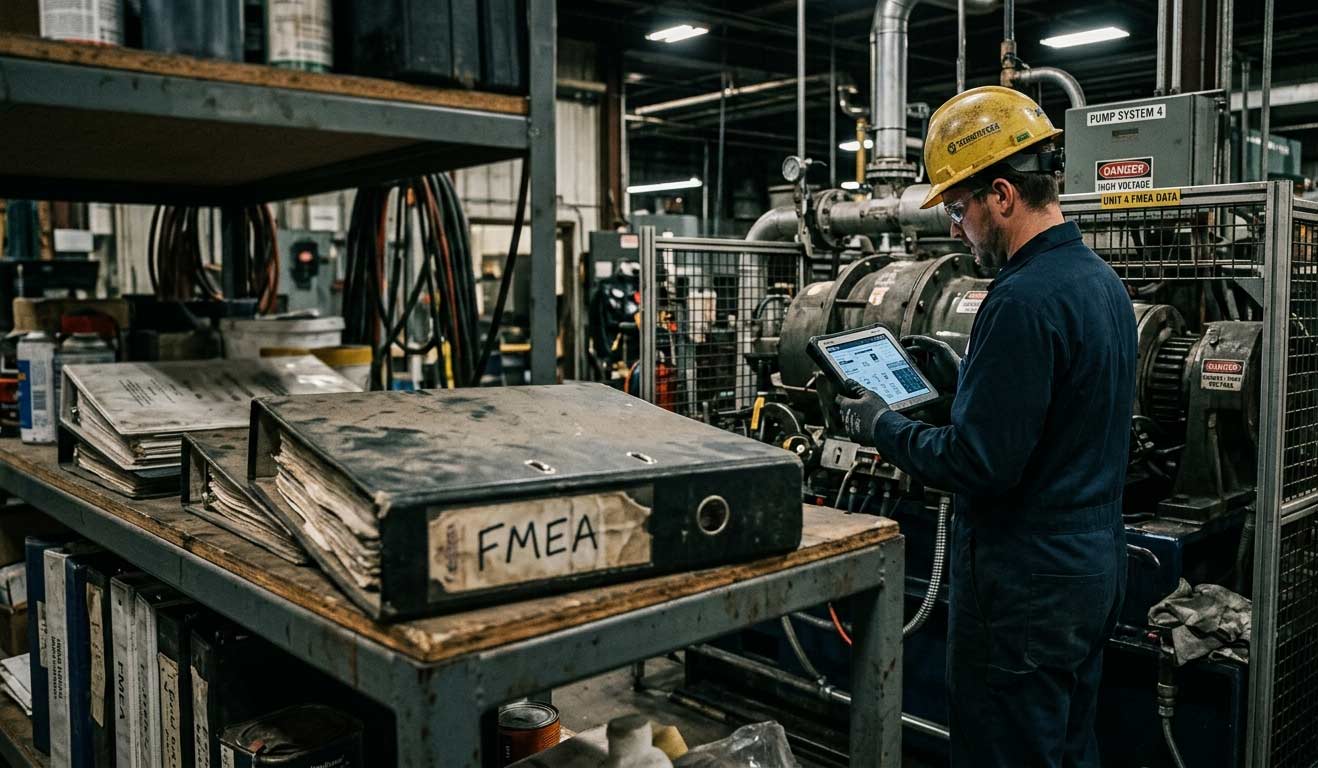
Why Your FMEA Is Sitting in a Binder (And What It Should Be Doing Instead)
Most facilities have an FMEA — but it’s collecting dust in a binder instead of driving decisions on the floor. Here’s how to turn your risk analysis into a living tool that actually protects uptime.

2026-04-24
CMMS Features and Functionality: What to Look for in a Maintenance Management System
Not all CMMS (Computerized Maintenance Management System) platforms are built the same, and in industries like quarrying, aggregates, cement, and ready-mix concrete, there are certain capabilities that carry more weight than others. The CMMS features that matter most for maintenance teams in asset-intensive industries include things such as centralized asset data, work order automation, preventive and predictive scheduling, digital checklists, deviation management, fleet optimization, and mobile-first design with offline capability.

2026-04-24
Cement Plant Inspection Checklist: What to Check, When to Check It, and Why It Fails
Most unplanned shutdowns in a cement plant don’t come out of nowhere. There’s usually a trail beforehand. Maybe a kiln bearing that’s been running 15 degrees above baseline for three weeks, noted by the operator on shift but never formally flagged because it hadn’t tripped an alarm yet. The issue isn’t a lack of warning, its that small deviations are often tolerated until they tip over into something serious.

2026-04-01
How to Choose the Right Work Order App for Your Industry
When something breaks on site, the fix gets most of the attention, but it’s rarely where things go wrong. What’s just as critical is everything around it: who reported it, who picked it up, what got missed between shifts, and how long it sat before anyone acted. In many operations, that whole flow is still held together by paper forms, radio calls, and memory.


