

Author
Linn Björklund
Published: 2023-10-27
Last updated: 2025-04-25
To keep your frontline workers safe – and prove HSE / EHS compliance to external auditors – you need quick access to all required documentation for hazardous tasks. Find out how switching to digital processes will help you save time and improve traceability across your heavy industry sites.
Kyle Hunter-Marsden, Customer Success Manager at CheckProof, has several years of experience in the aggregates industry. He’s well aware of the importance of HSE documentation and compliance:
– Health and safety regulations keep getting stricter, and rightfully so. Heavy industry workplaces are risky environments. Correct procedures for maintenance and HSE are literally a matter of life and death.
When the paperwork takes more time than the actual task
From permits-to-work and pre-work assessments to isolation procedures and COSHH (Control Of Substances Hazardous to Health) – the number of HSEQ documents required to perform certain tasks can be extensive:
– For sites and quarries still using pen-and-paper, the process is extremely time-consuming. There’s typically only one copy of the required documents. Everyone on the team has to take turns to read and sign the papers before they can get to work. Without exaggerating, a task that takes fifteen minutes to complete can require two hours of paperwork before you’re able to start working on it.
Even if you do the paperwork perfectly – can you prove it in hindsight in case of an audit or incident?
– If you rely on finding a specific piece of paper sitting in a binder somewhere to show that you’ve done everything by the book, an unannounced inspection can be pretty stressful, says Kyle.
Accurate documentation the minute you need it
It’s no wonder more and more companies are switching from analog processes to digital routines, reporting, and documentation. With today’s mobile technology, you can give frontline operators access to critical information on a device that fits in their pockets. And instead of chasing down managers and contractors to sign a physical document, they can confirm directly through the app.
Not only does this free up valuable time. It also improves traceability since you’ll always have immediate access to accurate data – logged in real-time.
Kyle recollects the first environmental audit after a digital system had been implemented at his previous job in an aggregates company:
– The auditor asked to see our dust emissions inspections for the last twelve months. With our old analog process, that would’ve taken a lot of effort to produce. But now, I could just log on to the platform, enter the dates, and export the entire report within minutes. Every inspection from our frontline operators was right there, time and date-stamped. The auditor thought it was brilliant.
How mobile apps connect frontline and management
In his current role, Kyle helps heavy industry businesses get started with their CheckProof platform and customize it to fit the HSEQ and maintenance routines for each site and machine. As the customers get more familiar with the different features, they’ll often come up with new ways to use them. And simultaneously, CheckProof’s developers keep adding new features to address customers’ needs.
For example, companies can link their CheckProof app to other sources of information. This is especially valuable from a ‘deskless worker’ perspective, according to Kyle:
– The average frontline operator doesn’t have access to a work email address or a company portal where they can find HR-related information or do simple things like fill out a holiday request form. Instead, they need to go through their manager, which is very inefficient.
By providing staff with a mobile-first platform, companies make vital documentation more accessible to frontline employees and create a channel for two-way communication between frontline and management. In this way, no critical deviation falls through the cracks:
– Suppose an operator reports a deviation on Monday, but it doesn’t get picked up by a site manager until Friday, because that’s when they hand in the check sheet. An issue that could have been fixed directly at a low cost will instead end up causing a major breakdown and thousands of dollars worth of damages. With a tool like CheckProof, the report reaches the manager the instant a frontline operator submits it on their device, Kyle concludes.
—
Want to learn more about how to use digital tools to keep staff safe and ensure HSE compliance? Download our helpful guide today!
Author

Want to know what CheckProof can do for you?
CheckProof's easy-to-use app makes it easier to do the right thing at the right time. Discover how you can run world-class maintenance that is both cost-effective and sustainable.
Book a demo
2026-09-29
The AggNexus 2026 Report: Highlights from the Digital Innovation Conference
AggNexus 2026 in Austin was the biggest edition yet. After a year of AI first steps, the focus shifted to how to get people to change. Here are CheckProof’s key takeaways on change management, fast-moving AI, compliance and passing on know-how.

2026-09-24
A Stronger Foundation: Rohrdorfer on Digitizing Safety and Efficiency
Rohrdorfer, a leading construction materials producer in five countries, has used CheckProof for years to streamline safety, maintenance and quality work and to sharpen its customer focus.

2026-07-10
10 Must-Have Features for an Incident Management Platform in the Heavy Industry
When an incident happens, every minute matters. A near miss, equipment damage, or a hydraulic leak can quickly become a bigger risk if the issue is not reported, investigated, and followed up properly. When an incident happens, every minute matters. A near miss that goes unreported, or a fault that isn’t followed up, can quickly become a bigger risk if the issue is not reported.

2026-07-09
The Benefits of a Quarry Crusher Management Software
Paper forms, scattered systems, and knowledge locked in one person’s head all delay the same thing: catching crusher problems before they become breakdowns. This piece covers the four biggest challenges in crusher operations and how CheckProof brings inspections, maintenance, and issue tracking into one place.

2026-07-06
Hillhead 2026 – The CheckProof Report
Hillhead 2026 broke every record with 627 exhibitors and three days packed with electric machinery, connected intelligence, and sustainable innovation. CheckProof was on the ground as an exhibitor and sponsor — here’s what our team took away from the show floor.

2026-06-12
Brice Aggregates: What Operational Excellence Looks Like at a Needingworth Quarry
The inaugural CheckProof Industry Excellence Award winners on going digital from the ground up, and the moment their frontline teams bought in.
2026-05-07
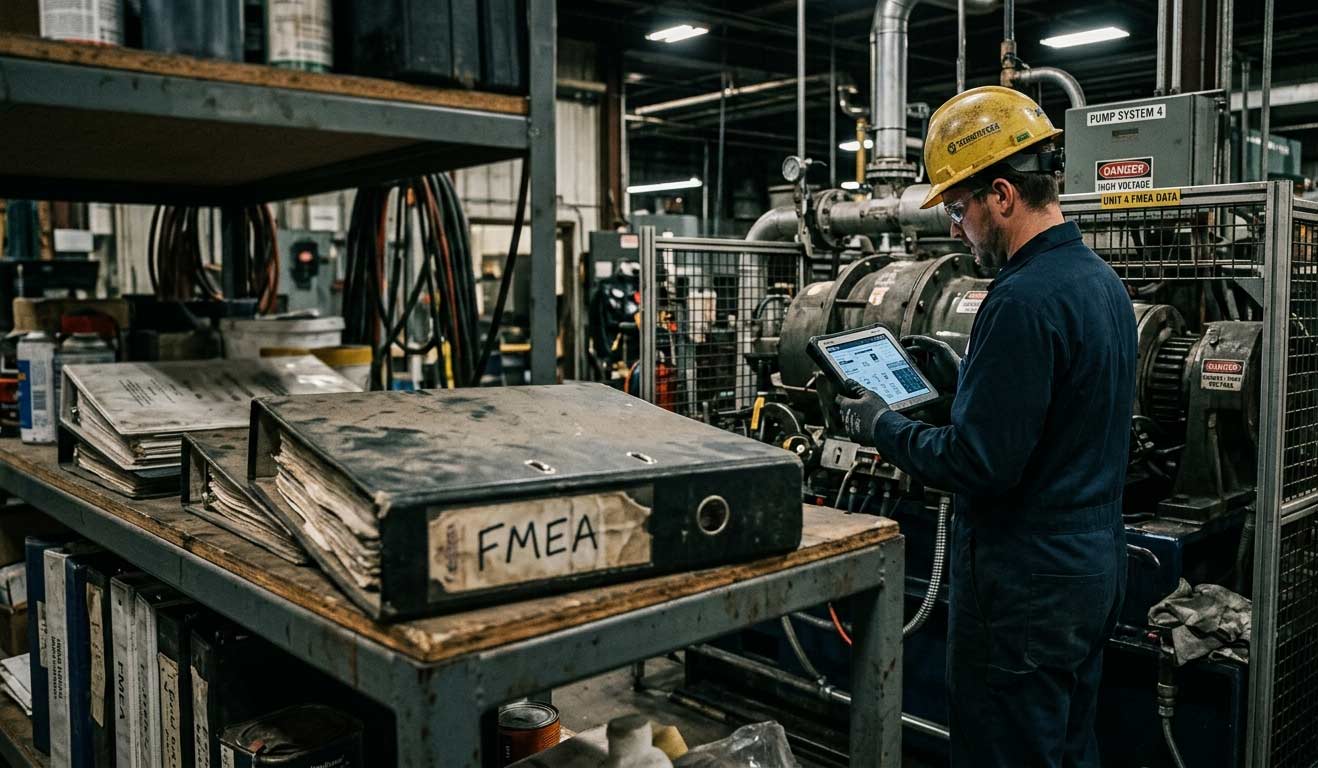
Why Your FMEA Is Sitting in a Binder (And What It Should Be Doing Instead)
Most facilities have an FMEA — but it’s collecting dust in a binder instead of driving decisions on the floor. Here’s how to turn your risk analysis into a living tool that actually protects uptime.

2026-04-24
CMMS Features and Functionality: What to Look for in a Maintenance Management System
Not all CMMS (Computerized Maintenance Management System) platforms are built the same, and in industries like quarrying, aggregates, cement, and ready-mix concrete, there are certain capabilities that carry more weight than others. The CMMS features that matter most for maintenance teams in asset-intensive industries include things such as centralized asset data, work order automation, preventive and predictive scheduling, digital checklists, deviation management, fleet optimization, and mobile-first design with offline capability.

2026-04-24
Cement Plant Inspection Checklist: What to Check, When to Check It, and Why It Fails
Most unplanned shutdowns in a cement plant don’t come out of nowhere. There’s usually a trail beforehand. Maybe a kiln bearing that’s been running 15 degrees above baseline for three weeks, noted by the operator on shift but never formally flagged because it hadn’t tripped an alarm yet. The issue isn’t a lack of warning, its that small deviations are often tolerated until they tip over into something serious.

2026-04-01
How to Choose the Right Work Order App for Your Industry
When something breaks on site, the fix gets most of the attention, but it’s rarely where things go wrong. What’s just as critical is everything around it: who reported it, who picked it up, what got missed between shifts, and how long it sat before anyone acted. In many operations, that whole flow is still held together by paper forms, radio calls, and memory.


