
Author
Anju Khanna Saggi
Content & Media Relations
Published: 2025-11-27
Last updated: 2025-12-05
Routine maintenance doesn’t fail because of a lack of effort - it fails when priorities compete. Even the best-laid plans can be interrupted by production demands, unexpected repairs, or shifting schedules. A shift might begin with maintenance tasks lined up, but as issues arise - a screen plugs, a haul truck signals a warning, or an air compressor needs attention - those small but essential checks can easily be delayed. What was meant to be a quick round of greasing or a ten-minute walkaround often ends up postponed until the next convenient downtime.
This is the quiet cost that most plants live with every day, not any dramatic failures, just a steady grind of preventable issues stacking up because routine maintenance never becomes a consistent rhythm. In this article we’ll go over where and why routine maintenance breaks down, and how to make sure it doesn’t:
Contact a Maintenance Specialist
Where and Why Routine Maintenance Breaks Down
Routine maintenance fails more often due to a lack of structure, with no sort of system holding it together. The crew often knows the machines better than any manual, so their practical know-how is rarely an issue. Instead, the problem is keeping that knowledge consistent when shifts flip, production surges, or you’re running with a thin maintenance team.
Without a clear rhythm, the small checks that keep equipment healthy get buried under everything else that demands attention. Here’s where things usually fall apart:
- Notes disappear or never get shared. Information gets stuck on a scrap of paper, a text message, or someone’s memory.
- Minor issues slide because production can’t stop. A small leak or noise gets pushed off until “things slow down,” which, let’s be real, they rarely do.
- Shift handovers are rushed. One crew sees a problem that the next never hears about.
- Preventive maintenance tasks drift without visibility. Whiteboards smudge, spreadsheets get outdated, and no one’s fully sure what’s been done.
- Small oversights snowball into real failures. A dry bearing, a loose bolt, a wandering belt - each one grows quietly until it becomes downtime.
- Crews fall into reactive mode. Instead of staying ahead, they spend their time chasing breakdowns that started as preventable misses.
Maintenance Schedule and Checklist - Your First Steps to Better Uptime
Does a maintenance schedule and checklist solve all your problems? No, of course not. However, they are a big first important step in the right direction. Most crews don’t need any more meetings or bigger binders (who does?) - they need a routine that holds up even on the busiest day, every day.
A good, clearly defined maintenance schedule with a simple checklist does that. Not the kind that lives in a drawer or gets printed once a year, but one that becomes part of the shift. When the steps are clear, short, and tied to the actual machines on site, the crew builds a rhythm, where the threshold of actually completing the routine maintenance checkup is lowered significantly.
A solid maintenance schedule and checklist cuts through chaos because they do three things well:
- It sets the minimum standard. Everyone knows the basic checks for each shift, each week, and each service interval.
- It keeps small problems visible. Instead of hoping someone remembers, issues get logged the moment they’re spotted.
- It creates consistency across crews. No matter who’s on shift, the same steps get done the same way.
Combine with Routine Maintenance Software for Success
Routine maintenance software gives your schedules and checklists staying power. It keeps the day-to-day work visible for everyone, even when the crew is stretched thin or running hard to stay ahead of production. Issues don’t vanish between shifts. PMs don’t drift because someone missed a note. And every inspection, photo, and comment builds a clear record that follows the equipment, not the person who happened to spot the problem.
The biggest advantage is reliability. A routine maintenance software handles the realities of pits and plants: poor signal, mixed device use, and crews that need something fast, not fancy. It turns every quick walkaround and every minor fix into shared knowledge the whole team can act on.
FAQ
Want to know what CheckProof can do for you?
CheckProof's easy-to-use app makes it easier to do the right thing at the right time. Discover how you can run world-class maintenance that is both cost-effective and sustainable.
Book a demo

2026-09-29
The AggNexus 2026 Report: Highlights from the Digital Innovation Conference
AggNexus 2026 in Austin was the biggest edition yet. After a year of AI first steps, the focus shifted to how to get people to change. Here are CheckProof’s key takeaways on change management, fast-moving AI, compliance and passing on know-how.

2026-09-24
Stärkere Basis: Rohrdorfer verbessert durch Digitalisierung Sicherheit und Effizienz
Rohrdorfer, ein führendes Baustoffunternehmen in fünf Ländern, nutzt CheckProof seit Jahren für Sicherheit, Wartung und Qualität. Das stärkt den eigenen Betrieb und die Kundenorientierung.

2026-07-10
10 Must-Have Features for an Incident Management Platform in the Heavy Industry
When an incident happens, every minute matters. A near miss, equipment damage, or a hydraulic leak can quickly become a bigger risk if the issue is not reported, investigated, and followed up properly. When an incident happens, every minute matters. A near miss that goes unreported, or a fault that isn’t followed up, can quickly become a bigger risk if the issue is not reported.

2026-07-09
The Benefits of a Quarry Crusher Management Software
Paper forms, scattered systems, and knowledge locked in one person’s head all delay the same thing: catching crusher problems before they become breakdowns. This piece covers the four biggest challenges in crusher operations and how CheckProof brings inspections, maintenance, and issue tracking into one place.

2026-07-06
Hillhead 2026 – The CheckProof Report
Hillhead 2026 broke every record with 627 exhibitors and three days packed with electric machinery, connected intelligence, and sustainable innovation. CheckProof was on the ground as an exhibitor and sponsor — here’s what our team took away from the show floor.

2026-06-12
Brice Aggregates: What Operational Excellence Looks Like at a Needingworth Quarry
The inaugural CheckProof Industry Excellence Award winners on going digital from the ground up, and the moment their frontline teams bought in.
2026-05-07
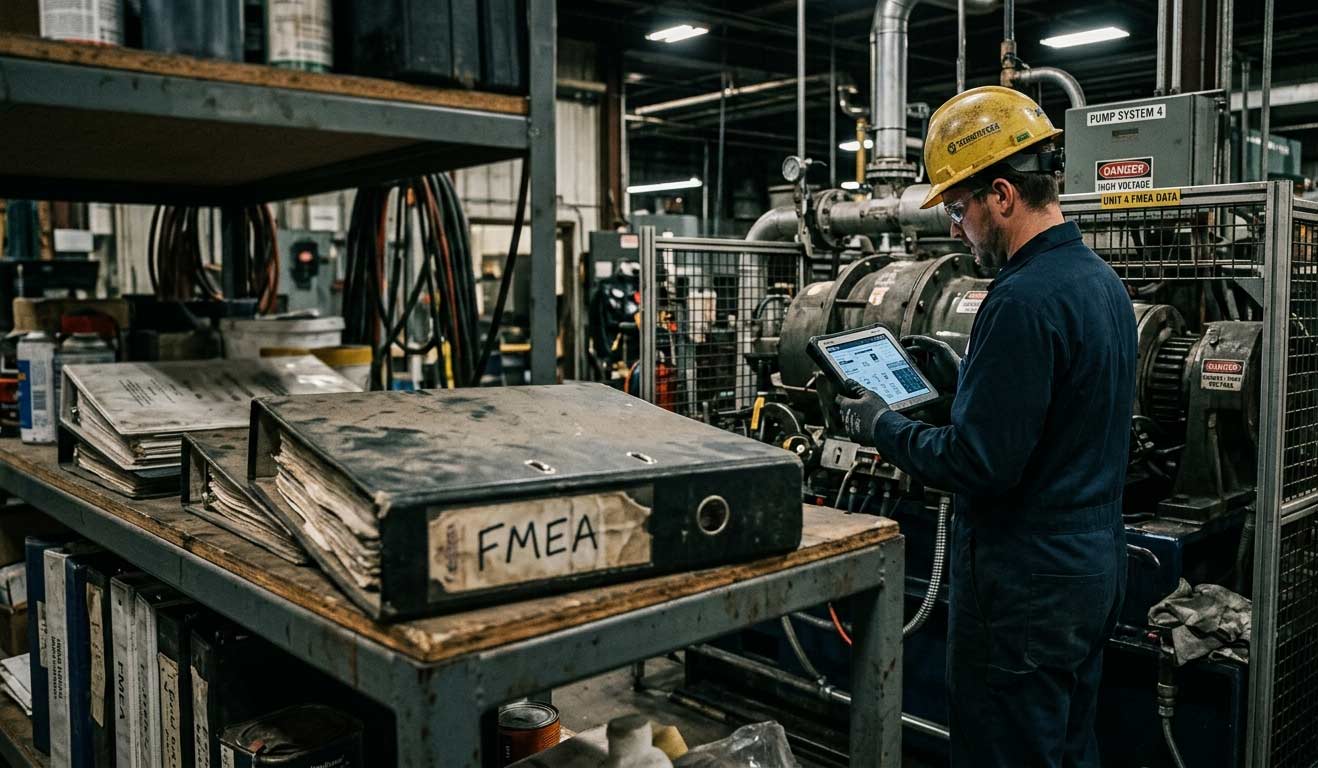
Why Your FMEA Is Sitting in a Binder (And What It Should Be Doing Instead)
Most facilities have an FMEA — but it’s collecting dust in a binder instead of driving decisions on the floor. Here’s how to turn your risk analysis into a living tool that actually protects uptime.

2026-04-24
CMMS Features and Functionality: What to Look for in a Maintenance Management System
Not all CMMS (Computerized Maintenance Management System) platforms are built the same, and in industries like quarrying, aggregates, cement, and ready-mix concrete, there are certain capabilities that carry more weight than others. The CMMS features that matter most for maintenance teams in asset-intensive industries include things such as centralized asset data, work order automation, preventive and predictive scheduling, digital checklists, deviation management, fleet optimization, and mobile-first design with offline capability.

2026-04-24
Cement Plant Inspection Checklist: What to Check, When to Check It, and Why It Fails
Most unplanned shutdowns in a cement plant don’t come out of nowhere. There’s usually a trail beforehand. Maybe a kiln bearing that’s been running 15 degrees above baseline for three weeks, noted by the operator on shift but never formally flagged because it hadn’t tripped an alarm yet. The issue isn’t a lack of warning, its that small deviations are often tolerated until they tip over into something serious.

2026-04-01
How to Choose the Right Work Order App for Your Industry
When something breaks on site, the fix gets most of the attention, but it’s rarely where things go wrong. What’s just as critical is everything around it: who reported it, who picked it up, what got missed between shifts, and how long it sat before anyone acted. In many operations, that whole flow is still held together by paper forms, radio calls, and memory.