
Routine maintenance doesn’t fail because of a lack of effort - it fails when priorities compete. Even the best-laid plans can be interrupted by production demands, unexpected repairs, or shifting schedules. A shift might begin with maintenance tasks lined up, but as issues arise - a screen plugs, a haul truck signals a warning, or an air compressor needs attention - those small but essential checks can easily be delayed. What was meant to be a quick round of greasing or a ten-minute walkaround often ends up postponed until the next convenient downtime.
This is the quiet cost that most plants live with every day, not any dramatic failures, just a steady grind of preventable issues stacking up because routine maintenance never becomes a consistent rhythm. In this article we’ll go over where and why routine maintenance breaks down, and how to make sure it doesn’t:
Contact a Maintenance Specialist
Where and Why Routine Maintenance Breaks Down
Routine maintenance fails more often due to a lack of structure, with no sort of system holding it together. The crew often knows the machines better than any manual, so their practical know-how is rarely an issue. Instead, the problem is keeping that knowledge consistent when shifts flip, production surges, or you’re running with a thin maintenance team.
Without a clear rhythm, the small checks that keep equipment healthy get buried under everything else that demands attention. Here’s where things usually fall apart:
- Notes disappear or never get shared. Information gets stuck on a scrap of paper, a text message, or someone’s memory.
- Minor issues slide because production can’t stop. A small leak or noise gets pushed off until “things slow down,” which, let’s be real, they rarely do.
- Shift handovers are rushed. One crew sees a problem that the next never hears about.
- Preventive maintenance tasks drift without visibility. Whiteboards smudge, spreadsheets get outdated, and no one’s fully sure what’s been done.
- Small oversights snowball into real failures. A dry bearing, a loose bolt, a wandering belt - each one grows quietly until it becomes downtime.
- Crews fall into reactive mode. Instead of staying ahead, they spend their time chasing breakdowns that started as preventable misses.
Maintenance Schedule and Checklist - Your First Steps to Better Uptime
Does a maintenance schedule and checklist solve all your problems? No, of course not. However, they are a big first important step in the right direction. Most crews don’t need any more meetings or bigger binders (who does?) - they need a routine that holds up even on the busiest day, every day.
A good, clearly defined maintenance schedule with a simple checklist does that. Not the kind that lives in a drawer or gets printed once a year, but one that becomes part of the shift. When the steps are clear, short, and tied to the actual machines on site, the crew builds a rhythm, where the threshold of actually completing the routine maintenance checkup is lowered significantly.
A solid maintenance schedule and checklist cuts through chaos because they do three things well:
- It sets the minimum standard. Everyone knows the basic checks for each shift, each week, and each service interval.
- It keeps small problems visible. Instead of hoping someone remembers, issues get logged the moment they’re spotted.
- It creates consistency across crews. No matter who’s on shift, the same steps get done the same way.
Combine with Routine Maintenance Software for Success
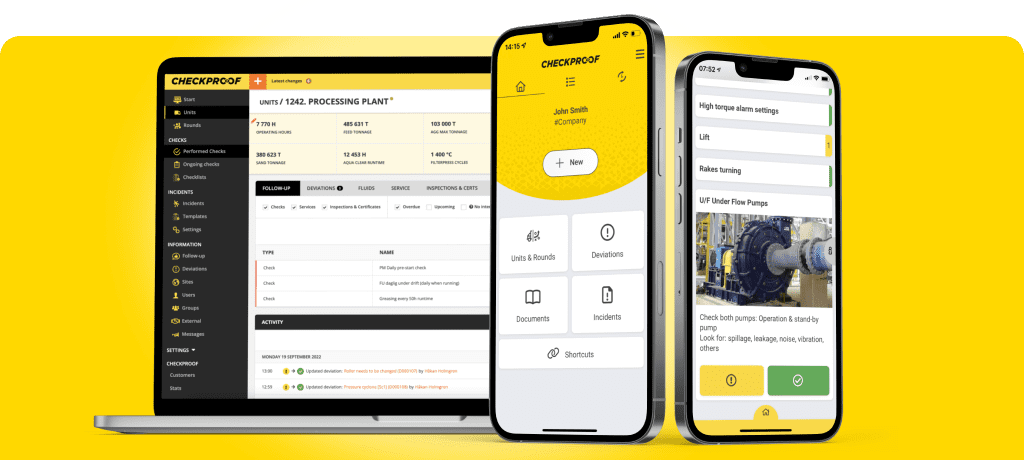
Routine maintenance software gives your schedules and checklists staying power. It keeps the day-to-day work visible for everyone, even when the crew is stretched thin or running hard to stay ahead of production. Issues don’t vanish between shifts. PMs don’t drift because someone missed a note. And every inspection, photo, and comment builds a clear record that follows the equipment, not the person who happened to spot the problem.
The biggest advantage is reliability. A routine maintenance software handles the realities of pits and plants: poor signal, mixed device use, and crews that need something fast, not fancy. It turns every quick walkaround and every minor fix into shared knowledge the whole team can act on.
FAQ
Want to know what CheckProof can do for you?
CheckProof's easy-to-use app makes it easier to do the right thing at the right time. Discover how you can run world-class maintenance that is both cost-effective and sustainable.
Book a demo

2026-04-24
CMMS Features and Functionality: What to Look for in a Maintenance Management System
Not all CMMS (Computerized Maintenance Management System) platforms are built the same, and in industries like quarrying, aggregates, cement, and ready-mix concrete, there are certain capabilities that carry more weight than others. The CMMS features that matter most for maintenance teams in asset-intensive industries include things such as centralized asset data, work order automation, preventive and predictive scheduling, digital checklists, deviation management, fleet optimization, and mobile-first design with offline capability.

2026-04-24
Cement Plant Inspection Checklist: What to Check, When to Check It, and Why It Fails
Most unplanned shutdowns in a cement plant don’t come out of nowhere. There’s usually a trail beforehand. Maybe a kiln bearing that’s been running 15 degrees above baseline for three weeks, noted by the operator on shift but never formally flagged because it hadn’t tripped an alarm yet. The issue isn’t a lack of warning, its that small deviations are often tolerated until they tip over into something serious.

2026-04-01
How to Choose the Right Work Order App for Your Industry
When something breaks on site, the fix gets most of the attention, but it’s rarely where things go wrong. What’s just as critical is everything around it: who reported it, who picked it up, what got missed between shifts, and how long it sat before anyone acted. In many operations, that whole flow is still held together by paper forms, radio calls, and memory.

2026-04-01
Best Practices for Work Order Management
Efficient maintenance starts with clear work orders. When issues are logged quickly with the right details, photos, and priority, teams spend less time chasing information and more time fixing problems. The result is reduced downtime, smoother shift handovers, and audit-ready operations — even in low-signal or harsh environments where mobile work orders let crews flag issues before they escalate.

2026-03-26
How DAY Group went paperless and transformed maintenance operations with CheckProof
DAY Group Ltd is an independent, family-owned business supplying construction materials and services across the south of England since 1947. Handling over five million tonnes of material annually across divisions including Day Aggregates, Day Glass Recycling, Day Contracting, and Day Equestrian — plus recycling operations processing over 1.5 million tonnes a year — the group operates with close to 200 staff and a large fleet of plant equipment, making uptime, compliance and safety mission-critical.

2026-03-17
CONEXPO-CON/AGG 2026 – CheckProof’s Industry Report
CONEXPO-CON/AGG 2026 highlighted an industry laser-focused on execution: demand is strong, but labor, schedules, and downtime risk remain tight. The goal is clear — repeatable performance, early risk visibility, and simpler tech adoption. This report covers the key signals from the show and what they mean for the next era of construction materials.

2026-02-20
Gebr. Arweiler: Transforming Multi-Site Maintenance with one Digital System
Gebr. Arweiler, a family-owned company with multiple locations across Saarland and France, has long been known for combining tradition with forward-looking action. With eight plants, a fleet of 26 trucks – including 5 electric vehicles – and a strong commitment to sustainability, the company needed a digital solution to optimize maintenance, asset management, and compliance.

2026-02-12
Predictive Maintenance vs Condition-Based Maintenance
Walk any quarry, plant, or yard and you’ll see the same thing: assets and equipment emitting tell-tale signs of its condition, long before it actually fails. Operators note “sounds off” on a pre-shift, but the note gets buried in a binder or a spreadsheet. The gap between seeing a problem and acting on it at the right time is often where maintenance strategies break down.

2026-02-06
Fault Tree Analysis 101 – A Comprehensive Guide
Equipment rarely fails for a single reason. Fault Tree Analysis (FTA) helps teams work backwards from a breakdown, separate symptoms from causes, and identify what needs to change to prevent repeat failures.

2026-01-30
Holcim’s Torr Works Super Quarry – a Customer Success Story
On a quarry as large and complex as Holcim’s Torr Works, staying on top of daily work is a constant challenge. When information is scattered across paper, radios, and emails, even small issues can take too long to act on. This customer story looks at how Torr Works brought everything into one connected system with CheckProof – and what happened when visibility and ownership became part of everyday site work.