
Author
Anju Khanna Saggi
Content & Media Relations
Published: 2024-04-11
Last updated: 2026-09-27
In the construction materials industry (or for that matter, any other) effective Quality Control (QC) routines are business critical. Adopting digital quality controls can be a true game-changer in maintaining product standards, meeting customer expectations, and ultimately, ensuring business success.
Key takeaways
- Quality control catches defects and process changes before substandard products reach the customer.
- Quality assurance builds the system, while quality control checks whether the finished output meets its standards.
- Manual quality checks can work, but paperwork and reliance on individual knowledge make results harder to track.
- Digital quality control records results where the work happens, flags deviations faster and reveals patterns over time.
- A successful digital process starts with clear standards and tools that fit how frontline teams work.
The role of Quality Control
The Oxford dictionary defines Quality Control (QC) as ‘the use of sampling, inspection, and testing methods at all levels of system production to produce defect-free hardware and software.’ In the construction materials industry, this typically means using a set oThe role of Quality Control
The Oxford dictionary defines Quality Control (QC) as ‘the use of sampling, inspection, and testing methods at all levels of system production to produce defect-free hardware and software.’ In the construction materials industry, this typically means using a set of controls (including statistical significance) to test units to ensure the final output meets required product standards. There is often a dedicated Quality team or manager that works with Quality Assurance and ensures compliance and quality standards are met.
The difference between Quality Control and Quality Assurance
Quality assurance (QA) and quality control (QC) are frequently conflated terms, yet they bear distinct differences. The ASQE trade organization describes “QA as the activities which cover all of the quality system, whilst QC is a subset of the QA activities.”
Quality Assurance (QA) sets the bigger picture within quality management, to ensure a product or service meets both internal and external requirements (and indeed defining the bar that needs to be met). Internally to ensure regulatory quality requirements are met and externally to ensure that no substandard product or service is passed on to a customer or end user.
Quality Control (QC) is a crucial component of quality management, the actual execution of the pre-defined processes within QA. It’s the practical checks and controls used to ensure quality standards are met.
Different QC types – Manual vs Digital Quality Control
Quality control methods can vary depending on the industry and the nature of the products or services being provided. Here are two primary types of QC:
Manual QC:
Traditionally, manual quality control involves human inspection and oversight at various stages of production or service delivery. Skilled workers meticulously examine products or processes, checking for defects, inconsistencies, or deviations from predefined standards. While manual QC can be effective, it’s time-consuming, labor-intensive, and prone to human error. It also puts pressure on a select group of workers who are relied upon to do certain controls, leaving the business vulnerable if that knowledge isn’t transferred across teams.
Digital QC:
Digital quality control has emerged as a more efficient and reliable alternative to manual methods. Digital QC utilizes automated systems, sensors, and data analytics to monitor and assess quality throughout the production or service lifecycle. These systems can detect defects with greater accuracy, provide real-time insights, and facilitate proactive decision-making.
Benefits of a Digital Quality Control System
The shift towards digital quality control, and using a system such as CheckProof’s platform to perform digital quality controls offers numerous advantages for businesses operating within the construction materials and heavy industry, including:
- Consistency you can rely on. Frontline teams follow the same step-by-step checklist every time, filling in required fields and adding photo documentation as they go. That means inspection results don’t depend on who happens to be doing the check that day.
- Faster, simpler inspections. Digital checklists and mobile documentation cut the time spent on manual paperwork, so quality checks fit into the workday instead of competing with it.
- Cost savings. Complete traceability, from sample results to complaint resolution, means less time spent tracking down what happened and more time acting on it, which lowers the cost of rework, warranty claims, and compliance gaps.
- Real-time visibility into deviations. As inspections are logged, quality issues surface immediately rather than being discovered downstream, so teams can act while a fix is still simple.
- Data you will use. Filter, categorize, and search inspection data to spot recurring deviations and root causes, turning quality control from a reactive checklist into a driver of continuous improvement.
Quality control is indispensable for maintaining high standards, meeting customer expectations, and sustaining competitiveness. By leveraging technology to enhance quality assurance processes, organizations can unlock new opportunities for growth and success.
How to build a Digital Quality Control system in 4 simple steps
A complicated quality control process that’s done manually puts valuable data at high risk. So, if you’re contemplating implementing a digital quality control process, to increase accuracy and minimize quality breaches, follow our 4-step plan below to set up an effective digital
1. Set your standards
Ask yourself: Why are we doing quality controls? Is it to meet the quality standards of an official regulatory outside your company or to improve your own operations? The first step is to determine the correct quality attributes and streamline the process accordingly.
A digital quality control system must also be user-friendly, otherwise you’ll be setting up to fail. If it disregards the operator’s perspective, they might not use it. Therefore, make sure you know what checks need to be done and create routines adjusted to fit both Management and Frontline.
2. Determine the on-site requirements
Consider all angles and perspectives (from frontline workers to office management) What functionalities are critical to your quality control? When your operators do their checks on-site, make sure they have the right equipment. Tablets and phones have overtaken the desktop as it allows end-users to document and send their findings through an app (that can then be picked up instantly from office management). A desktop user would have to retroactively log and import their data to the database.
In addition, make sure you determine if there’s a need for an offline mode. In remote quarry environments, for example, access to the internet can sometimes be limited. For this reason, make sure your software supports an offline mode that syncs when there’s an internet connection again.
3. Integrate and extract the right data
Determine what you are going to do with the data you receive from your quality controls. Do you want to track the basic status and usage, or does your business need specific analysis and external APIs? Most software allows your check data to be transferred into a digital structure with automatic updates in real-time. Combine these with reported deviations to get full coverage on issues.
4. Eye on the prize – Keep focusing on the benefits
Keep in mind the long-term benefits of doing digital quality checks. A digital process will minimize downtime, keep your data clean and optimize your operational time. Cost is a relevant factor but remember to focus on the dollar – not the cent.
Do you want more examples of how digitizing your workflow can optimize your routines and minimize downtime? Download your free copy of the guide 9 keys to maximise the availability of your assets through frontline digitisation.
Author
Want to know what CheckProof can do for you?
CheckProof's easy-to-use app makes it easier to do the right thing at the right time. Discover how you can run world-class maintenance that is both cost-effective and sustainable.
Book a demo

2026-09-29
The AggNexus 2026 Report: Highlights from the Digital Innovation Conference
AggNexus 2026 in Austin was the biggest edition yet. After a year of AI first steps, the focus shifted to how to get people to change. Here are CheckProof’s key takeaways on change management, fast-moving AI, compliance and passing on know-how.

2026-09-24
Stärkere Basis: Rohrdorfer verbessert durch Digitalisierung Sicherheit und Effizienz
Rohrdorfer, ein führendes Baustoffunternehmen in fünf Ländern, nutzt CheckProof seit Jahren für Sicherheit, Wartung und Qualität. Das stärkt den eigenen Betrieb und die Kundenorientierung.

2026-07-10
10 Must-Have Features for an Incident Management Platform in the Heavy Industry
When an incident happens, every minute matters. A near miss, equipment damage, or a hydraulic leak can quickly become a bigger risk if the issue is not reported, investigated, and followed up properly. When an incident happens, every minute matters. A near miss that goes unreported, or a fault that isn’t followed up, can quickly become a bigger risk if the issue is not reported.

2026-07-09
The Benefits of a Quarry Crusher Management Software
Paper forms, scattered systems, and knowledge locked in one person’s head all delay the same thing: catching crusher problems before they become breakdowns. This piece covers the four biggest challenges in crusher operations and how CheckProof brings inspections, maintenance, and issue tracking into one place.

2026-07-06
Hillhead 2026 – The CheckProof Report
Hillhead 2026 broke every record with 627 exhibitors and three days packed with electric machinery, connected intelligence, and sustainable innovation. CheckProof was on the ground as an exhibitor and sponsor — here’s what our team took away from the show floor.

2026-06-12
Brice Aggregates: What Operational Excellence Looks Like at a Needingworth Quarry
The inaugural CheckProof Industry Excellence Award winners on going digital from the ground up, and the moment their frontline teams bought in.
2026-05-07
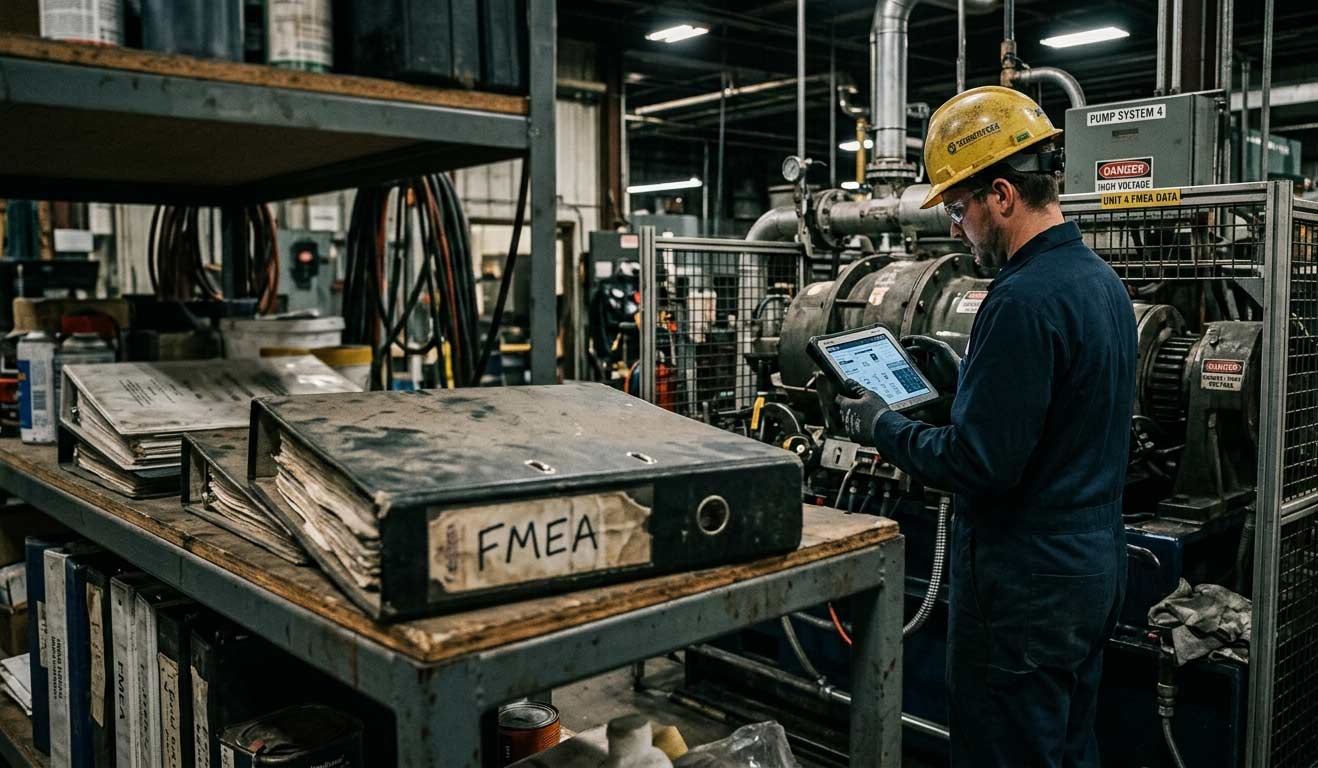
Why Your FMEA Is Sitting in a Binder (And What It Should Be Doing Instead)
Most facilities have an FMEA — but it’s collecting dust in a binder instead of driving decisions on the floor. Here’s how to turn your risk analysis into a living tool that actually protects uptime.

2026-04-24
CMMS Features and Functionality: What to Look for in a Maintenance Management System
Not all CMMS (Computerized Maintenance Management System) platforms are built the same, and in industries like quarrying, aggregates, cement, and ready-mix concrete, there are certain capabilities that carry more weight than others. The CMMS features that matter most for maintenance teams in asset-intensive industries include things such as centralized asset data, work order automation, preventive and predictive scheduling, digital checklists, deviation management, fleet optimization, and mobile-first design with offline capability.

2026-04-24
Cement Plant Inspection Checklist: What to Check, When to Check It, and Why It Fails
Most unplanned shutdowns in a cement plant don’t come out of nowhere. There’s usually a trail beforehand. Maybe a kiln bearing that’s been running 15 degrees above baseline for three weeks, noted by the operator on shift but never formally flagged because it hadn’t tripped an alarm yet. The issue isn’t a lack of warning, its that small deviations are often tolerated until they tip over into something serious.

2026-04-01
How to Choose the Right Work Order App for Your Industry
When something breaks on site, the fix gets most of the attention, but it’s rarely where things go wrong. What’s just as critical is everything around it: who reported it, who picked it up, what got missed between shifts, and how long it sat before anyone acted. In many operations, that whole flow is still held together by paper forms, radio calls, and memory.