
There is an increased awareness and acceleration within the heavy industries on how ‘Routine Maintenance’ workflows should replace traditional reactive maintenance methods for the upkeep of equipment and the wellbeing of personnel. Routine Maintenance when done well can form the backbone of any well-functioning system, whether it’s a piece of machinery, a vehicle, or even a building.
In this article, we’ll dive into why keeping a proactive mindset and integrating routine maintenance into your workflow is key to enhancing safety and increasing asset longevity. We will cover:
- What is Routine Maintenance?
- Real Examples of Routine Maintenance
- Challenges with Traditional Routine Maintenance
- 7 different types of common Routine Maintenance practices
- Create a Routine Maintenance workflow process
- Digitizing Routine Maintenance
What is Routine Maintenance?
Routine maintenance often refers to the planned (and scheduled at timed intervals) upkeep of equipment, machinery, systems, buildings, or infrastructure to ensure they remain in good working condition and operate efficiently. The purpose of routine maintenance is to prevent breakdowns, extend the lifespan of assets, reduce the risk of accidents or failures, and maintain optimal performance.
Real Examples of Routine Maintenance
Examples of routine maintenance span various industries and applications, including:
- HVAC Systems: Regular filter replacement, coil cleaning, and system checks to ensure optimal performance and energy efficiency.
- Fleet Vehicles: Scheduled oil changes, tire rotations, and brake inspections to prevent breakdowns and ensure driver safety.
- Manufacturing Equipment: Lubrication, calibration, and alignment checks to prevent wear and tear, maintain accuracy, and minimize downtime.
- Commercial Buildings: Routine inspections of electrical systems, plumbing, and structural integrity to address potential hazards and ensure occupant safety.
Challenges with Traditional Routine Maintenance
Traditional and out-of-date maintenance methods can often face several challenges, such as:
- Reactive Approach: Plants are often hit with unexpected and highly undesired downtime due to a lack of accounting for routine maintenance planning. The result can often be that equipment breaks down before action is taken. This leads to costly repairs, downtime – and in the worst case, compromised safety for staff.
- Inefficient Scheduling: Traditional methods may rely on fixed schedules rather than the actual condition of your assets. So, if a defect or deviation has gone unnoticed, it may not be until the next scheduled check that the problem is discovered – causing further unnecessary fixes, lengthier involvement from all involved to correct the issue and an overall waste of resources.
- Limited Visibility: Lack of real-time data and insights makes it difficult to anticipate maintenance needs and prioritize tasks effectively and to the appropriate teams.
- Paper-based Documentation & Manuals: Paper-based documentation and lengthy manuals that can only be found in binders in an office cupboard are a recipe for inefficient maintenance workflows. In extension this will lead to errors, missed checks, leading, lack of traceability, and a challenge to keep plants and assets compliant.
- Resource Allocation: This is true for both Reactive Maintenance as well as Planned Routine Maintenance. There is certainly an upfront investment in terms of staff time and cost when you put scheduled routines in place. This can create resistance to implementation. However, anyone who has experienced lengthier machinery downtime, or accidents at their plant, likely recognizes this will incur a far greater cost in the long run, whilst also causing unplanned staff scheduling issues.
7 different types of common Routine Maintenance practices
- Failure Finding Maintenance: As the name suggests, this is a proactive approach to identify potential failures before they even occur through regular inspections and tests, minimizing unexpected downtime.
- Condition-Based Maintenance: Real-time monitoring of equipment condition using sensors and data analysis, enabling informed decisions and optimized maintenance schedules.
- Predictive Maintenance: Anticipating equipment failures through advanced analytics and predictive modeling, maximizing asset reliability while minimizing downtime and costs.
- Corrective Maintenance: Identifying the beginning of an issue, but applying corrective action before it becomes a major issue.
- Emergency Maintenance: Urgent repairs to address critical failures or safety hazards, requiring quick mobilization of resources and personnel. This is the least desirable of all maintenance outcomes.
- Risk-based Maintenance: Prioritizing maintenance activities based on asset criticality and potential failure consequences, optimizing resource allocation and decision-making.
- Routine Maintenance Workflow: Systematic planning, scheduling, execution, and documentation of routine maintenance activities, ensuring consistency, compliance, and efficiency in maintenance operations.
Create a Routine Maintenance Workflow Process
Effective routine maintenance involves a systematic workflow process, but before you start creating one from scratch, consider downloading this guide, which holds insider tips on how leaders in the heavy industry go about creating incredibly efficient processes to run their plants. A Routine Maintenance process will often contain the following elements:
- Inspection: Conduct thorough inspections to assess equipment condition, identify potential issues, earmarking the assets that need routine maintenance.
- Planning: Digitize and download manuals for the chosen assets to understand scheduling needs and the resources you must allocate to keep the workflow running smoothly.
- Scheduling: This can be trickier than you think. As wrote scheduling or overscheduling can lead to carelessness and diminishing returns on the assets. Involving operators in this part is crucial to get a thorough understanding of how often your assets need to be checked.
- Maintenance Execution: Performing necessary maintenance activities, repairs, and replacements according to the schedule that has been implemented.
- Documentation: Recording maintenance data, including work performed, parts replaced, and any observations.
- Analysis: Analyzing maintenance data to identify trends, optimize schedules, and improve processes.
- Continuous Improvement: Implementing feedback loops and making adjustments to enhance efficiency and effectiveness.
- Use CheckProof’s maintenance calculator to calculate cost savings as a direct result of maintenance scheduling.
Digitizing Routine Maintenance with CheckProof
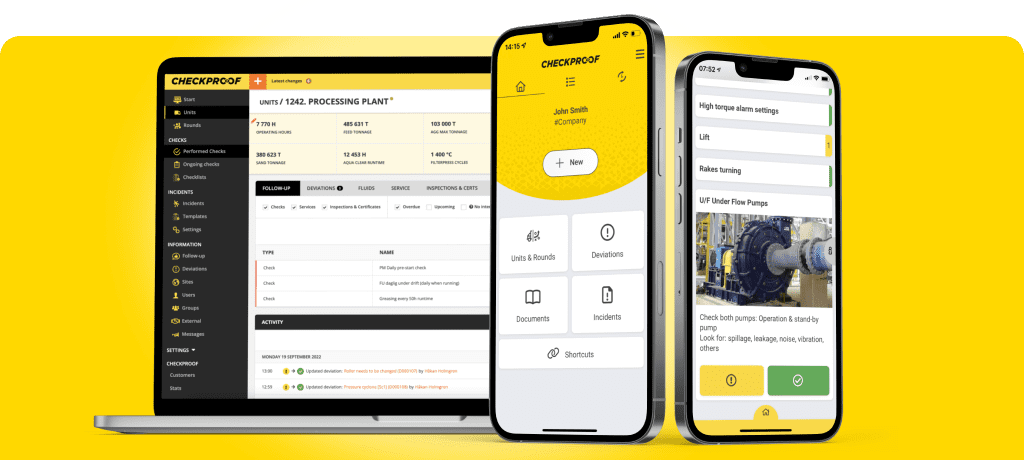
Digitizing routine maintenance practices with one system for everyone across the company has the power to achieve remarkable productivity gains and numerous practical benefits such as:
- Real-time Visibility: Access to up-to-date equipment data and insights from anywhere, anytime.
- Automated Alerts: Proactive notifications for maintenance tasks, upcoming inspections, and potential issues.
- Streamlined Workflows: Simplified scheduling, task assignment, and documentation processes, reducing administrative burden.
- Data-driven Decision Making: Analysis of historical data and predictive analytics to optimize maintenance strategies and resource allocation.
- Enhanced Compliance: Digital records and audit trails for regulatory compliance and accountability.
Routine maintenance is not just a necessity, but a clever strategy for organizations seeking to meet productivity, sustainability, and cost-saving targets. Embracing a digital platform, like CheckProof to create maintenance workflows, enables businesses to stay ahead of the curve, minimize risks and downtime, and unlock new opportunities for growth and innovation.
Want to know what CheckProof can do for you?
CheckProof's easy-to-use app makes it easier to do the right thing at the right time. Discover how you can run world-class maintenance that is both cost-effective and sustainable.
Book a demo

2026-04-24
CMMS Features and Functionality: What to Look for in a Maintenance Management System
Not all CMMS (Computerized Maintenance Management System) platforms are built the same, and in industries like quarrying, aggregates, cement, and ready-mix concrete, there are certain capabilities that carry more weight than others. The CMMS features that matter most for maintenance teams in asset-intensive industries include things such as centralized asset data, work order automation, preventive and predictive scheduling, digital checklists, deviation management, fleet optimization, and mobile-first design with offline capability.

2026-04-24
Cement Plant Inspection Checklist: What to Check, When to Check It, and Why It Fails
Most unplanned shutdowns in a cement plant don’t come out of nowhere. There’s usually a trail beforehand. Maybe a kiln bearing that’s been running 15 degrees above baseline for three weeks, noted by the operator on shift but never formally flagged because it hadn’t tripped an alarm yet. The issue isn’t a lack of warning, its that small deviations are often tolerated until they tip over into something serious.

2026-04-01
How to Choose the Right Work Order App for Your Industry
When something breaks on site, the fix gets most of the attention, but it’s rarely where things go wrong. What’s just as critical is everything around it: who reported it, who picked it up, what got missed between shifts, and how long it sat before anyone acted. In many operations, that whole flow is still held together by paper forms, radio calls, and memory.

2026-04-01
Best Practices for Work Order Management
Efficient maintenance starts with clear work orders. When issues are logged quickly with the right details, photos, and priority, teams spend less time chasing information and more time fixing problems. The result is reduced downtime, smoother shift handovers, and audit-ready operations — even in low-signal or harsh environments where mobile work orders let crews flag issues before they escalate.

2026-03-26
How DAY Group went paperless and transformed maintenance operations with CheckProof
DAY Group Ltd is an independent, family-owned business supplying construction materials and services across the south of England since 1947. Handling over five million tonnes of material annually across divisions including Day Aggregates, Day Glass Recycling, Day Contracting, and Day Equestrian — plus recycling operations processing over 1.5 million tonnes a year — the group operates with close to 200 staff and a large fleet of plant equipment, making uptime, compliance and safety mission-critical.

2026-03-17
CONEXPO-CON/AGG 2026 – CheckProof’s Industry Report
CONEXPO-CON/AGG 2026 highlighted an industry laser-focused on execution: demand is strong, but labor, schedules, and downtime risk remain tight. The goal is clear — repeatable performance, early risk visibility, and simpler tech adoption. This report covers the key signals from the show and what they mean for the next era of construction materials.

2026-02-20
Standortübergreifende Instandhaltung zum Wettbewerbsvorteil machen
Gebr. Arweiler, ein familiengeführtes Unternehmen mit mehreren Standorten im Saarland und Frankreich, ist seit langem dafür bekannt, Tradition mit zukunftsorientiertem Handeln zu verbinden. Mit acht Werken, einer LKW-Flotte von 26 LKW´s – darunter auch 5 Elektrofahrzeuge – und dem Engagement für Nachhaltigkeit benötigte das Unternehmen eine digitale Lösung zur Optimierung von Instandhaltung, Anlagenverwaltung und Compliance.

2026-02-12
Predictive Maintenance vs Condition-Based Maintenance
Walk any quarry, plant, or yard and you’ll see the same thing: assets and equipment emitting tell-tale signs of its condition, long before it actually fails. Operators note “sounds off” on a pre-shift, but the note gets buried in a binder or a spreadsheet. The gap between seeing a problem and acting on it at the right time is often where maintenance strategies break down.

2026-02-06
Fault Tree Analysis 101 – A Comprehensive Guide
Equipment rarely fails for a single reason. Fault Tree Analysis (FTA) helps teams work backwards from a breakdown, separate symptoms from causes, and identify what needs to change to prevent repeat failures.

2026-01-30
Holcim’s Torr Works Super Quarry – a Customer Success Story
On a quarry as large and complex as Holcim’s Torr Works, staying on top of daily work is a constant challenge. When information is scattered across paper, radios, and emails, even small issues can take too long to act on. This customer story looks at how Torr Works brought everything into one connected system with CheckProof – and what happened when visibility and ownership became part of everyday site work.