
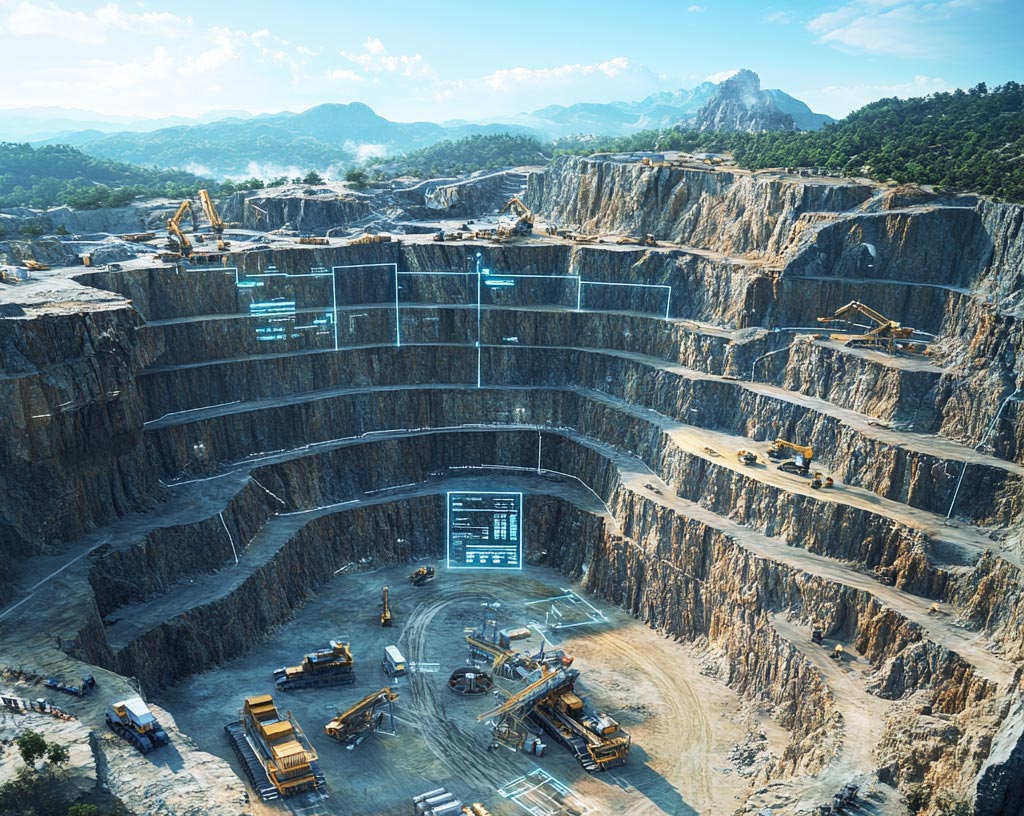
The construction materials industries form the backbone of the infrastructure which surrounds us. Global demand for the products from this sector will not slow down, and so the pressure to enhance efficiency in manufacturing and doing so sustainably will only increase. This industry, including cement, concrete, and aggregates plants, has varying levels of technological maturity. Some embracing advanced technology faster than others and relying on data-driven decisions to reduce costs and minimize environmental impact.
However, ten key innovations that stick out more than others have the power to transform production processes, making operations smarter, safer, and more sustainable.
In this article, we’ll cover the top ten technologies pushing the boundaries of what’s possible in the construction materials industry. When considering implementations for your operations, these should be on your radar:
- Wearable Technology
- Drone Technology
- Robotics
- Smart Inventory Management
- AI for Quality Control
- Fully Electric Mobile plants
- Virtual Reality
- Augmented Reality
- Sensors
- Digitized & Mobile Maintenance Systems
1. Wearable Technology
This can include everything from a smart watch to smart personal protective equipment (including clothing and helmets). It has been readily adopted in the construction industry; however, its value is increasingly recognized across the construction materials industries too. For example, as these devices monitor the well-being of personnel in real time, they can help prevent accidents and serious injuries. It’s also an extra form of protection for lone workers in remote quarries. Additionally, wearable tech improves productivity by tracking and analyzing worker movements, providing insights that streamline processes, reduce downtime, and optimize task allocation, leading to more efficient workflows.
2. Drone or Unmanned Aerial Vehicle (UAV) Technology
Drones have revolutionized quarry operations, replacing manual surveying and labor-intensive data collection with swift, precise, and efficient solutions. Equipped with advanced sensors and cameras, drones capture high-resolution images in real-time, allowing quarry managers to make informed decisions, optimize blasting, drilling, and excavation processes. This integration of drone technology has improved productivity, reduced environmental impacts and enhanced operational accuracy across quarry sites.
Similarly, with cement plants, drones are used to perform plant inspections and have dramatically improved safety for workers with indoor drones, reducing the need for inspectors to enter a potentially hazardous asset to collect visual data.
3. Robotics
Robotics are transforming the logistics processes in cement manufacturing by automating key tasks such as item picking, flattening, palletizing, and truck loading. Replacing these traditionally labor-intensive tasks helps make cement plants more efficient and resilient while contributing to the health and safety of frontline workers. By integrating robotic solutions, cement plants can optimize their logistics, enhance accuracy whilst increasing output.
4. Smart Inventory Management
A precarious supply chain within the construction materials industry can quickly erode the bottom line of a company and mismanaged stocks can trigger undesirable waste. An effective inventory management system therefore is vital for operations in the aggregates industry, as it ensures the availability of materials, reduces costs, and minimizes waste, ultimately improving efficiency and profitability. Larger operations often have dedicated teams to manage this, but smaller companies may lack these resources, making inventory management systems critical for achieving cost savings. By using sensor technology (smart barcodes, RFID tags) that track stock in real-time, companies gain visibility across multiple sites and can maintain optimal stock levels. For example, if stocks fall below a pre-set benchmark, such as a two-month supply, it signals the need for replenishment to avoid shortages.
5. AI for Quality Control
Applying Artificial Intelligence (AI) modelling in aggregate and cement plants vastly improves quality control processes, reducing rework costs and ensuring every batch meets necessary standards. For example, AI-driven image analysis enables real-time particle size evaluation on stockpiles or conveyor belts, ensuring consistent product quality without needing manual sampling. Computer vision technology powered by AI can accurately classify material quality. LiDAR is another method that can measure stockpile volumes without the need for personnel to physically access the stockpile. This is particularly crucial when measuring stockpiles of hazardous materials or in dangerous locations. Additionally, generative AI analyzes plant data to identify deviations and, through model-based optimization, predicts and maintains quality throughout the entire manufacturing process.
6. Electric Mobile fleet and plants
Aggregate Industries recently announced a sweeping electric upgrade to their cement fleet. And they’re not alone. At Hillhead 2024, Electric vehicles and machinery were at the forefront of the exhibition. The concept of massive charge pads in quarries, enabling electric vehicles to recharge on the go, was one of several exciting electrical innovations on show. With companies racing towards achieving Net Zero, the shift from mixed fleets to going fully electric is seen as pivotal. This transition gives companies a chance of meeting sustainability targets as well as gaining a competitive edge in the industry.
7. Virtual Reality (VR)
VR is a technology which allows a user to interact with a computer-simulated environment (a real or imagined one) often displayed on a computer screen. This makes it an excellent tool for training staff on new equipment and procedures, especially in hazardous environments in certain plants and quarries. Caterpillar increasingly provides training to operators in a safe and controlled virtual environment using VR simulators. Furthermore, Using VR technology for maintenance procedures can improve accuracy and reduce downtime by simulating complex repair scenarios and allowing technicians to practice in a virtual environment. Studies have shown that VR safety training outperformed traditional methods in terms of knowledge acquisition and retention.
8. Augmented Reality (AR)
AR and VR are sometimes used interchangeably but are distinctly different technologies that offer different advantages when applied within the construction materials industry. AR is an interactive experience based on real-world settings but enhanced by computer-generated information (mixed reality), whilst the VR setting is completely virtual. AR Remote assistance can allow experts to guide plant workers in real-time, enabling faster problem-solving and eliminating the need for experts to travel to the site. As a result, machine downtime is reduced, cutting both production losses and travel costs. AR can help experts monitor production and worker performance, assess sites, and identify potential machine defects.
9. Sensors
Internet of Things (IoT) technology enables real-time monitoring of critical equipment. Sensors installed in machinery continuously collect and transmit data about equipment performance, temperature, pressure, and other factors. This data helps manufacturers identify potential issues before they become problems, reducing the risk of unexpected breakdowns. Examples of sensors used in cement plants and aggregate quarries include vibration, temperature, level and pressure sensors. Changes in pre-set levels to these data points can signal the state of the equipment’s operational condition (triggering maintenance routines if necessary) as well as production efficiency. Advanced analytics powered by AI combined with the data retrieved from sensors can also help predict when machinery is likely to fail.
Implementing sensors to perform predictive or condition-based maintenance well, is crucial.
10. Digitized & Mobile Maintenance Systems
Mobile apps, such as CheckProof’s, allow maintenance teams on the field to stay connected and handle issues as they arise. Technicians can instantly access repair manuals, enter deviations, update repair status, and receive notifications of maintenance tasks—all from their mobile devices, ensuring seamless communication and quicker response times. The transition from pen and paper to a digital maintenance and HSEQ platform that supports mobile devices has allowed for:
- Automated maintenance scheduling
- IoT integrations of sensors that trigger tasks
- Real-time reporting of maintenance activities
- Tracking and managing incidents & deviations
- Efficient capturing of field data
- Optimizing preventive & condition-based maintenance
At CheckProof, we have long recognized the advantage of adopting innovative solutions in traditional industries. However, for a more friction-free integration, there needs to be tailored solutions, an understanding of the specific needs of these industries, and solutions that can integrate seamlessly with existing workflows, whether for equipment monitoring, safety protocols, or quality control.
As the construction materials industries continue to evolve, technology will play an increasingly critical role in driving efficiency, quality, and sustainability. By embracing these advancements, manufacturers can ensure they remain competitive and future-proof operations to adapt to changing demands.
Want to know what CheckProof can do for you?
CheckProof's easy-to-use app makes it easier to do the right thing at the right time. Discover how you can run world-class maintenance that is both cost-effective and sustainable.
Book a demo

2026-04-24
CMMS Features and Functionality: What to Look for in a Maintenance Management System
Not all CMMS (Computerized Maintenance Management System) platforms are built the same, and in industries like quarrying, aggregates, cement, and ready-mix concrete, there are certain capabilities that carry more weight than others. The CMMS features that matter most for maintenance teams in asset-intensive industries include things such as centralized asset data, work order automation, preventive and predictive scheduling, digital checklists, deviation management, fleet optimization, and mobile-first design with offline capability.

2026-04-24
Cement Plant Inspection Checklist: What to Check, When to Check It, and Why It Fails
Most unplanned shutdowns in a cement plant don’t come out of nowhere. There’s usually a trail beforehand. Maybe a kiln bearing that’s been running 15 degrees above baseline for three weeks, noted by the operator on shift but never formally flagged because it hadn’t tripped an alarm yet. The issue isn’t a lack of warning, its that small deviations are often tolerated until they tip over into something serious.

2026-04-01
How to Choose the Right Work Order App for Your Industry
When something breaks on site, the fix gets most of the attention, but it’s rarely where things go wrong. What’s just as critical is everything around it: who reported it, who picked it up, what got missed between shifts, and how long it sat before anyone acted. In many operations, that whole flow is still held together by paper forms, radio calls, and memory.

2026-04-01
Best Practices for Work Order Management
Efficient maintenance starts with clear work orders. When issues are logged quickly with the right details, photos, and priority, teams spend less time chasing information and more time fixing problems. The result is reduced downtime, smoother shift handovers, and audit-ready operations — even in low-signal or harsh environments where mobile work orders let crews flag issues before they escalate.

2026-03-26
How DAY Group went paperless and transformed maintenance operations with CheckProof
DAY Group Ltd is an independent, family-owned business supplying construction materials and services across the south of England since 1947. Handling over five million tonnes of material annually across divisions including Day Aggregates, Day Glass Recycling, Day Contracting, and Day Equestrian — plus recycling operations processing over 1.5 million tonnes a year — the group operates with close to 200 staff and a large fleet of plant equipment, making uptime, compliance and safety mission-critical.

2026-03-17
CONEXPO-CON/AGG 2026 – CheckProof’s Industry Report
CONEXPO-CON/AGG 2026 highlighted an industry laser-focused on execution: demand is strong, but labor, schedules, and downtime risk remain tight. The goal is clear — repeatable performance, early risk visibility, and simpler tech adoption. This report covers the key signals from the show and what they mean for the next era of construction materials.

2026-02-20
Gebr. Arweiler: Transforming Multi-Site Maintenance with one Digital System
Gebr. Arweiler, a family-owned company with multiple locations across Saarland and France, has long been known for combining tradition with forward-looking action. With eight plants, a fleet of 26 trucks – including 5 electric vehicles – and a strong commitment to sustainability, the company needed a digital solution to optimize maintenance, asset management, and compliance.

2026-02-12
Predictive Maintenance vs Condition-Based Maintenance
Walk any quarry, plant, or yard and you’ll see the same thing: assets and equipment emitting tell-tale signs of its condition, long before it actually fails. Operators note “sounds off” on a pre-shift, but the note gets buried in a binder or a spreadsheet. The gap between seeing a problem and acting on it at the right time is often where maintenance strategies break down.

2026-02-06
Fault Tree Analysis 101 – A Comprehensive Guide
Equipment rarely fails for a single reason. Fault Tree Analysis (FTA) helps teams work backwards from a breakdown, separate symptoms from causes, and identify what needs to change to prevent repeat failures.

2026-01-30
Holcim’s Torr Works Super Quarry – a Customer Success Story
On a quarry as large and complex as Holcim’s Torr Works, staying on top of daily work is a constant challenge. When information is scattered across paper, radios, and emails, even small issues can take too long to act on. This customer story looks at how Torr Works brought everything into one connected system with CheckProof – and what happened when visibility and ownership became part of everyday site work.


