
Author
Anju Khanna Saggi
Content & Media Relations
Published: 2025-12-03
Last updated: 2025-12-05
Preventive maintenance is the foundation of safe, compliant operations. And a disciplined approach to routine maintenance will ensure your operations stay safe and compliant.
Across sites, the challenge usually isn’t about knowing what to maintain; it’s maintaining the right things at the right time, every time. That’s where the three core pillars of preventive maintenance come into play:
- A defined PM schedule
- A practical PM checklist
- A cohesive PM plan
These three link daily work to long-term equipment health and compliance readiness.
In this article we’ll briefly go over all three, explaining WHY each of the pillars are so important, and what to consider for them:
PM Schedule
A PM schedule sets the pace for your entire maintenance program. It breaks work into predictable intervals (daily checks, weekly tasks, 250-hour services, seasonal prep, etc.).
In high-wear environments, consistency matters more than complexity. Miss a single interval on a machine or some equipment, and small issues turn into failures.
A strong PM schedule balances three inputs:
- OEM recommendations for lubrication, torque checks, and part replacements.
- Actual site conditions like dust loading, vibration, temperature swings, and run hours.
- Regulatory expectations tied to workplace exams, brake checks, lighting, guarding, and fire safety.
When these inputs are aligned, the PM schedule becomes a guardrail for both uptime and compliance. Crews know what needs attention before production starts, supervisors can confirm work across shifts, and audits stop feeling like a scramble. The goal isn’t a perfect schedule, rather it’s about creating a reliable one the team can follow even on days when staffing is thin and production is pushed hard.
PM Checklist
A PM checklist is where the schedule turns into action. It translates each interval into clear, repeatable steps the crew can follow without guesswork. Since mechanics rotate, operators cover for each other, and some shifts work with limited support, a good checklist ensures no ambiguity may lead to missed items or incomplete exams.
Proper PM checklists share a few traits:
- Straightforward language that matches how work is done in the field.
- Task sequences that follow the physical flow of the machine.
- Critical-to-safety items upfront, such as guarding, lights, horns, brakes, and emergency stops.
- Room for condition notes and deviations, so small issues don’t get buried.
PM checklists create a consistent baseline across shifts and sites, ensuring the same machine gets the same level of attention whether it’s Tuesday on day shift or Sunday night during a storm. When paired with a solid PM schedule, the checklist keeps inspections tight, defensible, and aligned with both equipment health and compliance requirements.
PM Plan
The maintenance plan ties the entire preventive maintenance program into one coherent structure. It defines who does the work, when it happens, and how issues move from inspection to repair. Without a plan, even the best schedules and checklists turn into isolated tasks with no clear follow-through.
A strong preventive maintenance plan covers four essentials:
- Roles and responsibility: Operators handle pre-shift checks; mechanics take on interval services; supervisors verify closure and sign-offs.
- Workflows for deviations: Anything out-of-spec triggers a clear path toward repair.
- Documentation expectations: What gets recorded, how photos or notes are used, and how long records must be kept for audits.
Integration with production: Preventive maintenance is scheduled around planned downtime, clean-outs, and trucking windows so maintenance and operations don’t pull against each other.
When the PM plan is solid, crews aren’t guessing. Work moves from “found it” to “fixed it” in a defined loop. Supervisors get real visibility across assets and shifts. And when an audit comes, the operation has a clean story of how each PM schedule and PM checklist fits into the broader preventive maintenance system.
Preventive Maintenance Frequency - How Often Should it be Done?
There’s no single answer that fits every site. What matters is finding a frequency that your operation can repeat properly every time, without shortcuts. It’s also finding a balance where checks shouldn’t be overly frequent, as this is a waste of resources.
However, going too long between services and you can expect to start seeing the all too familiar problems of dry bearings, loose guards, bad lights, leaking fittings, and so on. Go too aggressively, and the team drowns in work they can’t sustain.
The right preventive maintenance frequency sits in the middle: tight enough to catch issues early, steady enough that every shift follows it without cutting corners. Once that balance is set, the whole preventive maintenance system becomes something the site can rely on day after day.
How to Get Preventive Maintenance Right
Preventive maintenance only works when it’s consistent, visible, and grounded in real site conditions. You can’t hold the right frequency or prove the quality of the work when inspections live on clipboards, texts, or a dozen disconnected spreadsheets. To get frequency and quality right, you need one place where the PM plan, and its schedules and checklists all connect to the same source of truth.
The solution is a digital platform, where you get full visibility and control of all your preventive maintenance activities. That’s what keeps the whole system steady:
- Crews know exactly when maintenance is due and what the interval is based on.
- Operators can record issues at the machine, before they turn into downtime or compliance risks.
- Maintenance teams see work coming, not after the fact.
- Supervisors can verify what was completed, what was missed, and where trends are forming.
FAQ
Want to know what CheckProof can do for you?
CheckProof's easy-to-use app makes it easier to do the right thing at the right time. Discover how you can run world-class maintenance that is both cost-effective and sustainable.
Book a demo

2026-09-29
The AggNexus 2026 Report: Highlights from the Digital Innovation Conference
AggNexus 2026 in Austin was the biggest edition yet. After a year of AI first steps, the focus shifted to how to get people to change. Here are CheckProof’s key takeaways on change management, fast-moving AI, compliance and passing on know-how.

2026-09-24
A Stronger Foundation: Rohrdorfer on Digitizing Safety and Efficiency
Rohrdorfer, a leading construction materials producer in five countries, has used CheckProof for years to streamline safety, maintenance and quality work and to sharpen its customer focus.

2026-07-10
10 Must-Have Features for an Incident Management Platform in the Heavy Industry
When an incident happens, every minute matters. A near miss, equipment damage, or a hydraulic leak can quickly become a bigger risk if the issue is not reported, investigated, and followed up properly. When an incident happens, every minute matters. A near miss that goes unreported, or a fault that isn’t followed up, can quickly become a bigger risk if the issue is not reported.

2026-07-09
The Benefits of a Quarry Crusher Management Software
Paper forms, scattered systems, and knowledge locked in one person’s head all delay the same thing: catching crusher problems before they become breakdowns. This piece covers the four biggest challenges in crusher operations and how CheckProof brings inspections, maintenance, and issue tracking into one place.

2026-07-06
Hillhead 2026 – The CheckProof Report
Hillhead 2026 broke every record with 627 exhibitors and three days packed with electric machinery, connected intelligence, and sustainable innovation. CheckProof was on the ground as an exhibitor and sponsor — here’s what our team took away from the show floor.

2026-06-12
Brice Aggregates: What Operational Excellence Looks Like at a Needingworth Quarry
The inaugural CheckProof Industry Excellence Award winners on going digital from the ground up, and the moment their frontline teams bought in.
2026-05-07
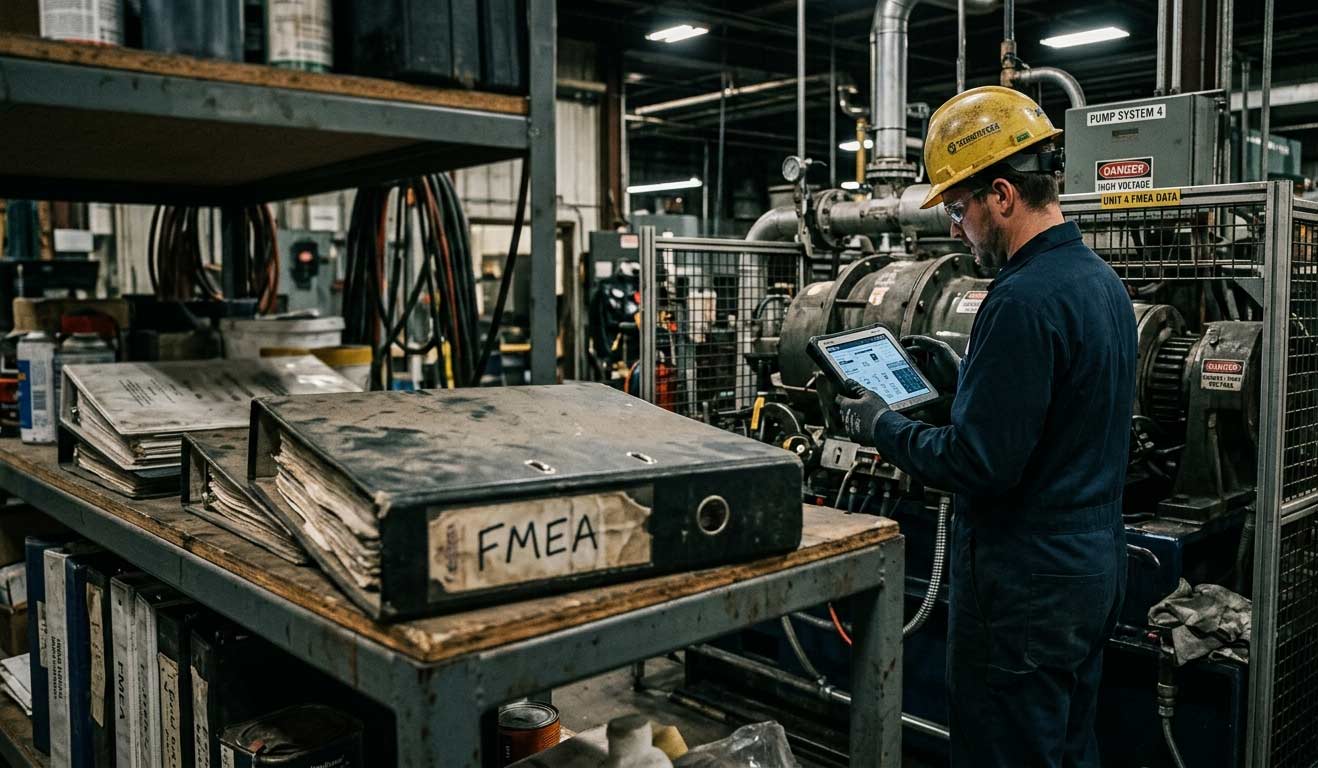
Why Your FMEA Is Sitting in a Binder (And What It Should Be Doing Instead)
Most facilities have an FMEA — but it’s collecting dust in a binder instead of driving decisions on the floor. Here’s how to turn your risk analysis into a living tool that actually protects uptime.

2026-04-24
CMMS Features and Functionality: What to Look for in a Maintenance Management System
Not all CMMS (Computerized Maintenance Management System) platforms are built the same, and in industries like quarrying, aggregates, cement, and ready-mix concrete, there are certain capabilities that carry more weight than others. The CMMS features that matter most for maintenance teams in asset-intensive industries include things such as centralized asset data, work order automation, preventive and predictive scheduling, digital checklists, deviation management, fleet optimization, and mobile-first design with offline capability.

2026-04-24
Cement Plant Inspection Checklist: What to Check, When to Check It, and Why It Fails
Most unplanned shutdowns in a cement plant don’t come out of nowhere. There’s usually a trail beforehand. Maybe a kiln bearing that’s been running 15 degrees above baseline for three weeks, noted by the operator on shift but never formally flagged because it hadn’t tripped an alarm yet. The issue isn’t a lack of warning, its that small deviations are often tolerated until they tip over into something serious.

2026-04-01
How to Choose the Right Work Order App for Your Industry
When something breaks on site, the fix gets most of the attention, but it’s rarely where things go wrong. What’s just as critical is everything around it: who reported it, who picked it up, what got missed between shifts, and how long it sat before anyone acted. In many operations, that whole flow is still held together by paper forms, radio calls, and memory.