CheckProof Releases Construction Materials Industry Report 2026

Maintenance Planning & Scheduling – Test if your Management of Key Equipment is Good Enough

Author
Anju Khanna Saggi
Content & Media Relations
Published: 2025-10-06
Last updated: 2026-09-27
Maintenance planning and scheduling is one of those things most companies believe they’ve got covered, - until a breakdown stops production, spare parts aren’t available, or the wrong machine is offline at the wrong time. That’s when the real cost of poor scheduling shows up: lost output, inflated repair bills, and operators waiting for equipment that should have been ready.
A strong maintenance scheduling system becomes the difference between firefighting breakdowns and running a predictable, reliable operation, and a steady edge over your competition. With a planned maintenance schedule in place, downtime shrinks, machines last longer, and teams know exactly what to do and when to do it.
Key takeaways
- Maintenance scheduling directly affects uptime, repair costs, machine lifespan and production stability.
- Frequent breakdowns, recurring faults and rising costs often reveal weaknesses in the maintenance schedule and internal processes.
- Critical equipment should receive priority, with reactive, preventive and predictive maintenance used where each makes sense.
- Clear ownership and performance data keep schedules relevant as machines, workloads and failure patterns change.
- Digital maintenance tools help teams carry out, document and improve planned work, not merely schedule it.
Take a tour
Test: Get an instant Maintenance Health Score
Test your current maintenance planning and scheduling routines and workflows with our short, 5-minute test. The questions below are designed to provide an overarching measurement of how well structured and reliable your current maintenance planning and scheduling really is.
Go through each question and answer honestly. Complete the quick test to see an instant Maintenance Health Score.
Regardless if you scored a 10 or a 0, we highly recommend you continue reading for a deep dive into the world of machine and equipment maintenance and planning.
Why Maintenance Scheduling matters more than you think
Maintenance planning and scheduling are often viewed as mundane and purely administrative tasks. In reality, it’s one of the strongest levers for keeping operations stable, safe, and cost-effective. A machine maintenance schedule isn’t just about checking boxes; it shapes how much uptime you get from your assets, how long components last, and how predictable your production really is.
Think about the cascading effect of poor scheduling: one machine goes down, production slows, orders pile up, and operations and teams scramble to catch up. Costs rise partly from rushed repairs and from lost hours, wasted materials, and penalties for late deliveries. By contrast, a carefully planned maintenance schedule turns maintenance into an investment. It reduces surprises, stretches the life of critical machines, and keeps teams focused on production instead of firefighting.
To put the impact into perspective:
- Unplanned downtime is expensive: Manufacturers lose about $125,000 per hour on average.
- Predictive maintenance cuts breakdowns and increases productivity: Structured, predictive maintenance leads to ~50% fewer equipment breakdowns and increases productivity by 25% compared to reactive approaches.
- Scheduled care extends lifespan: According to the Federal Energy Management Program (FEMP), preventive maintenance can stretch the life expectancy of equipment by 20-40%, delaying costly replacements.
Top 5 warning signs of poor Maintenance Scheduling
A weak maintenance scheduling system will have, cracks which show up in small but familiar ways that gradually erode performance and reliability. Spotting these warning signs early is the first step to fixing the problem before it becomes a crisis. Here are the five most telling red flags:
- Frequent breakdowns - machines that stop unexpectedly, despite recent servicing, usually signal poor scheduling discipline.
- Rising maintenance costs - spare parts and emergency call-outs cost far more than planned interventions, and the budget slowly spirals.
- Unexplained downtime - hours of lost production with no clear root cause often point back to missing or poorly executed preventive tasks.
- Recurring failures - the same component or machine fails repeatedly, a sign that issues aren’t addressed at the root.
- Lack of traceability - maintenance tasks are checked off on paper or spreadsheets with no proof of when or how they were done.
- No structured root cause analysis process – failures get logged and fixed, but without a consistent way to investigate why, so the same problems keep resurfacing under different names.
If several of these feel familiar, it’s a strong signal that your maintenance scheduling isn’t doing its job. The good news is that most of these problems can be solved with clearer routines, accountability, and the right equipment maintenance tool to keep schedules alive and visible.
Speak to a Maintenance Expert
Main reasons why Maintenance Planning and Scheduling fail
Even when companies understand the value of maintenance scheduling, making it work in practice might be harder than it looks on paper. There are constantly moving parts in operations - shifting production demands, limited budgets, unclear responsibilities, and a lack of the right tools. Below is our take on the main reasons why maintenance planning and scheduling of machines can fail.
Relying on reactive fixes
Without a structured machine preventive maintenance schedule, teams fall into firefighting mode - reacting to breakdowns instead of preventing them. This drains resources and increases downtime.
Poor prioritization
Critical machines don’t always get the attention they need. Without clear priorities, time and resources get spread thin, leaving the most important assets exposed to risk.
No proper Equipment Maintenance Tool
Spreadsheets, whiteboards, and paper make schedules hard to follow and easy to forget. Without a dedicated equipment maintenance tool, accountability and visibility can easily vanish.
Limited accountability
If it’s not clear who owns a task, checks get skipped or delayed. A schedule is only as strong as the responsibility assigned to it.
No dynamic planning
Schedules are often created once and then left unchanged, even as machines age, workloads increase, or production demands shift. A static plan quickly becomes outdated. Dynamic planning, on the other hand, emphasizes continuous adaptation and flexibility to respond to constantly changing conditions within operations.
Weak data feedback
Without tracking downtime, costs, or recurring failures, scheduling stays blind. A feedback loop is essential for continuous improvement.
How to set up proper Maintenance Scheduling
A strong maintenance planning and scheduling process isn’t just about filling in dates on a calendar. It’s about creating a system that keeps machines reliable, reduces downtime, and gives teams clear direction. The following steps outline how to build a schedule that works in practice, not just on paper.
Step 1 - Define your goals
Before building a schedule, decide what success looks like. Are you aiming to cut unplanned downtime, extend machine life, or improve safety compliance? Clear goals guide every decision that follows.
Step 2 - Map your assets and critical machines
Not all equipment has the same impact. Start by listing every machine and ranking them by criticality. Focus your machine maintenance schedule on the assets that cause the most disruption when they fail.
Step 3 - Choose the right mix of maintenance types
No single maintenance strategy works for every machine. Different assets, operating environments, and production pressures demand different approaches. The key is not to choose one method, but to combine them in a way that balances reliability with cost-effectiveness.
- Reactive maintenance: Fixing machines only after they break. While risky as a primary strategy, it can be acceptable for non-critical or low-cost equipment.
- Preventive maintenance: Tasks carried out at fixed intervals - such as lubrication, inspections, or part replacements - to prevent breakdowns before they happen.
- Predictive maintenance: Repairs and service triggered by real-time data, sensor readings, or performance trends, so work happens just before failure and with minimal impact on production. This maintenance type is well suited to high-value, continuously running assets, such as crushers, conveyors and pumps.
Step 4 - Assign responsibilities and ownership
A maintenance schedule without clear ownership quickly falls apart. Tasks get skipped, rushed, or repeated simply because no one knows who is responsible. Every check, inspection, and intervention needs a designated owner - whether that’s an operator handling daily routines, a technician carrying out specialized tasks, or a manager verifying completion.
Clarity is key: the person assigned should know exactly what needs to be done, when it needs to be done, and how it should be documented. This creates accountability and traceability. Without it, maintenance planning and scheduling become a paper exercise instead of a working system.
Step 5 - Create your maintenance schedule and asset checklists
Turn the previous steps into an actionable maintenance schedule. For each asset, define what work is required, how often it should be completed, who is responsible, and when it can be carried out with the least disruption. Include fixed intervals, operating-hour limits, meter readings, and condition-based triggers where relevant. Make sure technicians, tools, spare parts, and planned shutdowns are accounted for before setting each task.
We’d also suggest creating a maintenance checklist for every asset so inspections and service tasks are completed consistently, and you can keep track of it. Each checklist should explain and if necessary, show with pictures what to inspect, adjust, lubricate, or replace, along with any safety instructions and acceptable limits. It should also state how findings, faults, photos, and completed work must be recorded. Once ready, make the schedule accessible to everyone involved and establish a clear routine for assigning, completing, and following up on each task.
Step 6 - Track, measure, and continuously improve
A maintenance schedule should constantly be reviewed. Machines age, production demands change, and failure patterns shift over time. To keep your plan effective, you need to treat it as a living system that adapts to new data.
Track downtime, repair costs, and the frequency of preventive tasks. Measure whether the planned intervals are too short (leading to wasted effort) or too long (causing breakdowns). Use inspection results to identify patterns, such as a component that consistently fails earlier than expected. With this feedback loop in place, your machine maintenance schedule evolves from a static calendar into a dynamic tool that continuously improves reliability and efficiency.
The key to success: Equipment Maintenance Tool
Even the best maintenance plan falls short if it can’t be followed consistently. Paper checklists get lost, whiteboards go out of date, and spreadsheets are easy to ignore. What looks organized in the office often collapses on the shop floor.
An equipment maintenance tool/planning tool solves this gap. By putting schedules, checklists, and reporting into a customizable, digital system it makes maintenance planning and scheduling visible and actionable for everyone involved. Operators see what needs to be done today. Technicians log completed work with proof, like photos and notes. Managers track progress in real time and spot where schedules are slipping.
The benefits go beyond accountability. A digital tool connects preventive, planned, and even reactive maintenance in one place, making it easier to build the right mix. It ensures tasks are not just planned but also carried out, documented, and analyzed. Over time, this creates the data needed to refine intervals, reduce costs, and extend machine life.
FAQ
Want to know what CheckProof can do for you?
CheckProof's easy-to-use app makes it easier to do the right thing at the right time. Discover how you can run world-class maintenance that is both cost-effective and sustainable.
Book a demo

2026-09-29
The AggNexus 2026 Report: Highlights from the Digital Innovation Conference
AggNexus 2026 in Austin was the biggest edition yet. After a year of AI first steps, the focus shifted to how to get people to change. Here are CheckProof’s key takeaways on change management, fast-moving AI, compliance and passing on know-how.

2026-09-24
A Stronger Foundation: Rohrdorfer on Digitizing Safety and Efficiency
Rohrdorfer, a leading construction materials producer in five countries, has used CheckProof for years to streamline safety, maintenance and quality work and to sharpen its customer focus.

2026-07-10
10 Must-Have Features for an Incident Management Platform in the Heavy Industry
When an incident happens, every minute matters. A near miss, equipment damage, or a hydraulic leak can quickly become a bigger risk if the issue is not reported, investigated, and followed up properly. When an incident happens, every minute matters. A near miss that goes unreported, or a fault that isn’t followed up, can quickly become a bigger risk if the issue is not reported.

2026-07-09
The Benefits of a Quarry Crusher Management Software
Paper forms, scattered systems, and knowledge locked in one person’s head all delay the same thing: catching crusher problems before they become breakdowns. This piece covers the four biggest challenges in crusher operations and how CheckProof brings inspections, maintenance, and issue tracking into one place.

2026-07-06
Hillhead 2026 – The CheckProof Report
Hillhead 2026 broke every record with 627 exhibitors and three days packed with electric machinery, connected intelligence, and sustainable innovation. CheckProof was on the ground as an exhibitor and sponsor — here’s what our team took away from the show floor.

2026-06-12
Brice Aggregates: What Operational Excellence Looks Like at a Needingworth Quarry
The inaugural CheckProof Industry Excellence Award winners on going digital from the ground up, and the moment their frontline teams bought in.
2026-05-07
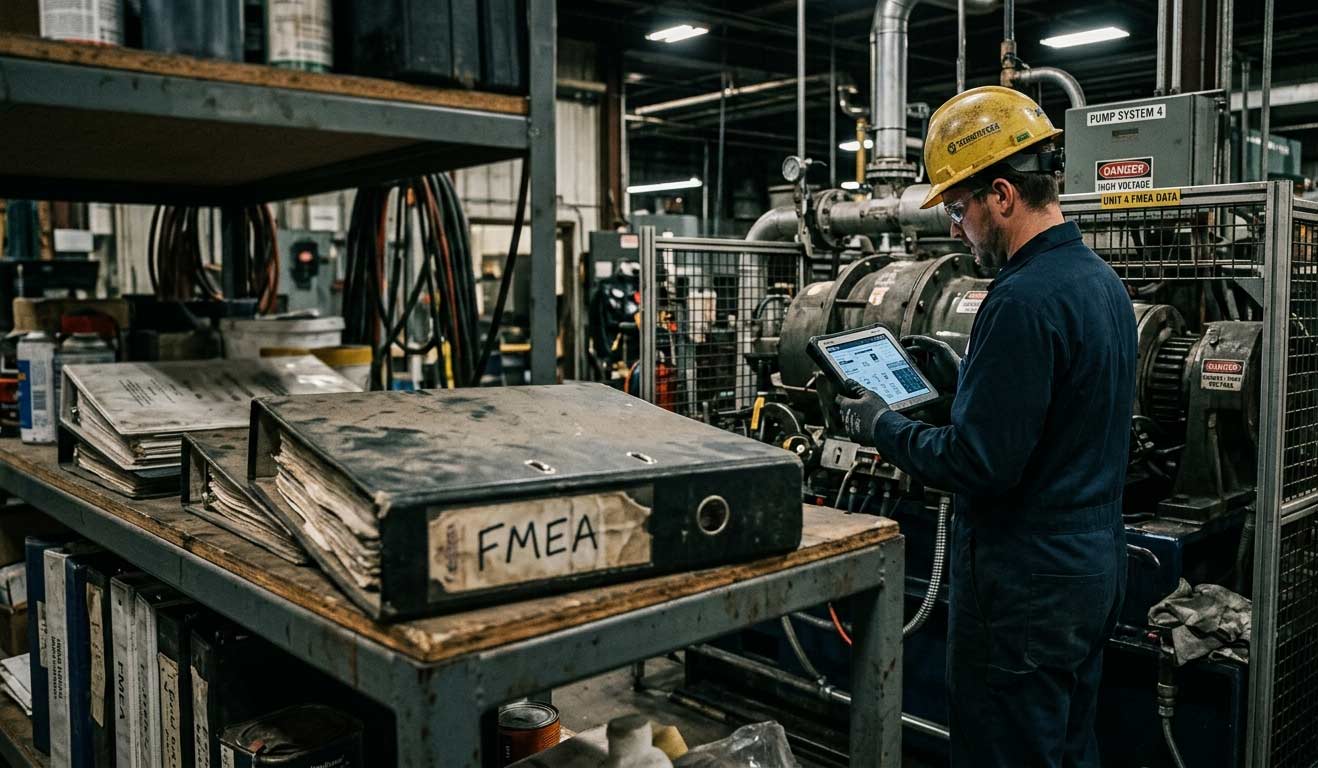
Why Your FMEA Is Sitting in a Binder (And What It Should Be Doing Instead)
Most facilities have an FMEA — but it’s collecting dust in a binder instead of driving decisions on the floor. Here’s how to turn your risk analysis into a living tool that actually protects uptime.

2026-04-24
CMMS Features and Functionality: What to Look for in a Maintenance Management System
Not all CMMS (Computerized Maintenance Management System) platforms are built the same, and in industries like quarrying, aggregates, cement, and ready-mix concrete, there are certain capabilities that carry more weight than others. The CMMS features that matter most for maintenance teams in asset-intensive industries include things such as centralized asset data, work order automation, preventive and predictive scheduling, digital checklists, deviation management, fleet optimization, and mobile-first design with offline capability.

2026-04-24
Cement Plant Inspection Checklist: What to Check, When to Check It, and Why It Fails
Most unplanned shutdowns in a cement plant don’t come out of nowhere. There’s usually a trail beforehand. Maybe a kiln bearing that’s been running 15 degrees above baseline for three weeks, noted by the operator on shift but never formally flagged because it hadn’t tripped an alarm yet. The issue isn’t a lack of warning, its that small deviations are often tolerated until they tip over into something serious.

2026-04-01
How to Choose the Right Work Order App for Your Industry
When something breaks on site, the fix gets most of the attention, but it’s rarely where things go wrong. What’s just as critical is everything around it: who reported it, who picked it up, what got missed between shifts, and how long it sat before anyone acted. In many operations, that whole flow is still held together by paper forms, radio calls, and memory.