CheckProof Releases Construction Materials Industry Report 2026

How 5 Whys and Ishikawa Complement Each Other

Author
Anju Khanna Saggi
Content & Media Relations
Published: 2025-11-25
Last updated: 2025-12-05
When something breaks, it can be tempting to tape it up and move on. But in heavy industry, that quick fix can hide deeper issues. Root Cause Analysis (RCA) helps teams go beyond the surface – uncovering why problems happened so they can be prevented for good. In day-to-day operations, most breakdowns look simple on the surface: a tripped motor, a wandering belt, a leaking pipe. However, the real cause usually sits one or two layers deeper. That’s where practical tools such as a quick five-why analysis and visual methods like the Ishikawa Diagram (also known as a Fishbone Diagram or Cause-and-Effect Diagram) come into play.
These methods help teams take a step back just long enough to understand why something failed, not just what failed, so the same problem doesn’t show up next shift, next week, or at the next site.
This article walks through the essentials of practical root cause work and sets the stage for how to use it effectively. Here’s what we’ll cover:
Why the Root Cause Matters
When something goes wrong with production, time disappears fast. Materials back up. Trucks wait. Schedules are thrown off course. Operators improvise just to keep things moving. A single missed component can throw an entire shift off balance.
That’s why quick, practical root cause work matters. Not the long, meeting-room version, but the kind where crews can do it immediately and right where the issue arose. Without root cause work, the same issue is highly likely to come back and haunt operations.
Fast RCA methods like the 5 Whys and deep-diving methods like the Ishikawa diagram give teams a way to move past the assumptions and get to the bottom of what caused the problem. The goal is to reduce repeating failures and keep productions and workflows stable and moving.
Start Simple: Use the 5 Whys First
Most problems start with something small. A blocked screen, a valve that won’t open, a machine that won’t start on the first try, or an accident and safety incident. The fastest way to understand what’s really going on or why something happened is to ask a simple set of questions. That’s where the 5 whys come in. It’s quick, it’s straightforward, and it fits the pace of real operations when crews need answers fast.
What are the 5 Whys?
The 5 whys, or “five why-analysis”, is a quick and straightforward way to trace a problem back to its underlying cause. Start with the issue in front of you and ask, “why did this happen?” five times, each answer leading to the next question. By the time you’ve reached the fifth “why?”, you will hopefully have moved past the obvious symptoms and uncovered the real reason for the issue.
Why it Works in the Field
It’s quick, verbal, and easy to run right at the machine. You don’t need a meeting room or a long report. Just a clear problem and a few minutes of focused questions. That’s why it works so well in situations like this:
WHY 1
“Why is the mixer shutting down as soon as the load increases?”
Because the motor is overheating.
WHY 2
“Why is the motor overheating?”
Because the cooling fan isn’t moving enough air.
WHY 3
“Why isn’t the fan moving air?”
Because the guard is packed with debris.
WHY 4
“Why is the guard packed?”
Because it hasn’t been cleaned in several shifts.
WHY 5
“Why hasn’t it been cleaned?”
Because it was not on the checklist.
root
cause
cause
Missing cleaning task for the fan guard.
Where the 5 Whys Fit and Where It Falls Short
The five why-analysis is most practical when the problem has a clear, direct path and the chain of questions usually leads straight to the underlying cause. But when the 5 whys fall short, is when the situation gets messy. If you reach the fifth question and still have several possible answers, the crew seems to disagree, or the “whys” don’t seem to end, the problem most likely calls for a more in-depth method in order to solve the issue. Maybe other factors like the weather, manufacturing changes, or human factors are the cause. Maybe the issue revolves around more than one of these factors.
Here is where a simple five why-analysis of “whys” can’t complete the full scope. If the cause branches out into multiple directions, the 5 whys won’t be enough, and it’s time to move on to a more structured and visual way of mapping everything out.
When It’s Time for the Ishikawa (Fishbone) Diagram
Sometimes a problem refuses to point to a single clear cause. You reach the end of the 5 Whys and still have multiple “maybes”, or the crew still seems to disagree, this is a sign that the problem has outgrown a simple five why-analysis. That’s when it’s time to move from a straight line of questions to a tool that can map out every potential factor. This is where the Ishikawa (or also commonly known as the Fishbone diagram or Cause and Effect Diagram) is necessary for the RCA.
What Is the Ishikawa (Fishbone) Diagram?
The Ishikawa Diagram, often called a Fishbone because of its shape, helps visualize all possible causes that could lead to an effect. The Ishikawa (or Fishbone Diagram), is structured around the 7M categories:
- Man: training, experience, communication gaps
- Machine: equipment condition, wear, setup
- Method: process steps, timing, procedures
- Material: moisture, quality
- Measurement: sensors, data accuracy
- Management: staffing, policies, scheduling, priorities
- Mother nature (Environment): weather, temperature, humidity, dust
By mapping a problem across these categories, the Ishikawa diagram exposes patterns that aren’t obvious during a quick five why-analysis. It also contributes to helping crews see how small factors in different areas add up to a larger issue, especially when the problem recurs.
How To Map a Problem With a Cause and Effect Diagram On Site
Against common misconceptions, a cause-and-effect diagram doesn’t necessarily need a meeting room, a laptop or a workshop. Most often, the best place to build it is right where the issue is, next to the equipment, in the control room, or on a workbench during break. The goal is to visualize the problem whilst the details are fresh.
Start the diagram by writing the problem at the “head” of the fishbone. Then build the branches using the 7Ms - Man, Machine, Method, Material, Measurement, Management, and Mother Nature (Environment). In each branch, you can add additional observations, notes, and maybe even photos.
By using the diagram on-site, the factors of how the machine sounds, what the material looks like, how the process is actually being run brings out the real conditions of the problem, instead of blame being put on what is stated on a piece of paper or what someone said. A field-built cause and effect diagram makes a messy problem visible and structured. Once every factor is laid out, patterns begin to show, and the resolution becomes more obvious.
How To Transition From the 5 Whys to an Ishikawa diagram
- Step 1 - Start with the 5 Whys
- Capture the immediate cause and get the equipment running.
- Step 2 - Identify the branches
- When multiple “why” possibilities appear, those becomes the bones of your cause-and-effect diagram
- Step 3 - Build the Fishbone Diagram
- Sort each branch with the 7Ms
- Add additional observations, notes, photos, sketches where necessary
- Step 4 - Validate in the Field
- Walk the site or look at the issue and confirm if each branch aligns with what is true in your scenario
At this point, you have effectively completed the Root Cause Analysis and your issue should become clear to what the underlying issue is. Now you can resolve the issue and increase both reliability and safety in equipment, workflows, and communication.
How to Make Lasting Corrective Actions Stick
The most difficult part is usually just getting started, once the ball is rolling, momentum starts to build and you’re halfway there. Adding a Root Cause Analysis (RCA) into guidelines and daily practice can not only prevent recurring problems but keeps production moving and customers satisfied. A digital tool for incident and case management significantly lowers the bar to getting started.
Ultimately, having a digital platform that helps structure data, uncover cause and effect, and identify the right corrective actions can make all the difference. Contact us at CheckProof to get started.
FAQ
Want to know what CheckProof can do for you?
CheckProof's easy-to-use app makes it easier to do the right thing at the right time. Discover how you can run world-class maintenance that is both cost-effective and sustainable.
Book a demo

2026-09-29
The AggNexus 2026 Report: Highlights from the Digital Innovation Conference
AggNexus 2026 in Austin was the biggest edition yet. After a year of AI first steps, the focus shifted to how to get people to change. Here are CheckProof’s key takeaways on change management, fast-moving AI, compliance and passing on know-how.

2026-09-24
A Stronger Foundation: Rohrdorfer on Digitizing Safety and Efficiency
Rohrdorfer, a leading construction materials producer in five countries, has used CheckProof for years to streamline safety, maintenance and quality work and to sharpen its customer focus.

2026-07-10
10 Must-Have Features for an Incident Management Platform in the Heavy Industry
When an incident happens, every minute matters. A near miss, equipment damage, or a hydraulic leak can quickly become a bigger risk if the issue is not reported, investigated, and followed up properly. When an incident happens, every minute matters. A near miss that goes unreported, or a fault that isn’t followed up, can quickly become a bigger risk if the issue is not reported.

2026-07-09
The Benefits of a Quarry Crusher Management Software
Paper forms, scattered systems, and knowledge locked in one person’s head all delay the same thing: catching crusher problems before they become breakdowns. This piece covers the four biggest challenges in crusher operations and how CheckProof brings inspections, maintenance, and issue tracking into one place.

2026-07-06
Hillhead 2026 – The CheckProof Report
Hillhead 2026 broke every record with 627 exhibitors and three days packed with electric machinery, connected intelligence, and sustainable innovation. CheckProof was on the ground as an exhibitor and sponsor — here’s what our team took away from the show floor.

2026-06-12
Brice Aggregates: What Operational Excellence Looks Like at a Needingworth Quarry
The inaugural CheckProof Industry Excellence Award winners on going digital from the ground up, and the moment their frontline teams bought in.
2026-05-07
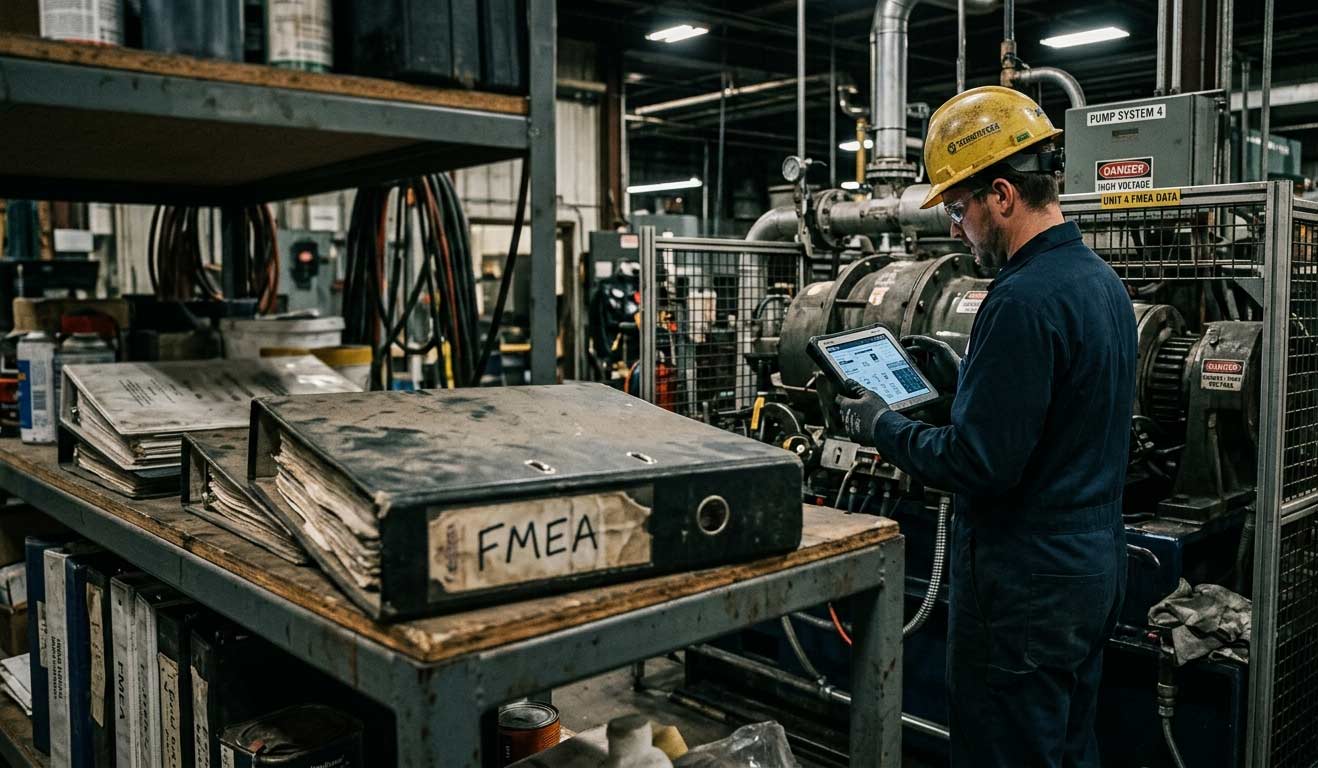
Why Your FMEA Is Sitting in a Binder (And What It Should Be Doing Instead)
Most facilities have an FMEA — but it’s collecting dust in a binder instead of driving decisions on the floor. Here’s how to turn your risk analysis into a living tool that actually protects uptime.

2026-04-24
CMMS Features and Functionality: What to Look for in a Maintenance Management System
Not all CMMS (Computerized Maintenance Management System) platforms are built the same, and in industries like quarrying, aggregates, cement, and ready-mix concrete, there are certain capabilities that carry more weight than others. The CMMS features that matter most for maintenance teams in asset-intensive industries include things such as centralized asset data, work order automation, preventive and predictive scheduling, digital checklists, deviation management, fleet optimization, and mobile-first design with offline capability.

2026-04-24
Cement Plant Inspection Checklist: What to Check, When to Check It, and Why It Fails
Most unplanned shutdowns in a cement plant don’t come out of nowhere. There’s usually a trail beforehand. Maybe a kiln bearing that’s been running 15 degrees above baseline for three weeks, noted by the operator on shift but never formally flagged because it hadn’t tripped an alarm yet. The issue isn’t a lack of warning, its that small deviations are often tolerated until they tip over into something serious.

2026-04-01
How to Choose the Right Work Order App for Your Industry
When something breaks on site, the fix gets most of the attention, but it’s rarely where things go wrong. What’s just as critical is everything around it: who reported it, who picked it up, what got missed between shifts, and how long it sat before anyone acted. In many operations, that whole flow is still held together by paper forms, radio calls, and memory.