CheckProof Releases Construction Materials Industry Report 2026

The AggNexus 2026 Report: Highlights from the Digital Innovation Conference

Author
Anju Khanna Saggi
Content & Media Relations
Published: 2026-09-29
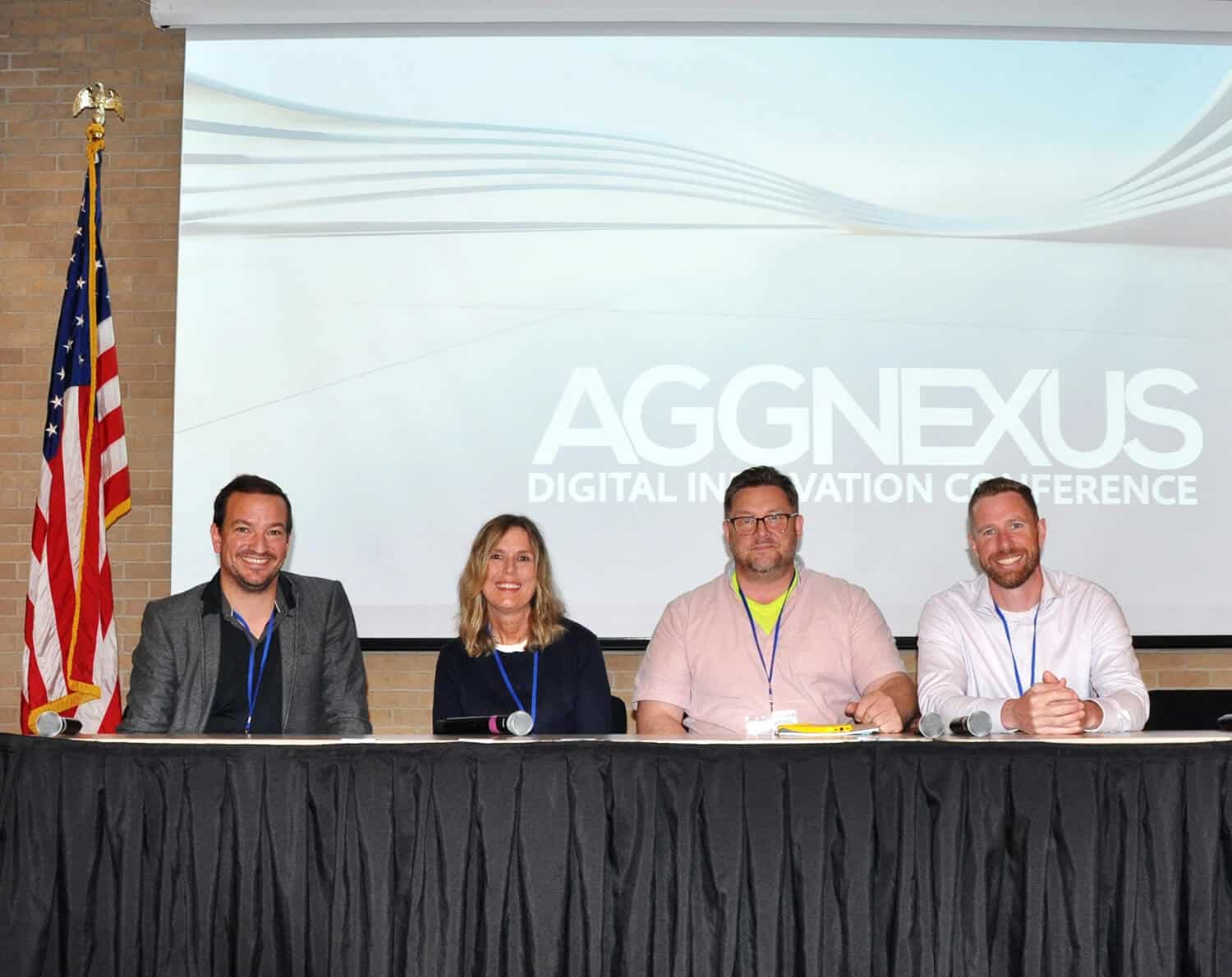
AggNexus returned to Austin, Texas, from September 15 to 17, 2026, for its third year, and it was the biggest edition yet, with more attendees than ever before. The invitation-only Digital Innovation Conference brings producers, technology vendors, associations and industry leaders together to talk openly about where the aggregates, ready-mix, asphalt and cement industries are heading, and what it will take to get there.
If 2025 was about identifying practical first steps with AI and data, 2026 was about the harder question underneath: how do you actually get people to change? Across two days of presentations, panels and debates, the same themes kept coming back. Change management deserves as much attention as the technology itself. AI is moving faster than anyone can plan for, and the industry is feeling it twice, as a user and as the builder of the infrastructure it runs on. And the knowledge held by experienced people needs a way to reach the next generation before it walks out the gate.
CheckProof was there as a founding AggNexus vendor, with CEO and Co-founder Håkan Holmgren moderating one panel and speaking on another, Chief Product Officer Tom O’Boyle joining the compliance panel at his first AggNexus, and Kyle Hunter, Head of Sales and System Specialist, from CheckProof’s US team in the room throughout. This isn't a full recap of every session, just the highlights that stood out most to our team. Here’s what we took away from the two days.
Key Takeaways from AggNexus 2026 Report
- Getting people to change is as important as the technology itself.
- New tools stick when frontline teams trust them.
- Vendors share responsibility for making a rollout work.
- You need to prepare for fast-moving AI, but foundational tech backlog can’t be overlooked.
- Our industry builds the AI economy (databases), simultaneously as AI is reshaping it.
- Major clients expect proven safety and compliance before you can even bid.
- Experienced staff need to pass on what they know before they retire.
- Technology can collect compliance data, but people stay accountable.
Day One: September 16, 2026
The conference opened on the evening of September 15 with a welcome reception at Caroline Rooftop Bar, sponsored by Sika USA. Day one proper began the following morning with breakfast and vendor introductions, before moving into a full program of panels.
Playing in the Majors: What Mega Clients Actually Want
Moderated by Bill Kavanaugh (CEO, Requordit), with panelists Greg Bernstein (Director, Strategic Partners, Amrize), Cameron Garrett (Director of Sales & Marketing, Colas Inc.), Kay Zinngrabe (Chief Development Officer, STAK Energy) and Jens Büschl (Vice President, Axians Industrial Applications & Services GmbH).
The opening session set the tone with a simple message: the demand curve has changed shape. Fewer, larger buyers are reshaping the market, and the opportunity is enormous, but so are the expectations. Cameron Garrett, from Colas defined a mega client as anyone who can move the needle - essentially make or break the year for that company
Introducing the session, Barry Hudson (President, Bulk Exchange) stressed an important point: data centers have become the largest single consumer for cement producers, which changes how materials companies need to sell and what major clients expect from them.
The presentation broke down what the ‘mega client’ market now requires. First, compliance. Mega clients set hard entry thresholds, with examples on screen including $10 million in insurance coverage, a minimum safety score of 0.85 and three years of clean financials. In short: show your paperwork, or don’t bother showing up. As the slide put it, meeting the standard doesn’t win the work, it earns you the right to compete.
Second, consistency. One good bid buys you one opportunity. From there, the path to a retained contract runs through delivering as promised, doing it again, and making it repeatable. Consistency is what turns one opportunity into the whole contract.
“Meeting the standard doesn’t win the work. It earns you the right to compete.”
From Chaos to Concrete Change
Presented by Rachael Mahoney (Chief Strategy Officer, Bulk Exchange) and moderated by Håkan Holmgren (CEO & Co-founder, CheckProof), with panelists LaNette Andrews (Program Director, Enterprise, Clyde Companies/Geneva Rock), Colin Shevloff (Reliability Analyst, Competence Center Aggregates & Asphalt, Heidelberg Materials) and Chris Kenney (Head of Transformation, Brannan Sand and Gravel).
Rachael opened with a question every operator recognizes: why is change so hard? Her answer was that we are wired for it to be. If what we did yesterday kept us alive, instinct tells us to do it again tomorrow. She used a wider example about how quickly a genuine shift can take hold. Within about 20 years of the engine arriving, nobody measured horsepower in actual horses anymore.
Back then, the new power was machines that do the pulling. Now, it is machines that do the thinking. The first engines were slow, unreliable and broke down; today’s AI can be inconsistent, unpredictable and prone to hallucinating. In both cases the rational take was “it isn’t ready.” But what mattered then was how fast the engine got better, and what matters now is how fast AI is getting better. What we’re seeing today, she said, is the first automobile: today AI answers, now it acts, and next it reasons. With more money being spent on AI than on any technology before, the time to prepare is now.
She also made the point that construction is impacted twice. The industry builds the AI economy (data centers, power, transmission, fiber, concrete, steel and site work), and AI is rebuilding the industry, from estimating, procurement and scheduling to logistics and field operations. “We’re building the stadium,” she said. “Then we play in it.”
Her advice to the room was to stop asking what AI does today and start asking three questions: if you could see five years ahead:
- What disappears?
- What becomes more valuable?
- What do we build now?
Håkan put the first question to the panel on how to make a rollout of new technology or systems successful. LaNette described how Clyde Companies has rolled out plant controls, load-out systems and telematics, with an executive team that keeps change as part of the culture. One approach that worked well was running mock go-lives before launch. It surfaced what did and didn’t work, resolved issues early, closed training gaps and brought people into the project before it went live.
Colin shared a different starting point. At the site he joined, people already knew change was needed, so the challenge wasn’t convincing them, it was building confidence in the solution. The team set up sandbox stations where people could try the tools for themselves and gamified the experience. Once people had a chance to play with it, their guard came down. The team collected all the feedback and took it into a second round, which has since proven successful.
“You can’t control the chaos, but if you do a really good job planning for it, you’ll be successful.”
Chris talked about planning for things to go wrong, because they will. On one go-live, Amazon Web Services went down within 30 seconds of logging in the first driver, with over 200 people to train across four days. It didn’t become a crisis because he had run a pre-mortem beforehand, asking what could go wrong on go-live day and how to mitigate it, and had the old system ready as a backup.
“The real sign a change is working? People start asking for more of it.”
On deciding what is worth changing, the panel agreed that not every idea justifies the disruption. Colin said there must be a clear problem and real value to justify the risk and cost. LaNette described governance teams that give each request a perceived business value score, since some problems only need an enhancement, not a full change. Chris uses a prioritization matrix weighted against the company’s four core pillars, adjusted each quarter, and suggested that sometimes the smartest move is revisiting the backlog and bringing back something you previously said no to as an easy win.
The hardest habits to change came up too. Chris said fear of AI replacing people is common, and it can make teams reluctant to describe their own processes. His answer is transparency about the what and the why, and reassurance that there will be plenty of work ahead.
"My biggest battle is side systems: spreadsheets and siloed tracking that create duplicate, inconsistent data. Keeping to one source of truth is the goal."
Colin said support on the ground is one of the biggest factors in changing habits, and that the most telling moment comes later: first people ask how to do something, then they say it’s fine, and then they start suggesting improvements. That’s when you know they see the value.
Håkan also raised the vendor’s side of the equation. What separates a rollout that sticks from one that stalls? LaNette was direct: vendors need to understand the customer’s problems, recommend an approach that fits them, and be in the trenches when things go wrong. She added that roadmaps need to be accurate, and that if a vendor can’t deliver something, saying so openly earns more respect next time. Chris added that clear statements of work would close much of the gap between what sales promises and what gets built.
“For vendors, delivering on the value that was promised must be part of the deal.”
On positive reinforcement, Chris, a former ready-mix driver himself, pointed out that a breakfast burrito can make all the difference to a driver’s day. Small incentives, public call-outs for the people who adopt early, and big thank-yous all add up, especially in global rollouts.
Teaching an Old Dog New Tricks: Adopting Innovation in a Legacy Industry
Presented by Manny Tejano (Founder & President, Rocket Start) and moderated by Crystal Burgess (CEO & Co-Founder, Burgex Mining Consultants), with panelists Cole Bland (President/CEO, Central Texas Stone & Aggregate), Wyatt Curry (Director of Engineering and Valuations, Burgex Mining Consultants), Dan Crouch (Principal, DC Connect ai) and Zach Satterwhite (COO, Sunrock Industries) and Paul Cousins (Chief Technology Officer, Chaney Enterprises).
Manny opened with a picture most people in the room recognized: notes lost in the back of the truck, whiteboards that get wiped, fax machines still running in dispatch, and "Ask Jim," because only Jim knows the schedule. Somehow, it still works.
He argued that this is a mindset grounded in the reality of the business. The industry was built to build lasting things, protect people, reduce risk and repeat what works.
“When you are pouring concrete that must support a bridge for a hundred years, you don’t experiment with unproven methods. That mindset built America and keeps crews safe, but it also makes change incredibly difficult. We repeat what works because the cost of failure is too high.”
The numbers he shared backed this up. Construction is consistently ranked the second least digitized industry, just above agriculture. Construction firms have historically spent less than 2% of revenue on IT, and 42% of construction technology investments fail to deliver ROI within three years.
“This isn’t because construction lacks smart people. It’s because construction hates unnecessary risk.”
Manny also shared what he learned bringing a new app to ready-mix drivers. At first they asked whether it was just another way to track them. The software wasn't the hard part. What made the difference was listening, following up and building trust.
Cole Bland described stepping into his family business in Austin as a new graduate, determined not to be seen as just the owner’s son. For him, bringing in new systems meant a structured approach rooted in humility, aligned with company goals and built around a collective benefit. He started with a small proof of concept alongside the frontline team who would ultimately use it, before any major rollout. The company has grown year on year under his leadership.
Paul Cousins was asked which outdated systems or processes in the aggregates industry most need a push into the 21st century. He said it's easy to blame a blue-collar workforce or resistance to change, but from an outside perspective he sees it differently. In his view, the technology sector has underserved the industry for years. Usually tech creates and industry follows, but when that gap opens up, it's hard to keep up with what comes next. The industry hasn't been lagging because of the industry itself. Years of foundational work are still needed, and some remediation has to happen before new technology can simply be switched on.
What Happens in the Association… Doesn’t Stay There
Presented by Pouria Ghods (CEO & Co-Founder, Giatec Scientific) and moderated by Mark Masotti (CEO and Co-Founder, alterBiota), with panelists Robert Dugan (CEO, CalCIMA), Andrew Pinkerton (CEO, TACA), Michele Stanley (President & CEO, NSSGA) and Amanda Muller (Senior Director of Membership Engagement, NRMCA).
The presentation started with the three advantages this industry already has when it comes to AI. The first is the data. Batch records, tickets, breaks, gradations and dispatch logs already exist, and the expensive part of AI is having the data. The second is the culture. An industry that argues about test methods knows how to evaluate a claim, and while most sectors adopting AI can’t tell whether it helped, this one will. The third is downside protection. You can experiment without risking the product. A materials change that goes wrong reaches the customer, but a failed pilot never leaves your office.
The discussion then made the case that associations have a unique role to play as AI arrives. They can build a shared vocabulary, give non-technical leaders enough understanding to govern AI and ask better questions in sales meetings, and bring members together to share what has and hasn’t worked, which is often worth more than any guidance document. Crucially, the rules for AI are being written right now, mostly by people who have never set foot in a plant or driven a truck. Advocacy from associations will make the difference in making sure members’ interests are represented.
On the fear many people feel about AI, Robert Dugan said the first step is understanding what drives it, pointing to accountability: everyone in this industry is always accountable for something. Michele Stanley stressed giving people a safe space to talk openly, alongside as much education as possible and a clear view of the opportunity. She also noted that larger members can afford to take more risk, while smaller members may need to be more targeted, starting with everyday tasks rather than big programs. Andrew Pinkerton acknowledged that the constant focus on AI might itself be stoking some of the fear and argued that reassigning roles offers far more upside than removing them.
Ditch the Spreadsheet: AI You’ll Actually Use
Presented by Thomas Bergmans (CEO, INFORM EVOTESS) and moderated by Jeff Van Grootel (Director of Business Development, INFORM EVOTESS), with panelists Thomas Bergmans, Håkan Holmgren (CEO, CheckProof), Barry Honig (President & CEO, TruckPay), Bill Callahan Jr. (Co-founder & CEO, skEYEwatch) and Matthew Jetmore (Owner, MEJ Consulting).
The day closed on practical AI. Barry Honig explained how AI can make hauling both more efficient and safer. Quarries and recycling sites can be dangerous places to step out of a truck, so the aim is to keep drivers in the cab. Cameras can read license plates front and back and can even read the dates on DOT stickers to flag an expired truck automatically, a check that has traditionally meant someone walking up and looking.
Håkan focused on AI for operations and maintenance. Learning sensors can trigger maintenance work orders before a breakdown happens. Manufacturer manuals that used to sit in binders can be loaded as PDFs so routines and workflows are created automatically, with tools, such as AI Checklist Builder. Through work with a crusher supplier, sensor data from crushers can generate AI-predicted maintenance recommendations, so operators know exactly what needs doing before a fault turns into downtime. He also noted that AI makes it faster to spot trends in the data, but that many sites still run older systems, so getting that data in easily is the first hurdle.
Thomas Bergmans spoke directly to the producers in the room about logistics: poor planning is expensive, and AI can build better plans that lower the unit cost of getting material to customers. Jeff Van Grootel reflected on how far field data has come. Years ago, he only knew when a truck left and returned to the quarry. Today telematics collects millions of data points from even a modest fleet, and that data, combined with AI and cameras, supports everything from predictive maintenance to understanding what happens with the driver in the cab. The challenge now is that much of it sits in dashboards without being fully used.
“Sensors and automation are already doing a lot of the finding and preparing work in production, but the repairs themselves are still mostly done by hand, and the knowledge of how to make them tends to walk out the door with the people who’ve done it longest.”
Reception Dinner & Charitable Auction
Day one ended with the reception dinner and charity auction. One of the most moving moments of the conference was a former US Marine who had volunteered at the front in Ukraine three times spoke at the dinner, and proceeds from the auction went toward causes including Ukraine relief. The bidding was serious. CheckProof’s RC model was once again a crowd favorite, though a Star Wars painting signed by the cast took the top price of the night.
The evening also included the presentation of the 2026 AggNexus Industry Innovation Award, which went to Luck Stone. The award was handed out during the dinner, and it recognized Luck Stone's work in bringing innovation to the aggregates industry. Congratulations to the whole Luck Stone team.
Day Two: September 17, 2026
Lost in the Regs? Follow the Compliance Compass
Presented by Alex Hanmore (Manager of Concrete Technologies, alterBiota) and moderated by Jason D’Angelo (Commercial Development Manager, Giatec Scientific), with panelists Logan Pickels (Senior Director of Information Technology, Luck Companies), Richard Szecsy (CEO, Big Town Concrete), Tom O’Boyle (Chief Product Officer, CheckProof) and Todd Spindler (National Manager, Digital Solutions, Sika USA).
Alex opened with a practical example from the lab. Using technology within existing test methods for size, shape and texture analysis often means asking a machine to mimic exactly what a technician does by hand, which doesn’t always make sense. The alternative is to rethink the test methods themselves so technology can do what it does best.
That set up three questions for the panel. Should technology adapt to existing practices, or should practices evolve to unlock technology’s potential? When a technology-generated result is wrong, who is responsible? And should standards prescribe the technology, or define the performance it must achieve? Standards take time to change, and rules are now shifting faster than ever, so the discussion also looked at who decides which regulations apply and how that turns into something an operator follows on site.
Richard Szecsy highlighted how poorly written product language, and the gap between what is explicit and what is merely implied, creates confusion. He was also clear that technology is a tool that shouldn’t relieve anyone of responsibility. A data agent is a collection tool, and it can’t fix bad data.
Tom, attending his first AggNexus, said he came away having learned plenty himself, particularly about how compliance can be managed in a modern operational environment. Tom picked up on the accountability theme with a point that resonated with the room:
“Distributed responsibility is not the same as clear accountability.”
The Workforce Apocalypse
Moderated by Stuart Burgess (Chairman & Co-Founder, Burgex Mining Consultants). Team Experienced: Ryan Penlerick (CIM Professor, Texas State University), Damian Murphy (CEO, Peckham Industries) and Bill Callahan Jr. (Co-founder & CEO, skEYEwatch). Team Next Gen: Kelsey Popolizio (Manager of Operations Excellence, South Division, Vulcan Materials Company) and John Paul Koch (Student, Texas State University CIM Program).
For both Tom and Kyle Hunter, this was the standout session of the week. One question in particular sparked plenty of debate: is losing talent a loyalty issue or a leadership issue?
People rarely leave just for a slightly bigger paycheck, and when someone is offered a significant increase elsewhere, the more uncomfortable question for the organization is why someone else recognized their value first. People stay where they feel challenged, respected, trusted and valued. When talented people keep leaving the same team, it’s easy to question their loyalty, but it may be more useful to ask what kind of environment made leaving the better option.
Loyalty isn’t something you can demand from people. It’s something you earn through leadership.”
Tom was struck by the relationship between technology and experience. The common assumption is that younger people drive the technology while experienced people provide the knowledge and direction, but he isn’t convinced it’s that simple. Many newcomers are comfortable experimenting with AI and new ways of working, while much of the industry’s practical knowledge still sits with people who have spent decades understanding the plant, the process and what happens when things go wrong. Both matter. The real risk isn’t one generation replacing the other, it’s failing to transfer enough knowledge between them. Move too fast without context and the industry risks repeating lessons it has already learned. Hold onto experience without finding better ways to pass it on, and that knowledge eventually
Key Themes & Takeaways
Change management is as important as the technology
The most consistent message of the week was that behavioral change and shifting mindsets are challenges almost everyone in the industry faces. As Manny Tejano put it, the software is rarely the hard part: trust is.
Judging by how many people came up to talk after the change panel, it deserves as much attention as the tools themselves. Mock go-lives, sandbox testing, pre-mortems and small proofs of concept with frontline teams all came up as ways to build confidence before launch.
Vendors share responsibility for adoption
Producers were clear that a rollout doesn’t end at the contract. They want vendors who understand their specific problems, stand alongside them when things go wrong, keep honest roadmaps and deliver the value that was promised.
AI is moving faster than anyone can plan for
From predictive maintenance and AI-generated routines to camera-based truck checks and logistics planning, practical use cases are already here. At the same time, panelists stressed that the pace of change is immense, and operators should start preparing now rather than waiting to see where it lands.
Data is plentiful, but often underused
Telematics and sensors are generating more data than ever, but much of it sits in dashboards. Side systems and spreadsheets still create duplicate, inconsistent records. One source of truth, and an easy way to get data from older site systems, remain priorities.
Knowledge transfer is the real workforce challenge
The workforce debate reframed the generational question. Neither experience nor new tools should set the direction alone. The priority is capturing and passing on the practical knowledge that keeps plants running before it leaves with the people who hold it and building leadership cultures that make good people want to stay.
Compliance needs clear accountability
Rules are changing faster than standards can keep up. Technology can help collect and organize compliance data, but it can’t replace ownership. Clear accountability, not just distributed responsibility, is what keeps an operation compliant.
Associations will help shape the rules
With AI regulation being written now, industry associations have an important role in advocating for producers, creating safe spaces for honest conversation and helping members of all sizes find a sensible starting point.
Recommendations for Industry Stakeholders
- Before any rollout, run a pre-mortem: ask what could go wrong on go-live day and plan for it.
- Test new tools with frontline teams in sandbox sessions or mock go-lives, and feed what you learn into a second round.
- Score change requests by business value so the disruption is reserved for problems worth solving.
- Be transparent about the what and the why of AI projects to reduce fear of replacement.
- Retire side spreadsheets and work toward one source of truth for maintenance, safety and quality data.
- Digitize manufacturer manuals and routines so knowledge isn’t locked in binders or in one person’s head.
- Build structured knowledge transfer between experienced staff and new starters.
- Hold technology partners to clear statements of work, honest roadmaps and delivered value.
- Engage with your trade association as AI rules and standards take shape.
Looking Ahead
AggNexus 2026 showed an industry that is well past asking whether to adopt new technology. The conversation has moved to how to do it well, bringing people on board, choosing partners who stay the course, and making sure hard-won experience isn’t lost along the way. We’re grateful to the organizers, speakers and everyone who stopped by for a conversation, and we look forward to continuing it at AggNexus 2027.
More Sessions that took place during AggNexus 2026
Alongside the sessions covered above, the program also included:
The Corner Office Weighs In: Where the Industry Is Headed (Day Two)
Presented by Shaun Garrison (Head of Enterprise Solutions & Client Advisory, Requordit) and moderated by Barry Hudson (President, Bulk Exchange), with panelists Cole Bland (President/Owner, Central Texas Stone & Aggregate), Damian Murphy (CEO, Peckham Industries), Richard Szecsy (CEO, Big Town Concrete) and Lindsay Berthelot (CEO, Sorrento Lumber & Concrete).
Autonomous and Accountable: The Sustainability Era and Agentic AI (Day Two)
Presented by David Boardman (Founder & CEO, EveryPoint) and moderated by Lionel Lemay (Founder & CEO, ConcreteNexus LLC), with panelists Eric Koehler (Vice President of Innovation, Titan America), Dirk Kestner (Director of Sustainable Design, Walter P Moore), Mikhail Haramati (State Industrial Lead, Climate & Energy, NRDC) and David Boardman.
Please Hold While Your Vendor Merges Again (Day Two)
Moderated by Barry Honig (President & CEO, TruckPay), with panelists Chris Strickland (Senior Vice President of Strategy & Innovation, Command Alkon), Chris Miranti (Applications Manager, Colas IS Support) and Craig Yeack (Innovator in Construction Materials Technology).
Wrap-up Panel: Innovate or Evaporate, The End of Optional Is Here (Day Two)
Presented and moderated by Jens Büschl (Vice President, Axians Industrial Applications & Services GmbH), with panelists Barry Hudson (President, Bulk Exchange), David Boardman (Founder & CEO, EveryPoint) and Thomas Bergmans (CEO, INFORM EVOTESS).
See CheckProof in Action
Want to see how CheckProof helps operators digitize inspections, maintenance and safety routines, and keep teams on one platform from the frontline to the dashboard? Book a demo with our team.
Want to know what CheckProof can do for you?
CheckProof's easy-to-use app makes it easier to do the right thing at the right time. Discover how you can run world-class maintenance that is both cost-effective and sustainable.
Book a demo
2026-09-29
The AggNexus 2026 Report: Highlights from the Digital Innovation Conference
AggNexus 2026 in Austin was the biggest edition yet. After a year of AI first steps, the focus shifted to how to get people to change. Here are CheckProof’s key takeaways on change management, fast-moving AI, compliance and passing on know-how.
2026-09-24
A Stronger Foundation: Rohrdorfer on Digitizing Safety and Efficiency
Rohrdorfer, a leading construction materials producer in five countries, has used CheckProof for years to streamline safety, maintenance and quality work and to sharpen its customer focus.

2026-07-10
10 Must-Have Features for an Incident Management Platform in the Heavy Industry
When an incident happens, every minute matters. A near miss, equipment damage, or a hydraulic leak can quickly become a bigger risk if the issue is not reported, investigated, and followed up properly. When an incident happens, every minute matters. A near miss that goes unreported, or a fault that isn’t followed up, can quickly become a bigger risk if the issue is not reported.

2026-07-09
The Benefits of a Quarry Crusher Management Software
Paper forms, scattered systems, and knowledge locked in one person’s head all delay the same thing: catching crusher problems before they become breakdowns. This piece covers the four biggest challenges in crusher operations and how CheckProof brings inspections, maintenance, and issue tracking into one place.

2026-07-06
Hillhead 2026 – The CheckProof Report
Hillhead 2026 broke every record with 627 exhibitors and three days packed with electric machinery, connected intelligence, and sustainable innovation. CheckProof was on the ground as an exhibitor and sponsor — here’s what our team took away from the show floor.

2026-06-12
Brice Aggregates: What Operational Excellence Looks Like at a Needingworth Quarry
The inaugural CheckProof Industry Excellence Award winners on going digital from the ground up, and the moment their frontline teams bought in.
2026-05-07
Why Your FMEA Is Sitting in a Binder (And What It Should Be Doing Instead)
Most facilities have an FMEA — but it’s collecting dust in a binder instead of driving decisions on the floor. Here’s how to turn your risk analysis into a living tool that actually protects uptime.

2026-04-24
CMMS Features and Functionality: What to Look for in a Maintenance Management System
Not all CMMS (Computerized Maintenance Management System) platforms are built the same, and in industries like quarrying, aggregates, cement, and ready-mix concrete, there are certain capabilities that carry more weight than others. The CMMS features that matter most for maintenance teams in asset-intensive industries include things such as centralized asset data, work order automation, preventive and predictive scheduling, digital checklists, deviation management, fleet optimization, and mobile-first design with offline capability.

2026-04-24
Cement Plant Inspection Checklist: What to Check, When to Check It, and Why It Fails
Most unplanned shutdowns in a cement plant don’t come out of nowhere. There’s usually a trail beforehand. Maybe a kiln bearing that’s been running 15 degrees above baseline for three weeks, noted by the operator on shift but never formally flagged because it hadn’t tripped an alarm yet. The issue isn’t a lack of warning, its that small deviations are often tolerated until they tip over into something serious.

2026-04-01
How to Choose the Right Work Order App for Your Industry
When something breaks on site, the fix gets most of the attention, but it’s rarely where things go wrong. What’s just as critical is everything around it: who reported it, who picked it up, what got missed between shifts, and how long it sat before anyone acted. In many operations, that whole flow is still held together by paper forms, radio calls, and memory.