CheckProof Releases Construction Materials Industry Report 2026

Maximize Efficiency with an OEE Monitoring System

Author
Anju Khanna Saggi
Content & Media Relations
Published: 2025-06-04
Last updated: 2025-12-05
OEE – A smarter way to measure productivity
You’ve probably heard of Overall Equipment Effectiveness (OEE)—maybe your company even uses it as a key performance indicator. But do you fully understand what it is or why it’s so important for your organization? And then there are the tricky questions: How do you calculate a reliable OEE score? What’s considered a good OEE score? Which features matter most when choosing an OEE system, an OEE monitoring system, or OEE tracking software? This article breaks it all down, answering your biggest OEE-related questions.
We cover:
Contact us
What is an OEE Monitoring System?
To understand what an OEE system is and how it can help you, let’s first break it down to the basics.
Overall Equipment Effectiveness (OEE) is a key performance metric to assess how efficiently equipment is used. OEE tracks three critical factors:
- Availability – Measures downtime due to maintenance, breakdowns, or setup changes.
- Performance – Analyzes machine speed and efficiency.
- Quality – Identifies production defects and waste.
By implementing an OEE tracking system, businesses gain a clear view of inefficiencies and areas for improvement, ultimately driving higher production without compromising on quality and profitability. In doing so, they will also likely contribute to more sustainable operations by extending asset lifespan and reducing waste.
The standard formula to calculate OEE
Using the three key factors above: availability, performance, and quality – multiply these to calculate the OEE and get a percentage score to help you benchmark and evaluate efficiency across your equipment.
OEE = Availability x Performance x Quality
Each unit is expressed as a percentage (%), helping businesses reach a final OEE score once they’ve been multiplied.
Let’s say a machine is scheduled to run for 8 hours (480 minutes) but has 60 minutes of downtime due to maintenance. During its actual run time, it produces 90 parts per hour, but it could theoretically produce 100 per hour. Out of the total produced, 95% are good quality with no defects.
Step 1. Calculate Availability
Availability = (Actual Operating Time / Planned Production Time) x 100.
So, put in numbers, from the example above this is: (420 / 480) x 100 = 87.5%, i.e., the availability percentage score.
Step 2. Calculate Performance
Performance = (Actual Output / Maximum Possible Output) x 100.
Again, using the example above this translates into (90/100) x 100 = 90%, i.e., the performance percentage score.
Step 3. Calculate Quality
Quality = (Good Output / Total Output) x 100.
As total output is always 100%, if the good output is 95%, your quality percentage score is 95%.
Final Step. Calculate OEE
OEE = 87.5% x 90% x 95% = 74.8%
What does this mean?
An OEE score of 74.8% means the machine is running efficiently, but there may be room for improvement. To increase OEE, the company should try reducing downtime (improving Availability), increasing the speed (boosting Performance), or improve quality control processes reducing defects (raising Quality).
In other words, OEE systems help businesses identify where they are losing efficiency so they can improve productivity and reduce costs.
Book a demo
A tale of two OEE scores
Even though most companies strive for higher OEE scores, bear in mind that a higher OEE score alone does not show the whole picture. Let’s demonstrate with the following example, where we do two quick OEE calculations and then compare the results.
Example 1: Higher Quality, Slightly Lower OEE
A crushing plant is processing aggregates, and the focus is on minimizing waste and maximizing high-quality output. They have the current score for each item:
- Availability = (8.5 / 10) × 100 = 85%
- Performance = (420 / 500) × 100 = 84%
- Quality = (4,100 / 4,200) × 100 = 97.6%
OEE = 85% x 84% x 97.6% = 69.7%
Example 2: Slightly Lower Quality, Higher OEE
A quarry operation is focused on maximizing output, but in the process have varying quality in the material produced. They have the following score for each item.
- Availability = (9 / 10) × 100 = 90%
- Performance = (450 / 500) × 100 = 90%
- Quality = (4,300 / 4,500) × 100 = 95.6%
OEE = 90% x 90% x 95.6% = 77.4%
On the face of it, the first operation may come off as least desirable with their lower OEE score, but most businesses would not swap a higher quality score simply to increase their OEE score. If you only focus on maximizing OEE without looking at Availability, Performance, and Quality individually, you might optimize the wrong things. A high OEE with lower quality could mean more rework or rejected materials, whereas a slightly lower OEE with higher quality may lead to better customer satisfaction and long-term cost savings.
The takeaway? Ensure you have the full picture and do not stare blindly at the OEE score alone.
5 Key Benefits of OEE Monitoring Software
If an OEE score isn’t something we should stare blindly at, is it even worth using an OEE system or tracking OEE at all? The answer is yes! While you shouldn’t view an OEE score in isolation, monitoring and benchmarking OEE, can provide valuable insights and truly improve how efficiently your operations are running.
Here are five key benefits of keeping up with OEE monitoring software:
1. Minimizing Downtime
Unexpected machine failures lead to costly production halts. OEE tracking software provides real-time alerts, helping teams proactively address maintenance issues before they escalate.
2. Increasing Productivity
With OEE machine monitoring in place, manufacturers can track real-time performance data and make informed decisions to improve operational efficiency.
3. Improving Quality Control
Defective products impact overall yield. An OEE system helps monitor quality metrics, reducing errors and ensuring consistency across production lines.
4. Data-Driven Decision-Making
An OEE tracking software solution delivers actionable insights, enabling plant managers to identify trends, implement corrective measures, and optimize workflow processes.
5. Extending Equipment Lifespan
Predicting maintenance needs, avoiding machine breakdowns, and extending the lifespan of machinery with all the associated costs is not just great for the environment, but also the bottom line. Win-win!
How OEE Tracking Software Works
The key function of OEE monitoring software is to stream usage data directly from your fleet and heavy equipment to let companies understand their asset availability and productivity. By connecting to your assets, it can also work effectively as a predictive maintenance tool, ensuring that triggers alert to any potential machine failure, minimizing downtime in the process. Key functionality should include:
Real-Time Data Collection
Modern OEE systems integrate with IoT sensors and machine interfaces to gather real-time performance data.
Automated Reporting & Analytics
OEE tracking systems generate detailed reports, allowing teams to analyze trends, pinpoint inefficiencies, and track improvements over time.
Seamless Integration with Existing Systems
A robust OEE system integrates with your fleet and existing systems, ensuring a streamlined workflow across different departments.
Choosing the Right OEE Monitoring Software
When selecting an OEE system, consider the following factors:
- Ease of Use – The software should have an intuitive interface for seamless adoption.
- Scalability – Choose an OEE system that grows with your operations.
- Customizable Dashboards – Real-time visualization of key metrics is essential for effective monitoring.
- Integration Capabilities – Ensure the software integrates with your existing infrastructure.
At the heart of it, an effective OEE system will help with seamless machine management.
An OEE system is a game-changer for industries looking to optimize machine efficiency, for heavy machine maintenance, and enhancing overall productivity. By investing in OEE tracking software, businesses can reduce downtime, identify bottlenecks, optimize processes, and enhance quality control - making data-driven decisions that drive long-term success.
FAQs on OEE Mornitoring Systems
Contact us
Want to know what CheckProof can do for you?
CheckProof's easy-to-use app makes it easier to do the right thing at the right time. Discover how you can run world-class maintenance that is both cost-effective and sustainable.
Book a demo

2026-09-29
The AggNexus 2026 Report: Highlights from the Digital Innovation Conference
AggNexus 2026 in Austin was the biggest edition yet. After a year of AI first steps, the focus shifted to how to get people to change. Here are CheckProof’s key takeaways on change management, fast-moving AI, compliance and passing on know-how.

2026-09-24
A Stronger Foundation: Rohrdorfer on Digitizing Safety and Efficiency
Rohrdorfer, a leading construction materials producer in five countries, has used CheckProof for years to streamline safety, maintenance and quality work and to sharpen its customer focus.

2026-07-10
10 Must-Have Features for an Incident Management Platform in the Heavy Industry
When an incident happens, every minute matters. A near miss, equipment damage, or a hydraulic leak can quickly become a bigger risk if the issue is not reported, investigated, and followed up properly. When an incident happens, every minute matters. A near miss that goes unreported, or a fault that isn’t followed up, can quickly become a bigger risk if the issue is not reported.

2026-07-09
The Benefits of a Quarry Crusher Management Software
Paper forms, scattered systems, and knowledge locked in one person’s head all delay the same thing: catching crusher problems before they become breakdowns. This piece covers the four biggest challenges in crusher operations and how CheckProof brings inspections, maintenance, and issue tracking into one place.

2026-07-06
Hillhead 2026 – The CheckProof Report
Hillhead 2026 broke every record with 627 exhibitors and three days packed with electric machinery, connected intelligence, and sustainable innovation. CheckProof was on the ground as an exhibitor and sponsor — here’s what our team took away from the show floor.

2026-06-12
Brice Aggregates: What Operational Excellence Looks Like at a Needingworth Quarry
The inaugural CheckProof Industry Excellence Award winners on going digital from the ground up, and the moment their frontline teams bought in.
2026-05-07
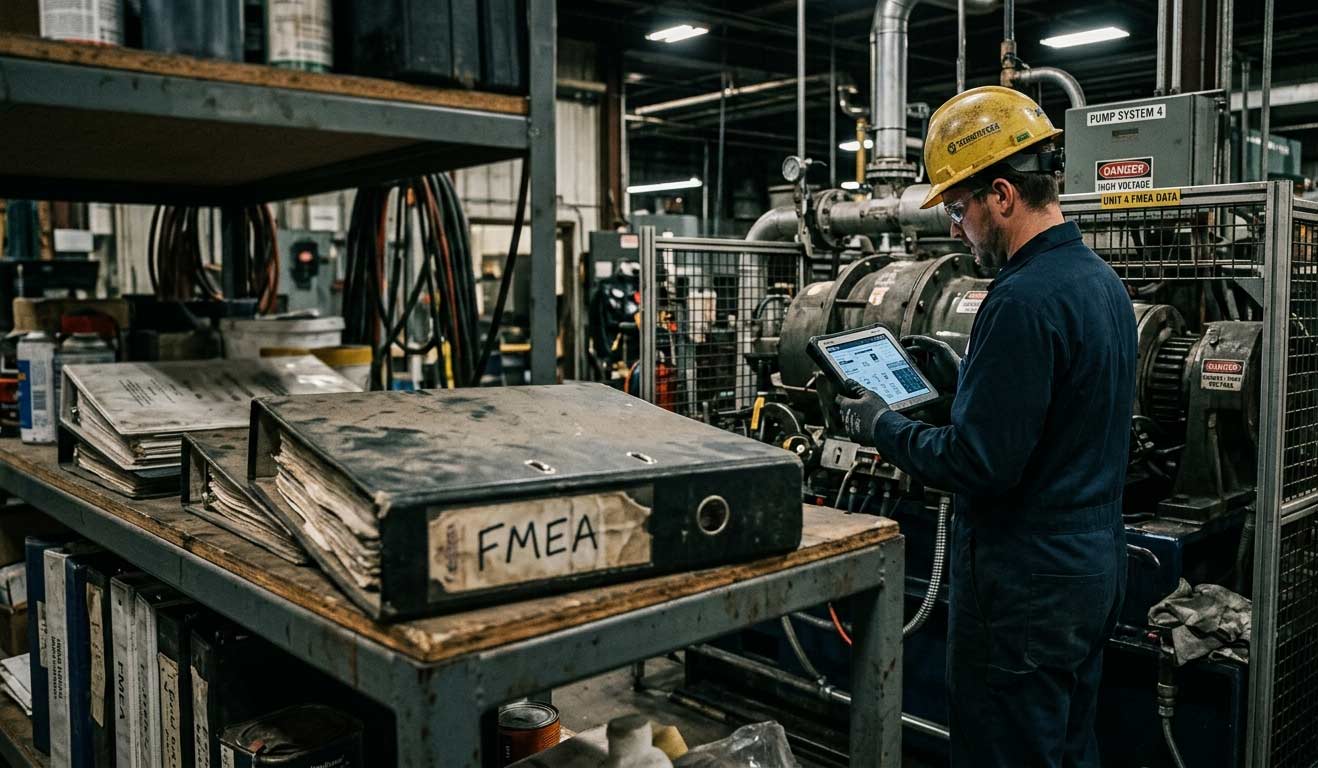
Why Your FMEA Is Sitting in a Binder (And What It Should Be Doing Instead)
Most facilities have an FMEA — but it’s collecting dust in a binder instead of driving decisions on the floor. Here’s how to turn your risk analysis into a living tool that actually protects uptime.

2026-04-24
CMMS Features and Functionality: What to Look for in a Maintenance Management System
Not all CMMS (Computerized Maintenance Management System) platforms are built the same, and in industries like quarrying, aggregates, cement, and ready-mix concrete, there are certain capabilities that carry more weight than others. The CMMS features that matter most for maintenance teams in asset-intensive industries include things such as centralized asset data, work order automation, preventive and predictive scheduling, digital checklists, deviation management, fleet optimization, and mobile-first design with offline capability.

2026-04-24
Cement Plant Inspection Checklist: What to Check, When to Check It, and Why It Fails
Most unplanned shutdowns in a cement plant don’t come out of nowhere. There’s usually a trail beforehand. Maybe a kiln bearing that’s been running 15 degrees above baseline for three weeks, noted by the operator on shift but never formally flagged because it hadn’t tripped an alarm yet. The issue isn’t a lack of warning, its that small deviations are often tolerated until they tip over into something serious.

2026-04-01
How to Choose the Right Work Order App for Your Industry
When something breaks on site, the fix gets most of the attention, but it’s rarely where things go wrong. What’s just as critical is everything around it: who reported it, who picked it up, what got missed between shifts, and how long it sat before anyone acted. In many operations, that whole flow is still held together by paper forms, radio calls, and memory.